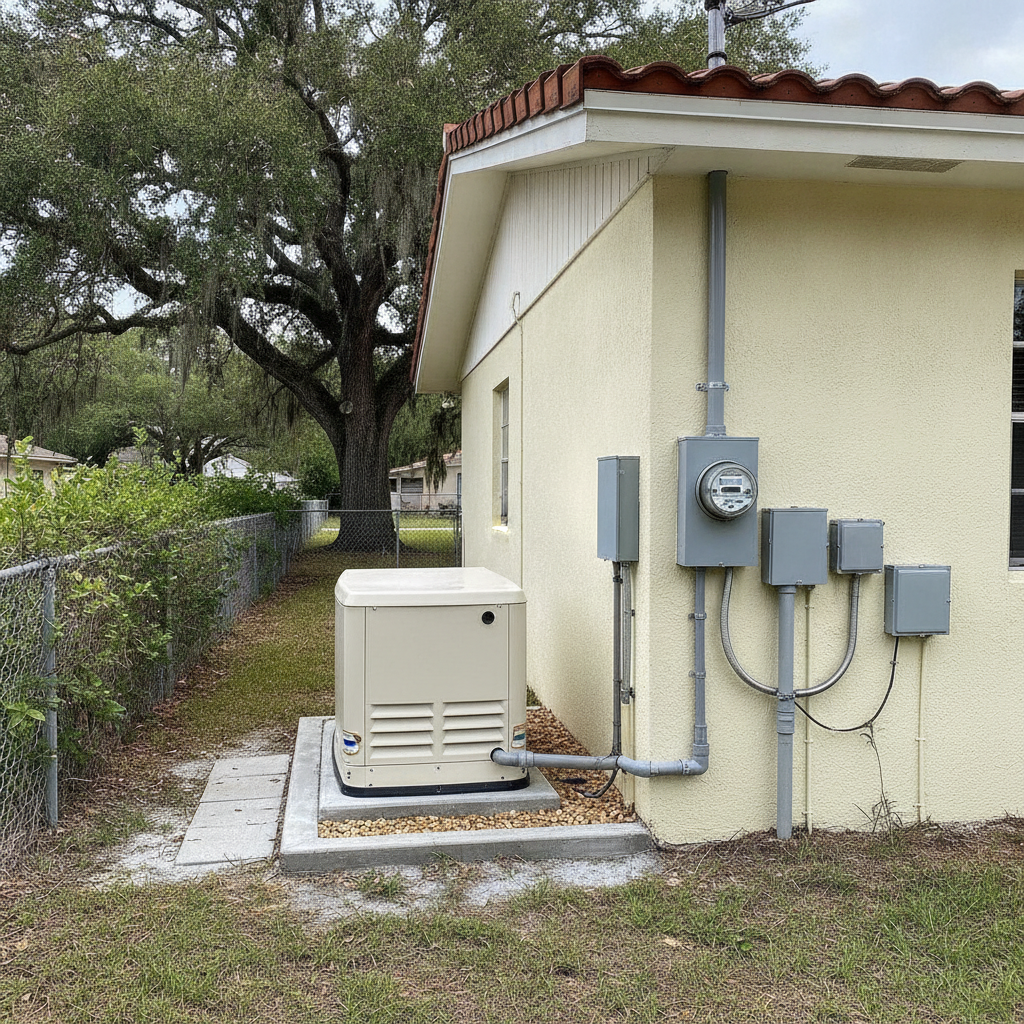
A backup generator for a Tampa home only keeps the house up if it is isolated from Tampa Electric while it runs. That isolation is the job. A cord stuffed into a dryer outlet is not a house connection, and a standby unit on a pad does not add utility load by itself. On a Seminole Heights bungalow the pad often has to live in a tight side yard, with the transfer equipment near the exterior meter can on the block wall.
Standby backup vs a portable on an inlet
A standby backup is a fixed generator, professionally installed, with transfer equipment that isolates the house from the utility. A portable on an inlet is a different path: the generator stays outdoors, a listed inlet takes a cord, and transfer or interlock equipment still isolates Tampa Electric before any house circuit is energized.
Tampa Electric’s home-safety guidance is blunt on the portable side. A portable unit can power individual appliances through properly rated outdoor cords. Direct backfeeding into house wiring is unsafe. Turning the main breaker off is not enough protection. A dryer outlet, a range outlet, or any other receptacle is still house wiring. That is why a proper generator inlet box exists: it is an outdoor connection built for a cord, not a workaround through an appliance plug.
The CPSC generator guidance puts the portable outdoors, far from the house and away from openings. Never run one in a garage, a home, a crawlspace, a basement, or a shed. A closed garage door does not make it outdoor use. Fuel-burning generators create carbon monoxide, fire, and electrical hazards. A standby unit does not erase combustion exhaust. It still burns fuel. It still needs the clearances in its listed instructions and whatever the local reviewer requires for that pad.
Standby and portable also split on what they can actually carry. A standby whole-home generator feeds the loads the electrician maps onto the transfer equipment. That can be most of the house, or a chosen essential list, depending on the equipment and the panel. A portable on an inlet feeds only the circuits that inlet and transfer path actually serve. The Florida side-by-side of those two paths is in our whole-house versus portable comparison. This page is the Tampa connection, not a second version of that one.
| Path | How it connects | What it can run | Fuel and exhaust |
|---|---|---|---|
| Standby backup | Fixed pad, wired through transfer equipment that isolates Tampa Electric | The loads mapped onto that transfer equipment | Piped fuel at the pad. Exhaust is still combustion exhaust |
| Portable on an inlet | Outdoor inlet plus a listed transfer or interlock path | Only the circuits that inlet and transfer path serve | Fuel you refill. The unit stays outdoors, away from openings |
Fuel is a planning item either way. A portable needs a supply you can store and refill during an outage. A standby unit typically sits on a natural-gas or propane feed at the pad, so you are not hauling cans in a storm. Neither one is a permanent cure for every outage. Tampa Electric’s own storm guidance says a backup plan still needs fuel, maintained equipment, and a defined essential-load list.
Transfer equipment that isolates the utility
Transfer equipment is the switch that keeps your generator and Tampa Electric from energizing the house at the same time. Without that isolation, generator current can travel out onto utility lines. Line workers can meet that current. So can anyone in the house who thought the system was dark. Isolation is not a courtesy. It is the difference between backup power and a backfeed.
A standby install uses transfer equipment as part of the permanent wiring. When utility power drops, the transfer path opens the utility connection and closes the generator connection. When utility power returns, it reverses that. The generator does not sit in parallel with Tampa Electric. It does not add load to the utility while it is carrying the house. It is a second source, switched in, with the first source locked out.
A portable path still needs that lockout. An interlock kit is one listed way to mechanically prevent the generator breaker and the main from being on together. A transfer switch is another. The hardware differs. The job does not: isolate, then feed. The electrician sizes and places that hardware from the panel in front of them, not from the square footage of the house.
Circuit space and service capacity are two different problems, and a generator install can hit either one. Service capacity is what the utility drop and the main can carry when Tampa Electric is up. Circuit space is whether the panel has room to land transfer equipment, a generator breaker, and the circuits you want on backup. A standby generator does not add utility load by itself. The feeder and the backed-up circuits still have to fit the panel you have. If they do not, that is a panel upgrade conversation sitting next to the generator, not a reason to guess a bigger machine from the street.
Write the essential-load list before anyone talks equipment. A South Tampa household in late May, with hurricane season already on the calendar, should put the refrigerator, medical devices, a few lights, communications, and any well or pump that actually exists on that property on paper. Cooling is a load, not a slogan. If the air handler and the outdoor unit are on the list, they have to be on the transfer path, and the generator has to be able to start them. If they are not on the list, they stay dark on purpose. Tampa Electric’s storm page is also clear about restoration: it starts with health and safety facilities, then essential supplies, then the greatest number of residential customers feasible. It depends on actual damage and repair complexity. It does not hand a Tampa neighborhood a place in line. Medical Watch does not guarantee uninterrupted service or priority restoration. The list you wrote is the plan that is actually yours.
What a Tampa install has to clear
A Tampa install has to clear the loads you want backed up, the panel those loads live on, the fuel and pad, and the building department that actually reviews that address. The mailing city on a bill does not pick the reviewer. The property does.
Inside the City of Tampa, that is the city’s building office. Unincorporated Hillsborough is the county. Temple Terrace publishes its own electrical applications, so a Temple Terrace house is not an automatic unincorporated referral. A New Tampa HOA rule can decide where a pad is allowed to sit in the yard. A Hyde Park plaster wall can decide how a new feeder gets routed from the pad to the panel. Those are site facts. They are not a diagnosis of the wiring, the panel brand, or the service size. The electrician reads the panel, the route, the fuel path, and the lot.
Pad placement is local in the small sense. A tight Seminole Heights side yard, a South Tampa lot line, and a New Tampa setback from a sidewalk are three different puzzles. Fixed standby clearances come from the listed equipment instructions and local review, not from a portable-generator rule of thumb. Do not invent a number for that gap. The listed unit and the reviewer set it. Fuel piping is in the same bucket: the run from the meter or the tank to the pad is labor and material the contractor prices after seeing the property. No published gas-line fee belongs in this picture.
Permits are pulled by the licensed contractor, never by this brand. The electrician confirms the permit and inspection steps with the authority for that address. Florida certified electrical contractors can work statewide. Registered contractors work within their authorized local jurisdictions. Specialty licenses have bounded scope. EC is not the only lawful category for every electrical task, and no one on a crew is assumed to hold a contractor license just because they showed up. The electricians we send are licensed and insured. Scheduling, scope, permits, workmanship, and price are set by the selected contractor after the walkthrough.
This site already publishes a whole-home generator range of $10,000 to $18,000 installed. That is this site’s published band, not a Tampa average and not a quote. The selected contractor sets the actual price after inspecting the property. What moves the number is the pad location, the feeder length, the transfer equipment, the fuel run, and whether the panel also needs work. Square footage is a weak proxy. The installed-cost post unpacks those drivers. The Pinellas version of this city page is the St. Petersburg backup generator piece, because that side of the bay is a different utility picture. For Tampa itself, Tampa Electric is the utility most Hillsborough houses are planning around.
What does a whole-home generator cost for a Tampa house?
This site publishes $10,000 to $18,000 for a whole-home generator, installed. Treat that as this site’s published range. It is not independent market evidence, and it is not the number you will hear after a walkthrough. A 100 amp to 200 amp panel upgrade, when it is actually in scope, is a separate site-published band of $2,500 to $4,500. The reviewing authority sets its own permit fee. The contractor prices the generator, the transfer equipment, the pad, and the fuel path from the house in front of them.
Does square footage tell you the generator size?
A 2,000 square foot house does not arrive with a generator size attached. The electrician sizes from the loads on the panel and from the essential-load list you actually write. Two Tampa houses with the same floor area can have different air handlers, different electric ranges, different well or pool equipment, and different panel space. The transfer path is built for the circuits that must stay up, not for the listing sheet on a real-estate flyer.
Is a backup generator worth it in Tampa?
It is worth it when the loads you cannot go without have to stay up while Tampa Electric is dark. Hurricane season runs June through November here, and ordinary storms knock feeders down outside that window too. Restoration is not a household schedule. A portable on an inlet is the smaller path if the list is short and you will run the machine. A standby unit is the path if the house should transfer itself. Fuel and maintenance are part of either plan. Storm-season load planning for this metro is in our hurricane generator post.
When to call us
A licensed electrician should handle any connection between a generator and house wiring, including a standby install, an inlet, transfer equipment, and any panel work that has to land with it. Tampa Electrical Pro matches homeowners with independent licensed and insured electricians for that work. Call us at (813) 850-0320.