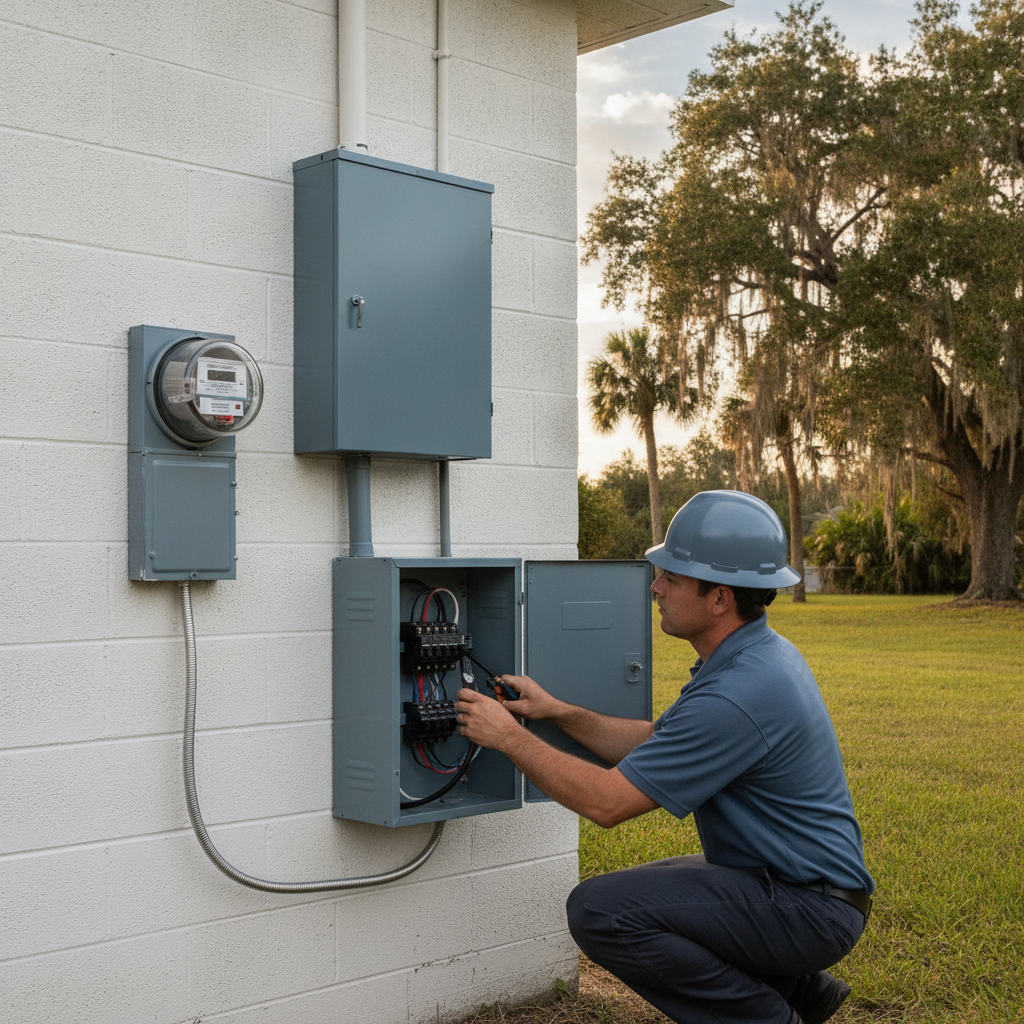
A portable generator in a Tampa driveway does not belong plugged into a dryer outlet or a garage receptacle. That path backfeeds the house wiring, and Tampa Electric treats direct backfeeding as unsafe. A generator inlet box is the outdoor connection a licensed electrician hardwires to an interlock or a transfer switch, so the cord stays outside and the house stays isolated from the utility while the generator runs.
Inlet vs a transfer switch
A generator inlet box is the outdoor plug. A transfer switch or an interlock is the isolation equipment that chooses utility power or generator power, never both at once. They are two pieces of one backup path, not two names for the same device.
Power travels a short chain. The generator makes it. A cord built for that generator carries it to the inlet on the exterior wall. From the inlet, a hardwired feeder runs to a generator breaker at the panel, or into a manual transfer switch. The isolation device is what keeps the utility and the generator from being tied together. Turning the main breaker off, by itself, is not enough protection against backfeed. Tampa Electric is direct about that: do not treat the main as sufficient backfeed protection, and do not open electrical equipment to improvise a hookup.
The inlet is not a regular receptacle. The housing is an outdoor-rated inlet with pins that mate to a generator cord. You are not pushing a household plug into a wall outlet. You are docking a cord that was made for that inlet, on the outside of the house, while the generator stays outdoors.
That outdoor part is the safety line, not a preference. The U.S. Consumer Product Safety Commission puts portable generators outdoors, far from the house and away from openings. Never in a garage, a home, a crawlspace, a basement, or a shed. Fuel-burning generators make carbon monoxide. A closed Westchase garage with the door down is still indoors. Even when the panel lives in that garage, the generator still belongs outside, which is why an inlet on the exterior wall is often the clean connection. A cord pinched in a door, or run through a South Tampa window, is a carbon monoxide path and a damaged-cord problem stacked on an awkward hookup.
Portable generators can also run individual appliances through properly rated outdoor cords. That is a different job. A fridge and a couple of lamps on cords is not the same as feeding house wiring. House wiring needs isolation. A whole-home standby generator is a third path: it is professionally installed with transfer isolation from the utility, and it does not use a plug-in inlet the way a portable unit does.
| Piece | What it does | Where it lives |
|---|---|---|
| Generator inlet box | Outdoor connection for the generator cord | Exterior wall, near where the generator will sit |
| Interlock | Keeps the main breaker and the generator breaker from being on together | At the panel |
| Manual transfer switch | Moves the house, or selected circuits, between the utility and the generator | Near the panel |
| Standby generator | Hardwired backup with transfer isolation from the utility | Outside, installed as a fixed system |
What the install includes
The electrician we send starts with the generator you actually own, or the one you plan to park in the driveway, and with the panel that will take the transfer equipment. The inlet has to mate with that generator’s cord and feed isolation equipment that can carry the same path. Mismatched ends do not “kind of work.” The plug either seats fully on a listed inlet or it does not.
On a typical Tampa Bay house the work is an outdoor-rated inlet on an exterior wall, a through-wall route that respects the finish, and a hardwired feeder to the generator breaker or transfer switch. Concrete block and stucco, the usual shell from Brandon through Town ‘n’ Country, change how that route gets built. A Hyde Park plaster wall changes it again. A long run to a detached Odessa garage is a different job than an inlet two feet from an interior-wall panel. None of that is a diagnosis of the wiring already in the house. It is the path the electrician has to see in person.
If the panel cannot accept a generator breaker and isolation hardware, a panel upgrade may sit underneath the inlet job. This site publishes a $2,500 to $4,500 range for a 100 amp to 200 amp upgrade as a site figure, not a Tampa average and not a quote. The selected contractor prices the actual work after opening the scope at the property. A full panel does not, by itself, mean the house needs 200 amp service. Service capacity and circuit space are two different problems, and the inlet only uses the second one if there is nowhere to land a generator breaker.
Outdoor gear has to match its exposure. The inlet is not the same device as a weathered receptacle on that same wall. If that receptacle is cracked, loose, or sitting in the weather without the protection it needs, that is a separate GFCI outlet conversation. GFCI protection can also sit upstream on a circuit, so a blank faceplate does not prove the run is unprotected. The electrician reads the circuit, not the face of one device.
Permits are pulled by the licensed contractor, never by this brand. The reviewing office follows the property, not the mailing city. Pinellas County reviews unincorporated addresses and specified partner cities; Largo has its own Building Division; Temple Terrace publishes its own electrical forms. A Lutz mailing label on a house that sits in a different jurisdiction does not pick the office. The electrician confirms the permit and inspection steps with the authority for that address, and that office sets the fee.
An existing inlet that is cracked, loose, or showing heat at the cover is electrical repair territory. Do not keep using a damaged outdoor connection through storm season and hope the next outage is the test.
Interlock already on this site
An inlet without isolation is only a cord landing. The piece that keeps the house off the utility while the generator is on is the interlock or the transfer switch, and we already walk through the interlock path in detail in generator interlock kit installation in Tampa. Read that if the panel is the open question. Stay here if the missing piece is the outdoor connection that feeds it.
An interlock is a mechanical sliding plate at the panel. It physically blocks you from turning the generator breaker on while the main is on, and the other way around. That is the isolation. The inlet is how that generator breaker gets fed from outside. After a licensed electrician has installed both, an outage sequence is a generator running outdoors, a cord docked on the inlet, then the interlock operated the way the installer trained you. It is not a homemade jumper in the panel. It is not a dryer-outlet backfeed with the main clicked off.
A manual transfer switch does the same isolation job in a different shape. It is a listed switch that moves the house, or a chosen set of circuits, between the utility and the generator. The inlet still sits on the exterior and still hardwires to that switch when the switch is indoors. The electrician matches the inlet, the cord, and the switch as one path.
Palm Harbor HOA rules can decide where a generator pad is even allowed, which then decides which wall can take the inlet. That is siting, not a reading of the panel. An Apollo Beach household writing an essential-load list in late May is doing the other half of the job: fridge, a few lights, medical devices, a well pump if there is one. Tampa Electric’s storm guidance is that a backup plan needs fuel, maintained equipment, and a defined essential-load list. A generator is not a permanent cure for every outage. Hurricane season here runs June through November. Restoration follows health and safety facilities, then essential supplies, then as many residential customers as the damage allows. It does not follow who bought which inlet.
The electricians we send are licensed and insured. Florida certified electrical contractors can work statewide; registered contractors work within their authorized local jurisdictions; specialty licenses have bounded scope. The person landing the feeder is not assumed to hold a contractor license just because they are on the job. The contractor responsible for the permit is the one who confirms the work with the local office.
Questions about generator inlet boxes
What is an inlet box for a generator?
It is the outdoor, listed connection that lets a portable generator feed transfer equipment inside the house. One end of the generator cord docks on the inlet. The other end docks on the generator. Behind the wall, a hardwired feeder carries that power to an interlock or a transfer switch that isolates the house from the utility. Without that isolation, plugging a generator into house wiring is backfeeding, and it is unsafe.
How much does it cost to install a generator power inlet box?
There is no honest flat number for the inlet alone, because the inlet is rarely the whole path. What moves the price is the run from the exterior wall to the panel, the wall construction, whether an interlock or transfer switch is already there, and whether the panel has space to land a generator breaker. A two-foot feeder through a garage wall is a smaller job than a long route around a slab-on-grade house in Riverview. Adding isolation at the same time is a larger job than landing an inlet on equipment that is already in place. A hardwired standby generator is a different project entirely; this site publishes $10,000 to $18,000 installed for a whole-home generator as a site range, not a Tampa average and not an inlet price. The selected contractor prices the inlet job after seeing the house. The reviewing authority sets any permit fee.
What size generator inlet box do I need?
The inlet has to match the generator’s output receptacle and the transfer equipment it feeds, in both configuration and rating. The plug shape has to seat fully. The conductors have to be rated for the current on that path. Inlets are made in more than one rating, and the right one is the one that matches the labels on your generator and on the listed isolation equipment, not a guess from the square footage of the house. The electrician reads those labels at the property. A bigger inlet does not add utility capacity, and it does not turn a portable generator into a standby system.
When to call us
Call when you want a portable generator connected to house wiring through a listed outdoor inlet and isolation equipment, when an existing inlet is damaged, or when the panel still needs an interlock or transfer switch before any cord should touch the house. The electricians we send are licensed and insured, and they confirm the permit and inspection steps with the authority for that address. Call us at (813) 850-0320.