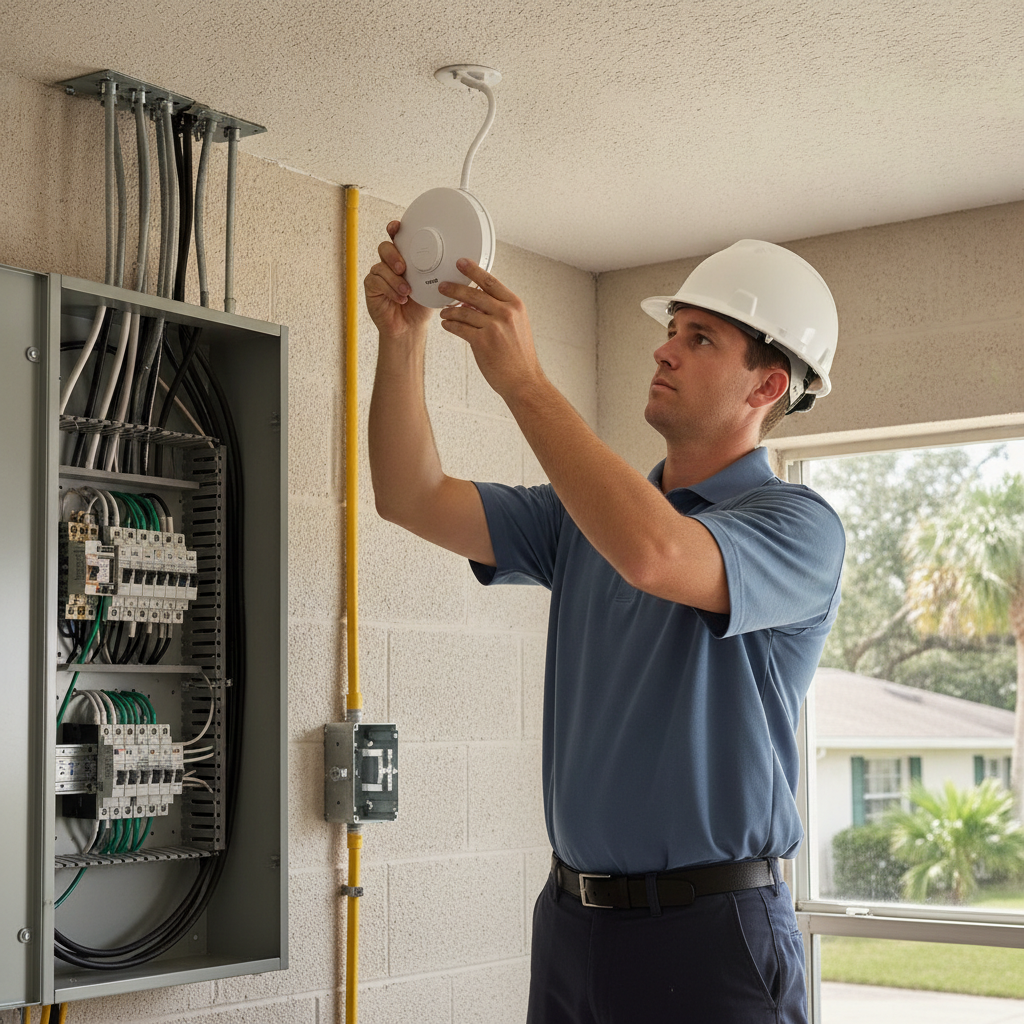
A battery puck on the ceiling can sit quiet the week a generator is running in the driveway. A hardwired carbon monoxide detector takes power from the house, and when the units share an interconnect, the detector that senses the gas can sound the ones by the bedrooms. That gap shows up across Tampa Bay from June through November, when portable generators and other fuel-burning equipment are the usual carbon monoxide sources in a house.
Battery vs hardwired
A battery carbon monoxide alarm is a self-contained box. A hardwired carbon monoxide detector is an electrical device on a house circuit, and the interconnect is what lets one unit speak for the rest.
Battery units live on the cell inside the case. They go on a ceiling or a wall with screws, and they keep working until that cell dies or the sensor ages out. Each one speaks for itself unless the model carries a listed wireless link. A unit in a Riverview hallway can be in full alarm while a closed bedroom at the far end of the house stays quiet.
Hardwired units take a 120 volt feed from the house, the same family of lighting-style circuit that already runs through most finished ceilings. Many listed models also hold a backup battery so the horn still works when the lights are out. The extra piece is the interconnect. On a wired interconnect, that is usually the extra insulated conductor in three-conductor-with-ground cable between detector boxes. When one sensor goes into alarm, it puts a signal on that conductor and the other compatible units sound. Some hardwired models interconnect over a listed radio module instead, so the electrician still lands power at each box and skips fishing a signal conductor through plaster.
Those two jobs are easy to mix up in a store aisle. A plug-in unit that sits in a receptacle is still a portable appliance. It travels when the furniture moves, and it goes dark if someone unplugs it to run a vacuum. A hardwired unit is part of the house wiring. Taking it down means opening a box that still has circuit conductors in it.
| Role | Battery-only unit | Hardwired unit |
|---|---|---|
| Power | Lives on the cell inside the case. | Lives on a house lighting-style circuit, and many listed models also hold a backup battery. |
| Blackout | Keeps working until that cell dies. | Stays on while the house has power; the backup battery, when the model includes one, covers the outage. |
| Signaling | Each unit speaks for itself unless it has a listed wireless link. | A dedicated interconnect conductor, or a listed wireless module, can make every compatible unit sound. |
| The electrical work | No house wiring. | An electrician lands the feed and, when the system uses a wired interconnect, the signal conductor between boxes. |
Combo smoke and carbon monoxide units put both sensors in one listed device. The interconnect still has to match. A new combo on an old smoke-only interconnect can power up and still fail to talk to the units that stay. That is a compatibility problem, not a mystery of the gas. A smoke detector replacement on the same circuit often lands in the same visit because the cable, the boxes, and the protocol are already open.
A hardwired detector that has gone dark, or a circuit that no longer feeds the hallway units, is electrical repair work. The electricians we send find whether the feed is dead, the interconnect is open, or the device itself has reached the end-of-life mark printed on the back of the case.
Florida locations
In Tampa Bay the carbon monoxide conversation usually starts at a generator, an attached garage, or a gas appliance.
The U.S. Consumer Product Safety Commission is blunt about portable generators. They belong outdoors, far from the house and away from openings. They do not belong in a garage, a home, a crawlspace, a basement, or a shed. Rain during a Tampa storm is the usual reason a unit gets rolled under a carport or into an attached garage in South Tampa or Town ‘n’ Country. The exhaust still moves. A window, a dryer vent, or a garage-entry door on the same wall as the generator is an opening. A hardwired detector on an interconnect is how a bedroom at the other end of the house hears that, because the people who are asleep are not standing in the driveway.
A portable generator also has an electrical job that is easy to get wrong. Tampa Electric’s home safety page states that portable generators can power individual appliances through properly rated outdoor cords, and that feeding a generator back into house wiring is unsafe. A hardwired carbon monoxide detector does not change that. It warns about the exhaust. It does not make a backfeed safe.
Fixed standby equipment is a different machine with the same combustion problem. A licensed electrician installs standby gear with transfer isolation from the utility so the house and the utility stay apart. Fuel-burning generators still create carbon monoxide, fire, and electrical hazards. Standby equipment does not erase combustion exhaust. Clearances come from the listed equipment instructions and local review, not from the portable-generator outdoor rule. A pad beside a Palm Harbor block wall, a run of stucco, and a nearby window are the real layout the installer walks. A whole-home generator and a detector interconnect are two halves of the same storm plan. One keeps selected loads on. The other is how sleeping rooms hear the exhaust if something on the pad is wrong. Portable versus standby is a separate equipment choice, and that comparison lives in our portable and standby generator guide.
Attached garages and gas appliances are the everyday sources. A car left running in a Brandon garage, a gas water heater in an interior closet, a furnace in a utility room, a range that runs for hours on a holiday, each one is a fuel-burning appliance in a closed shell. Carbon monoxide from those sources can sit in a closed bedroom while the kitchen still smells like dinner. Interconnected hardwired units exist so the detector nearest the source can sound the ones by the beds.
Where the electrician actually mounts a unit is a property-specific layout, not a neighborhood rule and not a guess from the year the house was built. A Hyde Park plaster ceiling changes how a new interconnect conductor gets routed. A slab ranch in Riverview with the panel on the far side of the house from the hallway boxes changes the length of a new run. A detached Odessa garage with a well pump and a heater on it is a separate building with its own wiring path back to the house. The electrician reads the existing cable, the boxes, the remaining units, and the fuel-burning equipment that is actually on the lot. The reviewing office follows the property. Largo has its own Building Division. Pinellas County covers unincorporated areas and specified partner cities. A Temple Terrace address uses city forms. A mailing city on an envelope does not pick the authority.
A garage that already needs receptacle work is still a receptacle job. GFCI protection on garage and outdoor outlets is shock protection for people using tools and cords. A carbon monoxide detector that goes dark because its feed shares a tripped GFCI in that garage is a coverage problem. The electrician keeps those two jobs straight: wet-location shock protection on the tool circuits, a stable feed for the detectors.
What replacement includes
Replacing a hardwired carbon monoxide detector is circuit work. The electrician confirms power at the box, reads the interconnect, and checks whether the new unit speaks the same language as the ones that stay.
The date printed on the back of an existing unit is the manufacturer’s end-of-life mark. Sensors wear out. A chirp can be a dying backup battery, an expired sensor, or a unit that has been in and out of power. A full alarm is a different event. Smoke or fire means leaving the hazard area and contacting emergency services. A carbon monoxide alarm that is in full voice gets the same response: people out, then the emergency number. A chirp you can walk up to in daylight is still a reason to have the circuit and the device looked at. It is not a reason to open a panel.
On a like-for-like swap, the box is already there and the cable is already in the ceiling. The electrician de-energizes the circuit and verifies it is dead before the device comes off the harness. The new unit has to land the same conductors: hot, neutral, equipment ground, and the interconnect lead when the system uses a wired signal. Brand mixing is the usual failure after a single-unit swap. The new horn powers up. The old units on the other end of the red conductor stay quiet in a real alarm, or chatter when they should be still. Replacing the set, or staying inside one listed interconnect family, is how that gets solved.
A house that only has battery pucks, and a homeowner who wants hardwired coverage, is a different scope. There is no interconnect conductor in that ceiling. The electrician has to get a feed to each new box and, for a wired interconnect, a signal conductor between them. Finished ceilings, plaster, a second-story run, and a panel with no spare space all move the work. When the panel cannot take another circuit, that is panel upgrade territory, and the selected contractor prices the job after seeing the panel, the route, and the number of boxes. Circuit space and service capacity are two different problems. A full breaker lineup can block a new detector circuit even when the service size is otherwise fine.
Wireless interconnect on hardwired units cuts the fishing. Power still has to reach each box. A listed radio link only replaces the signal conductor. It does not replace the circuit.
Permit and inspection steps sit with the licensed contractor, never with this brand. Florida certified electrical contractors can work statewide. Registered contractors work within their authorized local jurisdictions, and specialty licenses have bounded scope. The electrician confirms the permit and inspection steps with the authority for that address. A new run and a device swap are different scopes, and the reviewing office is the one that draws that line. Tampa Electrical Pro matches you with independent licensed and insured electricians. Scheduling, scope, permits, workmanship, and price are set by the selected contractor after the visit.
Do hardwired carbon monoxide detectors work during an outage?
A hardwired unit stays on while the house has power. Many listed models also hold a backup battery so the horn still works when the lights are out. The electrician reads the listing on the unit in your hand. A model with no backup battery goes silent when that circuit dies, which is exactly the night a portable generator is most likely running outside.
Can I swap a battery unit for a hardwired one on the same ceiling?
A battery puck sitting on drywall does not mean there is a cable in that ceiling. Hardwired coverage needs a feed at the box and, for a wired interconnect, a signal conductor between boxes. The electrician opens the question at the property: existing three-conductor cable, a nearby lighting box that can be extended, or a new run back toward the panel.
Why do all the detectors sound at once?
That is the interconnect doing its job. One sensor sees the gas, puts a signal on the shared conductor or the listed wireless link, and the compatible units on that system sound. Units that stay quiet during a real alarm, or chatter when they should be still, are usually a protocol mismatch or an open interconnect, and that is wiring work.
When to call us
A hardwired carbon monoxide detector, a new interconnect run, and a detector circuit that has gone dead all belong with a licensed electrician. The electricians we send confirm power, match the interconnect, and take the permit conversation to the authority for that address when the scope needs it. Call us at (813) 850-0320.