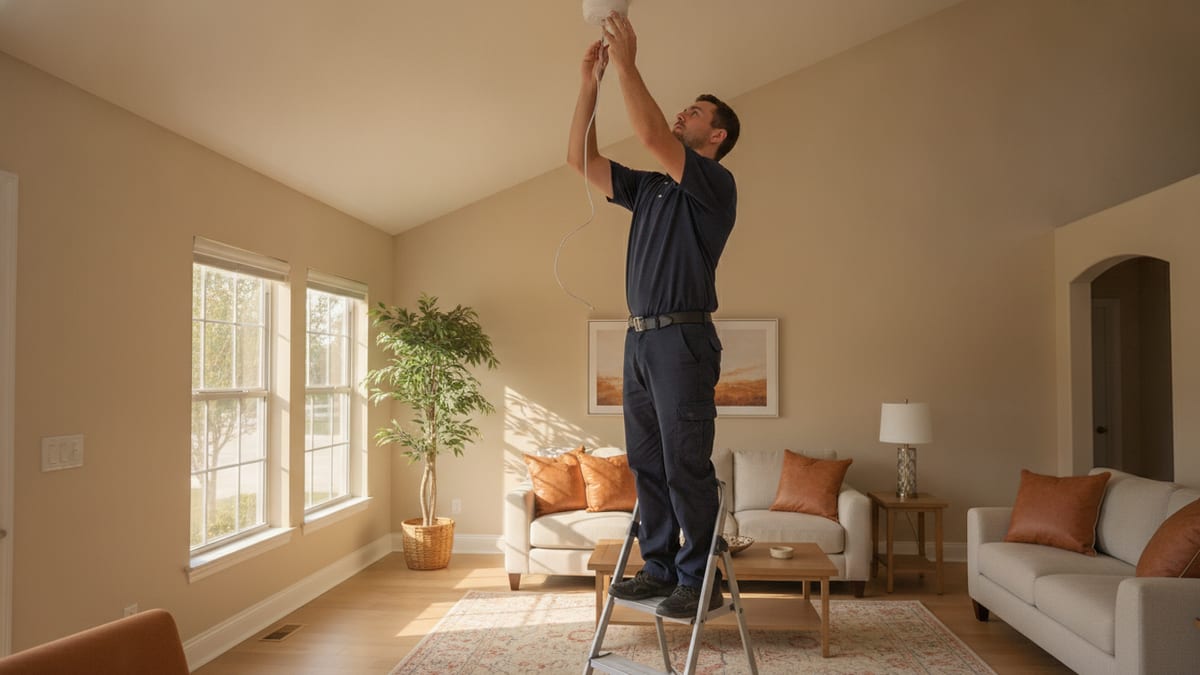
Replacing a smoke alarm starts with identifying what is already installed. Check the model, power source, interconnection method, location and replacement instructions before buying another unit. A device that fits the same ceiling opening or electrical connector is not necessarily compatible with the rest of the system.
Florida requirements also cannot be reduced to a rule that every permitted project needs a complete hardwired system or that every untouched home may rely on battery alarms. The answer depends on the property, the classification and scope of the work, the available wiring path and the exceptions that apply.
Start with the information on the alarm
Before removing an alarm, record the details printed on its label:
- Manufacturer and model number
- Manufacture date, replace-by date or other replacement guidance
- Whether it uses building power, a replaceable battery or a sealed battery
- Whether a battery is the primary supply or backup power
- Whether the alarm is interconnected by a signal wire or a listed wireless system
- Whether it also detects carbon monoxide
- Any compatibility information for connected alarms or replacement adapters
Follow the replacement interval and maintenance instructions for that model. A date printed on the alarm may be a manufacture date rather than a deadline, so read the surrounding label instead of assuming what it means.
If a sealed, nonreplaceable battery reaches the end of its service life, the alarm is replaced as a unit. If the model has a replaceable backup battery, use the battery type and procedure in its instructions. A successful button test does not override a manufacturer-directed replacement date.
Hardwired and interconnected describe different things
A hardwired alarm receives its primary power from the building wiring and may also contain backup power. Interconnection describes how alarms communicate so that activation of one causes the connected alarms to sound.
Interconnection may use a compatible signal conductor or a listed wireless method. It should not be assumed that any new alarm will communicate with an older group. The manufacturer’s compatibility instructions determine which alarms, modules and approved adapters can be used together.
Interconnection also does not make individual alarms maintenance-free. A missing, disabled or incompatible unit can still leave its intended area without the protection that device was meant to provide. Each alarm needs to remain installed, powered and maintained according to its instructions.
Converting battery-only alarms to building power is electrical work, not simply a generic low-voltage wiring project. The electrician must determine how power and any wired interconnection can reach each location without creating an unsafe or incompatible installation.
Florida requirements depend on the project
New construction, additions, repairs and different levels of alteration do not all receive the same treatment. Existing-area exceptions may also affect whether building power or physical interconnection must be added when finished walls and ceilings are present.
A permit by itself does not answer every smoke-alarm question. Before work begins, establish:
- Which part of the home is included in the project
- How the local building department classifies that work
- Which alarms are required within or outside the immediate work area
- Whether an accessible wiring route exists
- Whether a battery-powered or wireless option satisfies the applicable requirements
- Whether the proposed alarms are listed and mutually compatible
The selected contractor can compare the actual scope with the requirements enforced for that property. This avoids planning a complete rewiring project from an oversimplified rule or assuming that no update applies because the house already has alarms.
What F.S. 553.883 allows on a repair or level 1 alteration
Florida Statute 553.883 is the repair and level 1 alteration rule for one-family and two-family dwellings and townhomes. It states: “One-family and two-family dwellings and townhomes undergoing a repair, or a level 1 alteration as defined in the Florida Building Code, may use smoke alarms powered by 10-year nonremovable, nonreplaceable batteries in lieu of retrofitting such dwelling with smoke alarms powered by the dwelling’s electrical system.” It continues: “A battery-powered smoke alarm that is newly installed or replaces an existing battery-powered smoke alarm as a result of a level 1 alteration must be powered by a nonremovable, nonreplaceable battery that powers the alarm for at least 10 years.”
Those battery requirements “do not apply to a fire alarm, smoke detector, smoke alarm, or ancillary component that is electronically connected as a part of a centrally monitored or supervised alarm system; that uses a low-power, radio frequency wireless communication signal; or that contains multiple sensors, such as a smoke alarm combined with a carbon monoxide alarm or other multisensor devices, and is approved and listed by a nationally recognized testing laboratory.”
That statute does not mean every existing Tampa home must be retrofitted with hardwired alarms, and it does not mean every battery replacement is exempt from review. The project classification still has to be confirmed for the property.
Location matters as much as the replacement model
A replacement should not be moved merely to make wiring easier. Sleeping areas, different levels of the home, ceiling shape, nearby cooking appliances, bathrooms, air outlets and ceiling fans can affect the correct position for a particular alarm.
Use the alarm’s installation instructions and the requirements applicable to the project. If an existing location is unsuitable for the replacement model, the electrician can determine whether relocation, a different listed alarm type or another compatible approach is appropriate.
Do not open an alarm, ceiling box or electrical connection to investigate energized wiring. Hardwired replacement requires the circuit to be de-energized and verified before conductors or connectors are handled.
Carbon monoxide protection is a separate decision
Replacing a smoke alarm does not by itself establish whether the home also needs a carbon monoxide alarm. Florida Statute 553.885 has its own scope for qualifying buildings and additions, combustion-related features and alarm placement.
A combination smoke and carbon monoxide alarm may be useful where both functions are appropriate, but the unit must be suitable for its location and compatible with any connected system. Do not replace an interconnected smoke alarm with a combination model solely because the plug appears to fit.
What changes the work scope
There is no approved Tampa contractor price for this page. The useful comparison is what the electrician must change:
- A compatible replacement at an existing location usually has less scope than changing the power or interconnection method.
- Replacing one alarm in an interconnected group requires a compatibility check across the system.
- Adding or relocating alarms can require new wiring routes, ceiling access and finish repair.
- Converting battery-only locations to building power requires evaluation of the existing circuit and accessible paths.
- Combination smoke and carbon monoxide alarms add model, location and compatibility decisions.
- Unclear labeling, damaged connectors or prior modifications can require troubleshooting before a replacement is selected.
Ask what is included in the electrical scope and whether ceiling or wall repair is separate. Scheduling, permits and price are determined by the selected contractor after the existing system and project scope are known.
Coordinating replacement with other electrical work
If other work is planned, ask whether any wiring route genuinely overlaps with the alarm project. A panel upgrade does not automatically open walls or place an electrician in every needed attic area. The same caution applies when planning aluminum wiring remediation or evaluating a Federal Pacific panel or Zinsco panel.
Combining projects may reduce duplicated access work when the routes actually overlap. That is a property-specific scope decision, not a guaranteed saving.
Before a sale or inspection
Record each alarm’s model, label date, power source and test status before an inspection. Replace missing, damaged or manufacturer-expired units with compatible products, but do not assume that a battery-powered alarm automatically passes or fails a particular report.
A 4-point inspection has its own electrical review and documentation. The inspector, insurer and applicable form determine how an observed alarm issue is treated.
Frequently asked questions
Does every existing Florida home need hardwired smoke alarms?
That conclusion cannot be made from the age of the home alone. The applicable requirements depend on the property and on whether the current work is new construction, an addition, a repair or a particular type of alteration.
Can I replace one hardwired alarm with any current model?
Not safely based on appearance alone. Confirm the approved replacement, electrical connector, backup-power arrangement and interconnection compatibility in the manufacturer’s instructions.
Can I replace only the battery?
Follow the model instructions. A replaceable backup battery can be changed as directed. A sealed, nonreplaceable battery is not opened or bypassed; the alarm is replaced when its instructions call for unit replacement.
Do interconnected alarms provide complete redundancy?
No. Interconnection allows compatible alarms to sound together, but every required device still needs to be present, powered and maintained. One working alarm does not prove that the others are operating correctly.
When should an electrician handle the replacement?
Use a qualified electrician when the work involves building wiring, an uncertain connector, a damaged box, a new location, a change in interconnection or an unexplained power problem. Do not handle exposed wiring while trying to identify the alarm circuit.
Arrange a smoke-alarm evaluation
Tampa Electrical Pro refers customers to independent licensed and insured electricians. Call (813) 850-0320 to discuss smoke-alarm replacement within the Tampa Bay service area, including Ybor City. If the alarm issue is part of a wider wiring or power problem, start with an electrical repair request.