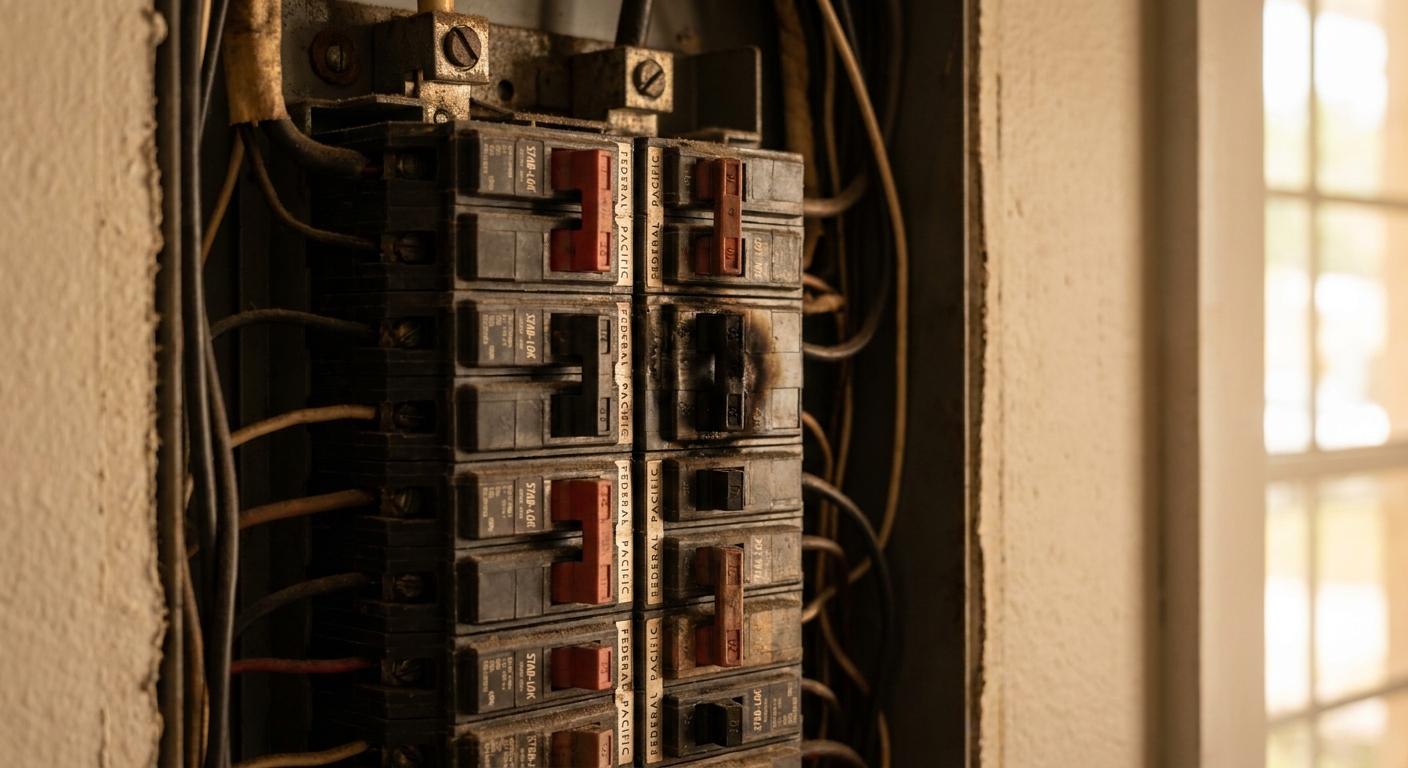
If an inspection report identifies a Federal Pacific Electric or Stab-Lok panel, the next step is a qualified electrical evaluation. The electrician needs to verify the equipment, its condition, the service arrangement, and the scope of any recommended work. An insurance company may also have its own documentation or replacement requirements, so get those instructions in writing before making decisions.
Tampa Electrical Pro connects homeowners with independent licensed and insured electricians. The selected contractor determines the electrical scope, permitting needs, schedule, and price for the property.
Confirm what panel you have
Start with the exact wording on the inspection report. It may list a manufacturer, product line, model, or other identifying information.
Photograph Stab-Lok or FPE wording on the closed door before anyone opens the enclosure. If a label is visible on the panel’s exterior or inside its hinged door, photograph it without touching wiring, removing the protective cover, or opening any sealed equipment. Useful photos can include:
- The full panel and surrounding area
- The manufacturer label and model information
- The breaker directory
- Any visible damage or discoloration
- The service equipment outside the home, viewed from a safe distance
Appearance alone isn’t enough to decide whether equipment should remain in service. This site already treats Federal Pacific equipment as documented for failure-to-trip issues. When replacement is the inspected scope, a 100A to 200A panel upgrade is published at $2,500 to $4,500. That band is not a quote. A licensed electrician can verify the panel and evaluate conditions that a photograph cannot show safely.
Separate the electrical decision from the insurance decision
An electrician evaluates the electrical system. An insurer decides what documentation or changes it will accept for a particular policy. Those are related decisions, but they aren’t interchangeable.
If the issue appeared during a sale, refinance, renewal, or 4-point inspection, ask for the exact written requirement. Clarify whether the requesting party wants:
- Identification of the panel and breakers
- An electrician’s written findings
- A repair recommendation
- Proof of completed replacement
- Permit or inspection records when applicable
- Updated photographs or another inspection
Don’t assume one insurer’s response predicts another’s. A replacement also shouldn’t be presented as a guarantee of coverage. Confirm the required documents and deadline directly with the company handling the policy.
What an electrician should evaluate
A useful panel assessment goes beyond reading the name on the door. The electrician may need to examine the accessible equipment, circuit arrangement, service conductors, grounding and bonding, visible heat damage, and compatibility of installed components.
Tell the electrician about unexplained flickering or dimming, frequent breaker trips, buzzing or crackling, shocks, burning odors, or hot or discolored electrical plates. These conditions call for prompt qualified inspection and shouldn’t be diagnosed from an article. Don’t repeatedly reset a breaker or remove a panel cover to investigate.
If there is smoke or fire, leave the hazard area and contact emergency services.
What panel replacement can and cannot change
Replacing a panel changes the distribution equipment and breakers. It does not automatically increase the home’s electrical service capacity.
These are separate questions:
- Panel condition: Whether the existing enclosure, breakers, connections, or related equipment need corrective work
- Circuit space: Whether the panel has appropriate room for the circuits the home needs
- Service capacity: Whether the electrical service can support the property’s calculated load
- Future equipment: Whether planned EV charging, air-conditioning changes, cooking equipment, or other loads affect the design
A panel with no open breaker positions doesn’t by itself prove that a service upgrade is necessary. A subpanel can provide circuit space, but it doesn’t add service capacity. The contractor should evaluate the actual loads and service before recommending an upgrade.
What changes the project scope
There is no reliable Tampa price or schedule that can be determined from the panel brand alone. The work depends on what is present at the property and what must change.
Important scope questions include:
- Is only the panel being replaced, or does the service equipment also need work?
- Can existing circuits be identified and transferred safely?
- Are there damaged or incompatible components that require correction?
- Is the panel indoors or exposed to weather?
- Is there safe working access around the equipment?
- Will the utility need to isolate or reconnect service?
- Which permitting authority serves the property?
- Are future loads part of the current project or only a later plan?
The electrician should explain the proposed equipment, included work, exclusions, permitting responsibility, power interruption, and documentation before the homeowner approves the project.
Prepare for an evaluation
Gather the inspection report, insurer’s written request, panel photographs, and any known electrical plans. If the home is in South Tampa, St. Petersburg, or another Tampa Bay community, the selected contractor should determine the correct permitting authority from the property itself.
For help reviewing the situation, use the Federal Pacific panel replacement service page to request a connection with an independent licensed and insured electrician. The contractor can inspect the equipment and provide property-specific recommendations.