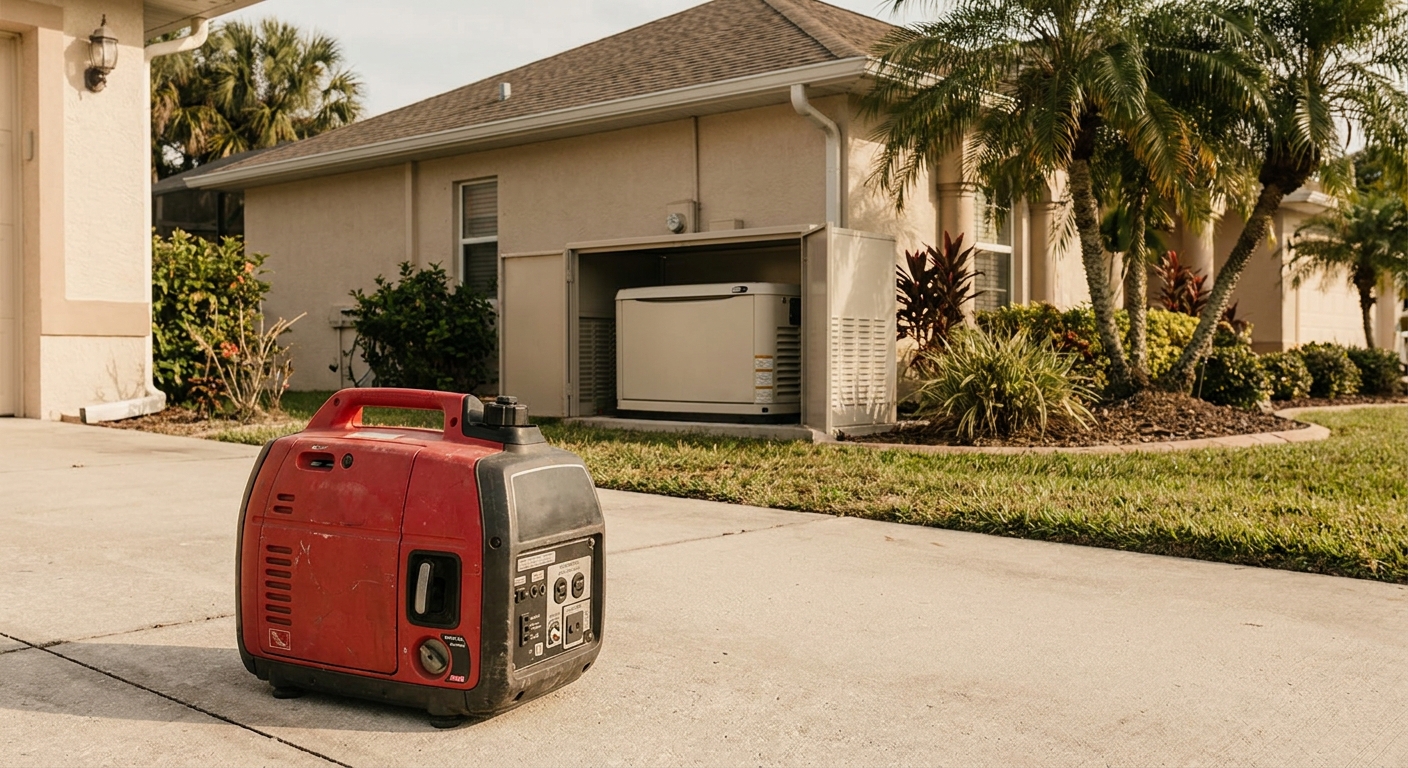
A portable generator can be a practical choice when you need to power a short list of appliances and can operate the equipment safely. A permanently installed standby generator is better suited to homeowners who want automatic backup and the ability to support a larger, planned group of loads.
The right choice doesn’t come from the words “portable” or “whole-house.” It comes from the loads you need, how the generator will connect, the available fuel, and who will manage it during an outage.
What a portable generator can do
A portable generator can supply selected appliances through properly rated outdoor extension cords. The useful load depends on the generator’s rating and the requirements of everything connected to it. Refrigeration, lighting, communications equipment, medical equipment, and portable cooling may compete for the available output, so the priority list matters.
A portable generator must never be connected directly to house wiring by improvising a cord or backfeeding a receptacle. Turning off the main breaker isn’t a substitute for proper transfer isolation. Tampa Electric explains the distinction between portable appliance connections and professionally installed standby equipment.
Portable equipment also requires someone to move it into a safe operating location, start it, connect the intended loads, monitor it, and manage fuel. That hands-on work may be acceptable for one household and impractical for another.
What a standby generator can do
A standby generator is installed permanently and uses transfer equipment that isolates the home from the utility during generator operation. Depending on its design and sizing, it may support selected essential circuits or a broader portion of the home.
“Whole-house” shouldn’t be read as a promise that every electrical load can run at the same time. Air conditioning, water heating, cooking equipment, pumps, and other large loads can affect the design. A contractor evaluates which loads must operate together, their starting demands, the transfer arrangement, fuel, and the manufacturer’s installation requirements.
A generator supplies backup power during an outage. It doesn’t add utility service capacity or correct a crowded electrical panel by itself.
Safety comes before convenience
Fuel-burning generators create carbon monoxide, fire, and electrical hazards. The Consumer Product Safety Commission says portable generators belong outdoors, far from the house and away from openings. They must never be operated inside a home, garage, basement, crawlspace, or shed. Review the CPSC generator safety guidance before an outage, not while a storm is underway.
A standby unit also produces combustion exhaust. Its required location and clearances come from the particular listed equipment, site conditions, and local review. Permanent installation doesn’t remove the need for safe exhaust placement, maintenance, or fuel planning.
Don’t open electrical equipment, remove panel covers, or attempt generator wiring yourself. Stay away from wet or damaged electrical equipment and leave installation and transfer work to a qualified electrician.
Fuel and maintenance change the experience
Portable units require an accessible fuel supply and active refueling according to the manufacturer’s instructions. Standby systems can reduce manual setup, but they still depend on the correct fuel source, maintained equipment, and a system that is ready when utility power fails.
Before choosing either type, consider:
- Which loads are truly essential during an outage
- Whether someone can safely set up and operate portable equipment
- Where the unit can run without exposing the home to exhaust
- How fuel will be obtained and managed
- Whether automatic operation is important
- What inspection, testing, and maintenance the manufacturer requires
Don’t choose by neighborhood assumptions
A coastal address doesn’t prove a home will experience a longer outage, and an inland address doesn’t promise faster restoration. Tampa Electric says restoration depends on actual damage and repair complexity, with work prioritized across safety facilities, essential supplies, and repairs that can restore service to many customers. Its storm information doesn’t establish a fixed restoration order for particular Tampa Bay neighborhoods.
Use your household’s needs and documented experience as planning inputs, but don’t treat a previous outage as a guarantee of what the next storm will do.
Medical and accessibility needs deserve a separate plan
If someone in the home depends on powered medical equipment or is vulnerable to heat, decide which loads must remain available and what backup is required if the generator can’t operate. Tampa Electric’s Medical Watch program doesn’t guarantee uninterrupted service or priority restoration.
Automatic starting may reduce the physical work of responding to an outage, but a standby generator isn’t a complete emergency plan. Fuel availability, maintenance, equipment condition, and the defined essential-load list still matter.
Compare noise, placement, and property restrictions
Sound varies by model and operating load, so compare manufacturer specifications for the actual equipment rather than assuming every standby unit is quieter than every portable unit. Placement must account for exhaust safety, access, manufacturer instructions, and the property’s physical constraints.
A permanent exterior installation may also be subject to local review or private community rules. The selected contractor can determine the applicable permitting authority from the property and coordinate the installation scope. Homeowners should check their own association documents rather than assuming that every community follows the same approval process.
The useful middle ground: three ways to get backup power
The choice is not only extension cords or a generator sized around every load in the home. There are three common setups:
- Extension cords from a portable generator to selected appliances, kept outdoors and never backfed into a receptacle.
- A portable generator plus a permitted interlock. This site’s published interlock band is $1,200 to $2,000 on the generator interlock installation guide.
- A permanently installed standby generator. This site’s published whole-home installed range of $10,000 to $18,000 lives on the whole-house generator cost guide.
A permanently installed standby system can also be designed around a defined group of essential circuits. That can preserve automatic operation while avoiding the assumption that every appliance must run simultaneously.
The essential-load list should be specific. Identify refrigeration, lighting, communications, medical equipment, pumps, cooling, and any other equipment the household can’t reasonably be without. The electrician can then compare those actual loads with the proposed generator and transfer arrangement.
Questions to settle before selecting a system
Ask the contractor to explain:
- Which loads the proposed system is designed to support together
- Whether large loads will be excluded, managed, or included
- How utility isolation is provided
- Which fuel source the equipment requires
- Where the generator can be located under its instructions and site review
- What maintenance and testing the owner will need to arrange
- Which parts of the scope require permitting or coordination
Tampa Electrical Pro connects homeowners with independent licensed and insured electricians who can evaluate the property and proposed backup loads. Scheduling, equipment selection, permits, workmanship, and pricing are determined by the selected contractor.
Call (813) 850-0320 to discuss the home, the essential-load list, and whether portable or permanent backup better fits the way your household would manage an outage.