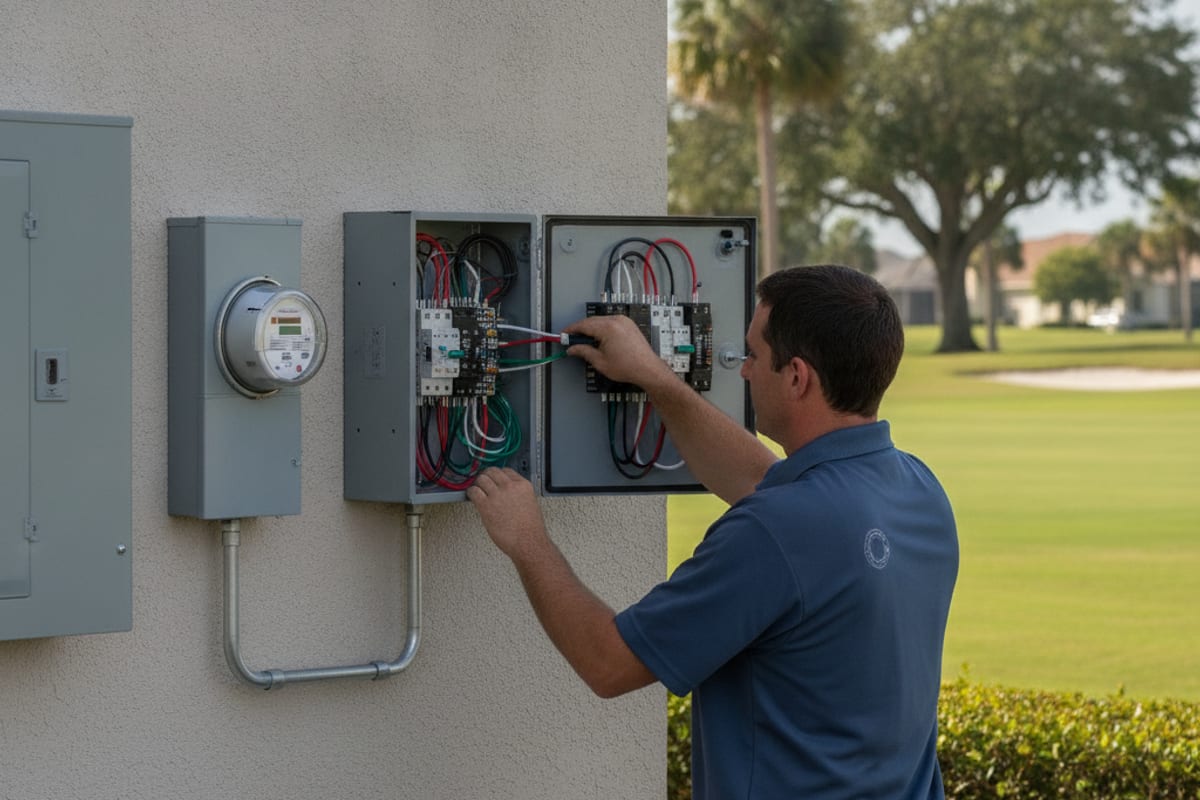
A generator connection needs a reliable way to isolate the home from utility power. For a fixed standby system, that function is normally built around transfer equipment. A portable generator may instead power individual appliances through properly rated outdoor cords or connect to selected house circuits through compatible, professionally installed transfer equipment.
What matters is that generator power cannot feed back onto utility lines. Turning off the main breaker by itself is not a safe substitute for equipment designed to prevent the utility and generator sources from being connected at the same time.
What a transfer switch does
Transfer equipment controls which source supplies the connected circuits. It disconnects those circuits from one source before connecting them to the other, maintaining isolation between utility power and generator power.
That isolation protects people working on the electrical system and prevents an unsafe direct backfeed into utility wiring. Homeowners should not improvise a connection through a receptacle, modify panel wiring or remove electrical covers to connect a generator.
Automatic and manual transfer options
An automatic transfer switch is commonly paired with a fixed whole-home generator. It monitors the normal power source and controls the change between utility and generator power according to the equipment’s design. The generator and switch must be compatible, and the installation has to account for the loads the system is intended to support.
Manual transfer equipment requires a person to perform the changeover. It can be a practical choice when the household expects to operate a portable generator and is comfortable following the installed system’s operating instructions. It does not provide unattended operation.
The choice is not simply automatic versus manual. The electrician also needs to determine:
- Which circuits are essential during an outage
- Whether large loads will be excluded or managed
- Whether the generator and transfer equipment are compatible
- How the equipment will be isolated from the utility
- Where outdoor equipment can be installed under its listed instructions
- How fuel, exhaust and routine maintenance will be handled
A standby generator supplies backup power. It does not add utility service capacity by itself.
Where a panel interlock fits
A panel interlock is a mechanical arrangement that prevents the main breaker and a generator-supply breaker from being on together. When the panel, interlock and generator connection are suitable for one another, it can provide utility isolation for a portable-generator setup.
An interlock is not the same as an automatic transfer switch. The homeowner still has to start and connect the portable generator, operate the breakers in the proper sequence and decide which loads to energize. The exact equipment and installation method must be evaluated for the existing panel rather than chosen from appearance alone.
Portable generators can also power individual appliances through properly rated outdoor cords without connecting to the home’s wiring. Fuel-burning generators belong outdoors, far from the house and away from doors, windows and other openings. They should never run in a home, garage, basement, crawlspace or shed because of carbon monoxide, fire and electrical hazards.
What the electrician checks at the panel
A transfer project starts with the actual electrical equipment, not assumptions about a Palm Harbor neighborhood or the age of the house. The electrician may check:
- The panel manufacturer, model, condition and labeling
- The service rating and a calculation of the loads involved
- Available circuit positions and the circuits selected for backup
- The generator’s output and connection requirements
- Compatibility among the panel, transfer equipment and generator
- Access for wiring and the location of exterior equipment
- Signs of heat, corrosion, damage or earlier alterations
Breaker space and electrical capacity are different questions. An open position in a panel does not prove that the service can support additional utility load. Likewise, a full panel does not automatically mean the utility service must be enlarged. A subpanel can provide more circuit positions, but it does not increase service capacity.
A panel upgrade may be appropriate if the existing equipment is damaged, incompatible or inadequate for the planned work. It should follow an inspection and the relevant electrical calculations, not a blanket rule based on panel amperage or neighborhood age.
What changes the project scope
There is no supported flat local price for a Palm Harbor transfer-switch installation. The useful comparison is the work each setup requires.
A fixed standby installation can involve the generator, transfer equipment, selected or managed loads, fuel arrangements, exterior placement, wiring routes and coordination with the electrical service. Adding compatible transfer equipment to an existing generator still requires verification of the generator, panel and intended loads.
A portable-generator connection may have a narrower scope, but it can still require compatible transfer equipment or an approved interlock arrangement, an inlet, a dedicated generator circuit and clear operating instructions. Difficult wiring access, damaged equipment or necessary panel work can expand either project.
The selected electrician determines the scope, price, scheduling and workmanship terms after inspecting the property.
Permits, jurisdiction and community rules
The permitting authority depends on the property’s actual jurisdiction. A Palm Harbor mailing address does not by itself settle every permitting question. The electrician should identify the authority for the property and confirm the required application and inspection steps for the proposed installation.
HOA or community rules are separate from electrical approval. If exterior equipment will be visible, the homeowner should review the governing documents and obtain any required architectural approval before finalizing placement. Approval from an association does not replace electrical review, and an electrical permit does not replace private community approval.
Tampa Electrical Pro refers Palm Harbor customers to independent licensed and insured electricians. The selected contractor determines who handles permits and any supporting documentation.
Planning the backup loads
Start with a written list of what must operate during an outage. Refrigeration, lighting, communications, medical needs, pumps and cooling equipment can have different starting and running requirements. The electrician can compare those actual loads with the proposed generator and transfer arrangement.
This prevents two common mistakes: assuming a generator will run every circuit because it connects near the main panel, or assuming a larger service automatically makes the generator capable of supplying more backup power. Utility-service capacity, generator output and the selected backup loads are related but distinct decisions.
Frequently asked questions
Can I connect a generator directly to a house receptacle?
No. Direct backfeeding through a receptacle is unsafe. A portable generator can power individual appliances through properly rated outdoor cords, or it can connect to house wiring through professionally installed equipment that isolates the utility source.
Can transfer equipment be added to a generator I already own?
Possibly. The electrician needs the generator model and output information, the panel details, the intended backup loads and the manufacturer’s connection requirements. Compatibility cannot be determined from available breaker spaces alone.
Is an interlock the same as a transfer switch?
No. An interlock mechanically prevents conflicting breaker positions in a compatible panel setup. A transfer switch changes the connected load between power sources. Automatic transfer equipment can perform that function without a person operating the switch, while an interlock remains a manual system.
Does a standby generator require a service upgrade?
Not automatically. A generator is a backup supply, not a new utility load by itself. The electrician evaluates the service, panel condition, equipment compatibility and any other electrical work included in the project before recommending panel or service changes.
Who confirms the permit requirements?
The selected electrician should determine the property’s jurisdiction and confirm the requirements for the actual installation. HOA or community approval, when applicable, is a separate process.
Call (813) 850-0320 to be connected with a licensed and insured electrician serving Palm Harbor. Have the generator model, panel information and a list of essential loads ready if they are available. The electrician can evaluate the property and define the appropriate transfer setup, scope and price.