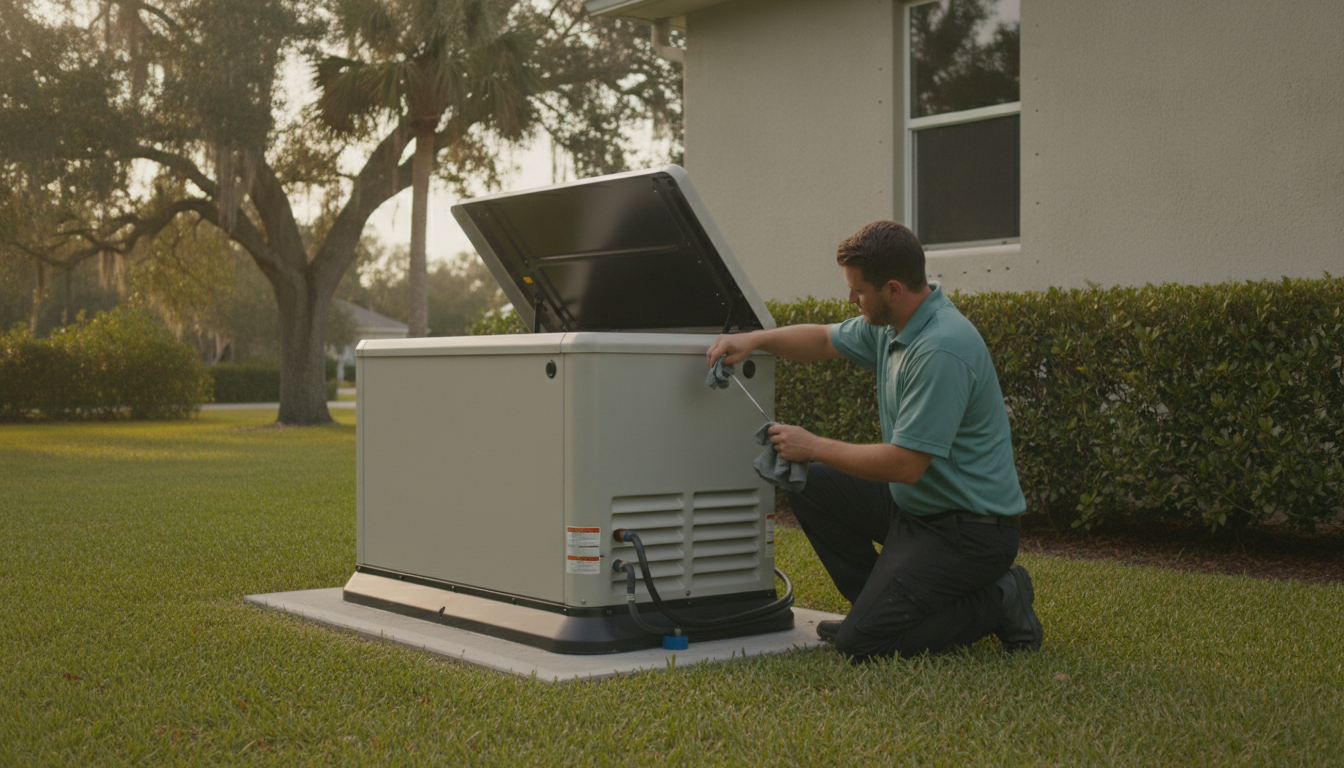
Standby generator maintenance starts with the exact model and its owner’s manual. From outside the equipment, a homeowner can watch the status display, look for blocked ventilation, notice runoff or visible damage, and confirm when professional service was last completed. Oil checks, battery work, filter changes, internal inspections, and electrical testing require the shutdown and access procedure specified for that unit.
This post covers a generator that is already installed. If you’re still comparing systems, see sizing a whole-home generator for hurricane season, whole-house generator installation costs, whole-house versus portable generators, and choosing a transfer switch.
Start with the model, hours, and service record
Maintenance intervals are not interchangeable across brands or product lines. Find the generator’s model information, the correct manual, its operating-hour reading, and the record of completed service before deciding what is due.
For example, the service table for certain Generac 9 kW through 22 kW air-cooled models separates routine observations from scheduled engine work. It lists an initial oil-and-filter service after the first 25 operating hours, a Schedule A at two years or 200 hours, and a Schedule B at four years or 400 hours, with the earlier limit controlling. A hot-weather note calls for oil and filter service every year or 100 operating hours when the unit runs continuously above 85°F.
Those figures belong only to the covered models. Kohler, Briggs & Stratton, Cummins, and other Generac lines may specify different work and intervals. The correct answer is the schedule for the model on the property, adjusted only where that manual tells the owner to account for operating conditions.
What can a homeowner inspect safely?
Begin with observations that do not require opening electrical equipment or defeating an enclosure:
- Read the exterior status display and note any warning or service message.
- Look for leaves, grass, stored items, or other material blocking the intake or discharge area.
- Check whether roof runoff, sprinklers, or standing water are reaching the enclosure.
- Look from a safe distance for impact damage, loose exterior panels, corrosion, or signs of a fluid leak.
- Compare the hour reading and service date with the schedule for the exact model.
- Confirm that the household has a current essential-load plan and a separate outage plan if the generator cannot run.
Do not open electrical compartments, remove covers, touch damaged equipment, or approach a unit standing in water. If you see or smell a fuel leak, notice smoke or fire, or find serious physical damage, keep away and contact the appropriate emergency service or qualified provider. Do not return the generator to AUTO or try another start while that condition remains unresolved.
Checking engine oil may require access beneath the generator lid. Follow the manufacturer’s owner procedure, including shutting the unit down, preventing an automatic start, and allowing hot components to cool. If the procedure is unclear or the inspection would expose wiring or moving parts, leave it to the authorized service provider.
Does the exercise cycle prove the generator is ready?
No. A normal exercise cycle shows that the engine can start and complete that programmed run. It does not by itself prove that the transfer equipment will isolate the utility correctly or that the generator can carry the intended backup loads during an outage.
On covered Generac models, the exercise function depends on the controller being in AUTO. Exercise timing and duration vary by model, and some controllers may need their clock reset after battery or fuse work. Use the instructions for the installed controller rather than applying settings from another unit.
AUTO also means the generator may start without someone standing at the controls. Before owner maintenance or professional service begins, automatic starting must be disabled through the manufacturer’s procedure. Return the equipment to its normal operating state only after the work is complete and no leak, damage, warning, or unsafe condition remains.
A transfer or load test is a separate procedure. It should be performed only by someone qualified to operate and evaluate that installed system.
How should coastal residue and corrosion be handled?
Salt residue and moisture can contribute to corrosion, so the enclosure and visible hardware deserve regular observation in coastal parts of Tampa Bay, including Hudson. The actual condition of the equipment matters more than a property’s ZIP code or distance from the water.
The covered Generac manual recommends more frequent enclosure cleaning in coastal areas. Its cleaning method uses warm, soapy water and a soft cloth rather than a hose or pressure washer. Before cleaning, follow the unit’s shutdown instructions, keep water out of openings, and do not open electrical compartments.
Surface cleaning is not a repair for corrosion. A qualified provider should evaluate corrosion affecting fasteners, the base, fuel components, wiring, or the enclosure’s integrity.
What should be checked before storm conditions arrive?
Do the safe inspection while the weather is calm, not after flooding begins or while debris is moving around the property.
- Identify the exact model and keep its manual available.
- Review the operating hours and the most recent engine-service record.
- Read the status display and arrange service for unresolved warnings.
- Keep ventilation areas clear according to the model’s installation instructions.
- Look for visible leaks, corrosion, water exposure, or physical damage without opening the equipment.
- Make sure the household knows which loads are intended for backup power.
- Confirm the fuel and outage plan appropriate to the installed system.
A standby generator supplies backup power. It does not add utility service capacity by itself. Its output, transfer equipment, fuel system, and selected backup loads must work together as a system.
Fuel-burning generators still create carbon monoxide, fire, and electrical hazards. Fixed installation does not eliminate combustion exhaust or make damaged equipment safe to approach.
Which provider handles which part of the system?
The generator manufacturer’s authorized service network generally handles engine oil and filters, spark plugs, valve-clearance work, batteries, engine controls, and fuel-system components according to the model’s procedures.
A licensed electrician handles the building’s electrical side, including the transfer equipment, conductors, breakers, grounding and bonding connections, and interaction with the existing panel. Tampa Electrical Pro is a referral service. We connect customers with independent licensed and insured electricians; the selected contractor determines the diagnosis, work scope, permits, scheduling, and price.
The electricians in the network can evaluate whole-home generator installations, panel work, and faults involving the transfer switch or connected building wiring through electrical repair. Panel capacity, available circuit space, generator output, and backup-load selection are different questions. A full panel does not automatically prove that service capacity must increase, and a subpanel creates circuit space without adding service capacity.
Surge protection is another electrical-system decision, but no device makes a generator control board immune to every surge. Product ratings, placement, grounding and bonding conditions, and the actual system determine what protection is appropriate.
What if the generator or house has flooded?
Do not start or operate a generator that has been submerged. Keep away from wet or damaged electrical equipment and have the generator’s authorized service provider inspect the unit before anyone attempts to return it to operation.
If water reached the house wiring, transfer equipment, or panel, do not remove covers or test the equipment yourself. A qualified electrician should evaluate the affected electrical system before generator power or utility power is restored to it. For smoke or fire, leave the hazard area and contact emergency services.
What affects the cost of generator maintenance?
The work changes with the model, operating hours, service history, access, fuel type, warning condition, and whether the problem is mechanical or electrical. Routine engine service is different from diagnosing a no-start condition, repairing transfer equipment, replacing damaged wiring, or evaluating flood exposure.
Ask the provider to separate scheduled engine maintenance from electrical diagnosis and any corrective work. That makes it easier to understand which part of the system is being serviced and who is responsible for it. No single Tampa price can be supported without the actual equipment and scope.
Frequently asked questions
How often should the oil be changed?
Use the schedule for the exact model and its operating conditions. Certain Generac 9 kW through 22 kW air-cooled models shorten the oil-and-filter interval when operated continuously in hot weather, but that schedule should not be applied to every standby generator.
Can I leave the generator in AUTO while checking it?
Not when the check requires opening the unit or performing maintenance. AUTO permits an unexpected start. Follow the manufacturer’s shutdown and automatic-start prevention procedure, allow hot components to cool, and return the unit to normal operation only when the work is complete and the equipment is safe.
Does a successful exercise cycle test the transfer switch under load?
Not necessarily. A routine exercise confirms a programmed engine run. Transfer operation and performance under the intended backup load require a separate, qualified test.
Can I rinse salt residue off with a hose?
Not on the covered Generac models. Their manual directs owners to use warm, soapy water and a soft cloth instead of a hose or pressure washer. Use the cleaning instructions for your exact model and keep water out of openings.
Who should I call if the generator does not start automatically?
The answer depends on the fault. Engine, battery, fuel-system, or generator-controller problems generally belong with the unit’s authorized service provider. Transfer-switch, panel, breaker, or building-wiring problems require a licensed electrician.
Get the right part of the system checked
If the issue involves the transfer switch, panel, breakers, or building wiring, call Tampa Electrical Pro at (813) 850-0320. We’ll connect you with an independent licensed and insured electrician who serves your part of Tampa Bay. If the evidence points to the engine, fuel system, or the generator’s internal components, the unit’s authorized service provider is the appropriate next call.