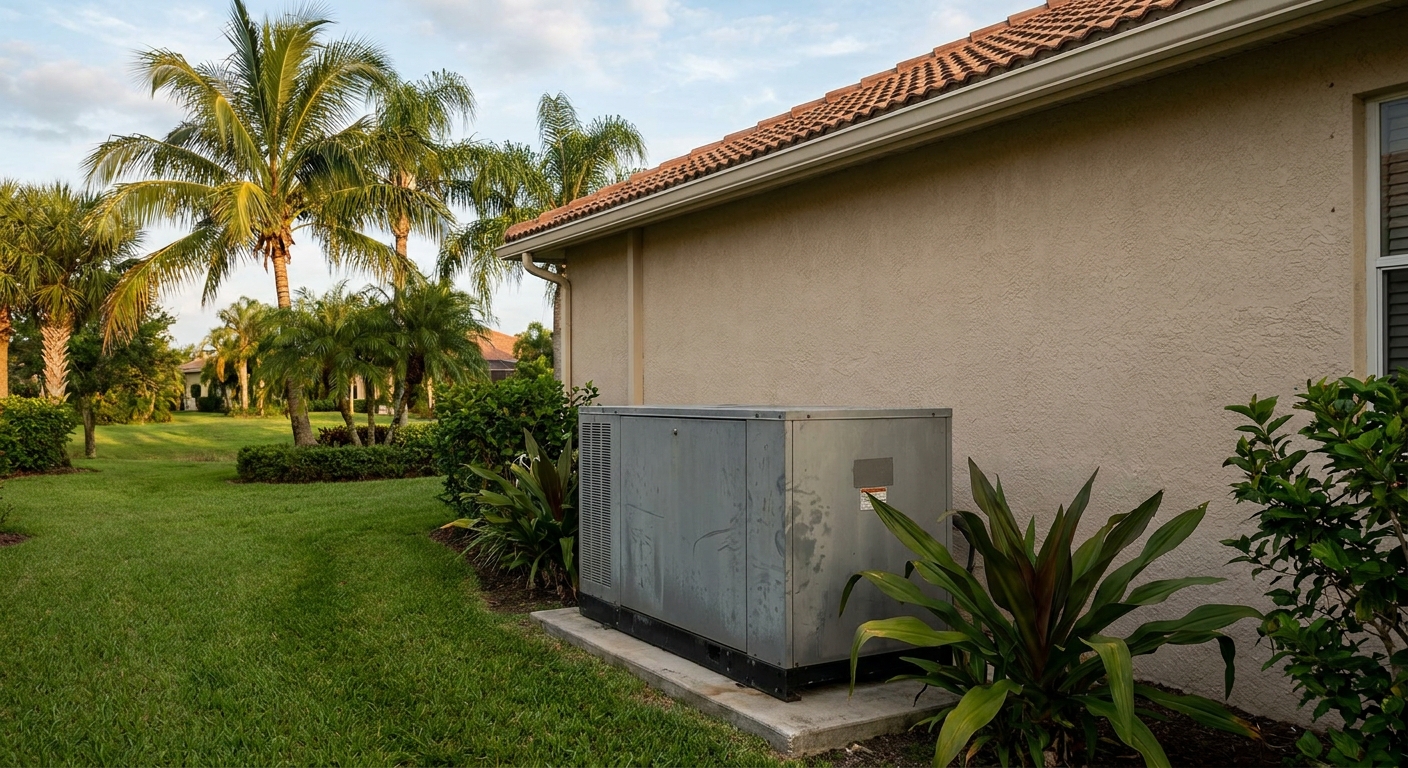
A useful generator plan starts with the equipment your household needs during an outage. It does not start with house size, panel amperage, or a promise that one generator will run everything.
Before selecting a standby generator, define the essential loads, check their operating and startup requirements, choose a workable fuel arrangement, and confirm how the generator will be isolated from utility power. Placement, maintenance access, equipment instructions, and local review also affect the installation.
Plan for the outage, not a neighborhood prediction
Storm restoration depends on actual damage, repair complexity, safety priorities, and the number of customers a repair can restore. A coastal or inland address does not establish when power will fail or return. The same planning approach applies across Tampa Bay, including Apollo Beach: decide what must remain available and prepare for the possibility that restoration will take longer than hoped.
If part of the house loses power while other areas still work, do not assume a generator is the answer. That pattern can have several causes and needs qualified evaluation. Our guide to half the house losing power explains the safer next steps.
Standby and portable generators serve different plans
A portable generator can power individual appliances through properly rated outdoor cords. It must operate outdoors, far from the house and away from doors, windows, vents, and other openings. It must never run in a home, garage, basement, crawlspace, or shed because fuel-burning generators produce carbon monoxide and create fire and electrical hazards. The CPSC generator safety guide provides operating guidance.
A portable generator may supply selected house circuits only through compatible transfer equipment installed for that purpose. Plugging a generator into a household receptacle to energize the wiring is unsafe backfeeding.
A fixed standby system is installed with transfer equipment that isolates the home from the utility. An automatic transfer switch can detect a utility outage and control the changeover without manual connection. Compatible manual transfer equipment can also provide safe isolation, but it requires the homeowner to follow the system’s operating procedure.
Build an essential-load list before choosing capacity
The term “whole-home” does not guarantee that every appliance can run at once. Generator selection depends on the actual loads and the way the household expects to use them.
Start by identifying priorities such as refrigeration, lighting, communications, medical equipment, a well pump, selected kitchen equipment, and heating or cooling. Then note which motors or compressors have startup demand beyond their normal operating load. The generator and transfer equipment must be evaluated as a system.
Central air conditioning may be included when the selected equipment and electrical design can support it. It should not be assumed from a generator label or a rule based on square footage. A well pump can also be an essential load for some households, but its priority and electrical requirements must be assessed rather than treated as universal. If a pump is already causing trips, have that condition evaluated instead of building it into a backup plan as though nothing is wrong. See why a well-pump breaker may trip.
Separate service capacity from panel space
A generator supplies backup power during an outage. It does not, by itself, add a new utility load to the home.
An electrician still needs to evaluate the service equipment, transfer arrangement, connected loads, and equipment condition. A panel with no open breaker spaces presents a circuit-space question, but that alone does not prove the home’s service capacity is inadequate or that a complete panel upgrade is required. Circuit space, service capacity, and replacement of damaged or incompatible equipment are separate decisions.
Compare fuel arrangements realistically
Natural gas and propane systems each depend on property-specific conditions, equipment requirements, and fuel availability.
A natural gas connection avoids storing a finite supply on the property, but it does not guarantee uninterrupted or unlimited operation. The utility connection, generator demand, equipment instructions, and conditions during the outage still matter.
Propane requires an on-site supply sized and located for the selected equipment. Runtime depends on the available fuel, generator load, and operating conditions. Delivery access may also affect the household’s backup plan. This is relevant in communities throughout the service area, including Land O’ Lakes, without assuming what fuel or equipment any particular home uses.
Both fuel types involve combustion exhaust. A fixed standby unit still needs model-specific clearances and placement reviewed under its listed instructions and the applicable local process.
What changes the project scope
No single installed price applies to every property. Meaningful scope differences include:
- Which loads the system will support and whether load management is used
- The generator, transfer equipment, and service-equipment configuration
- Fuel availability and any fuel-system work
- Distance, routing, access, trenching, and the proposed equipment location
- Existing equipment condition and compatibility
- Permit, utility, inspection, and jurisdiction-specific requirements
A full panel or the desire to run central air does not automatically establish that a service replacement is necessary. The selected contractor should explain which part of the design creates each recommended change.
Permitting depends on the property and installation
The authority responsible for the property and the details of the electrical and fuel work determine the applicable permit and inspection process. A mailing address alone may not identify the correct jurisdiction.
The selected contractor should confirm the authority, describe which applications apply, and separate electrical work from any fuel-system work. Tampa Electrical Pro is a referral service and does not pull permits or perform the installation itself.
Maintenance belongs in the backup plan
Maintenance requirements come from the particular generator, engine, battery, transfer equipment, and manufacturer instructions. A practical plan records the required service tasks, test procedure, fuel checks, and who will complete them.
Exercise cycles can reveal a warning or failed start, but they do not prove the system will perform under every outage condition. Never open electrical covers or attempt panel wiring as part of a homeowner test.
Automatic transfer and load management
An automatic transfer switch is useful when the household needs the system to change over without manual connection. It is not the only transfer method that can be valid for compatible equipment. The essential safety requirement is reliable isolation from utility power. Turning off the main breaker is not a substitute for approved transfer equipment.
Load-management controls can delay or shed selected loads when demand rises. They may help align a backup plan with a smaller generator, but they do not create service capacity, remove startup demand, eliminate fuel limits, or make overloading impossible. Decide the priority order before installation and confirm how the selected controls behave when several loads call at once.
Prepare before a storm is approaching
Equipment selection, property review, fuel planning, permitting, and installation all take time, but no fixed scheduling window applies to every project. Planning before a storm is nearby gives the selected contractor and the homeowner more room to resolve site-specific questions.
Tampa Electrical Pro can connect you with an independent licensed and insured electrician who can evaluate the property and explain the proposed generator, transfer method, supported loads, exclusions, maintenance needs, and project scope. Start with a whole-home generator evaluation.