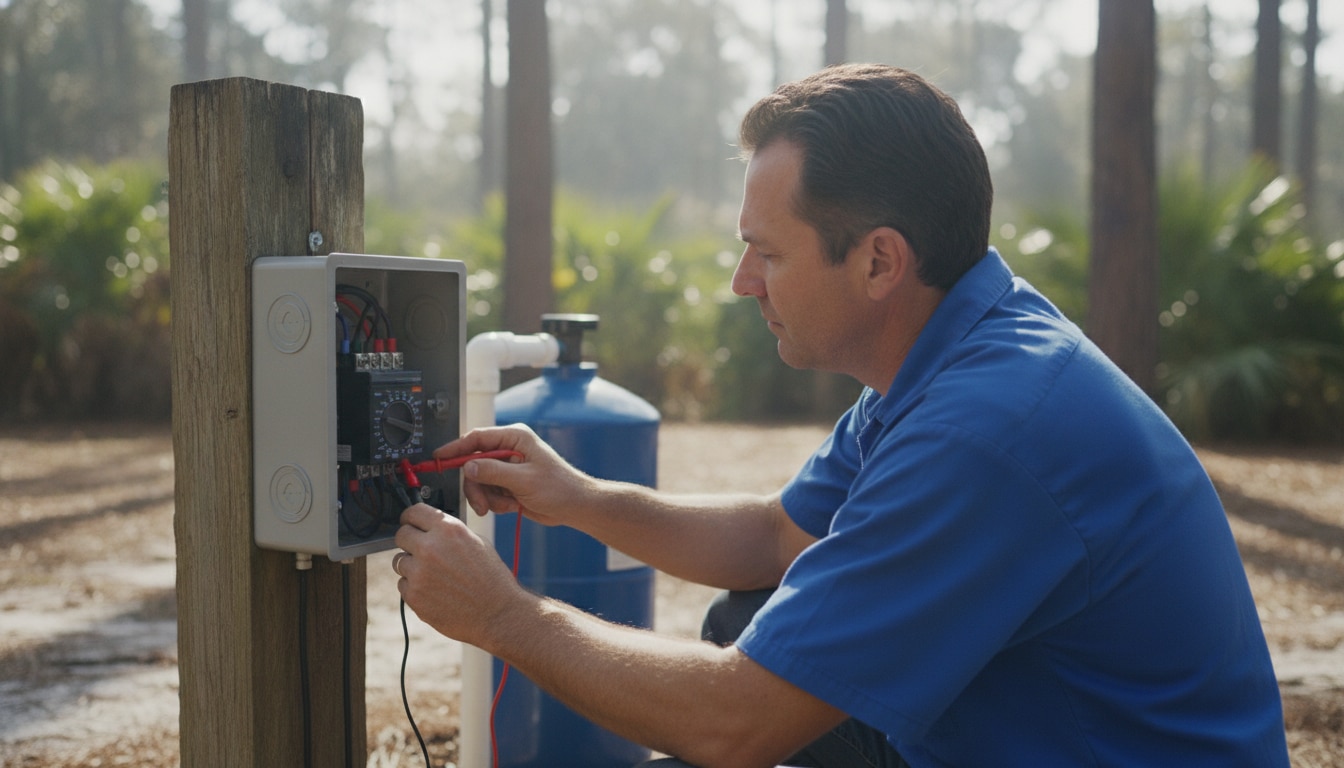
A well pump breaker that keeps tripping needs diagnosis, not repeated resets. The interruption may involve the motor, drop cable, control box, pressure switch, circuit conductors, breaker, water supply, or mechanical condition of the pump. Trip timing can provide a clue, but it cannot identify the failed part by itself.
Well pumps are motor loads. Their running current, starting behavior, equipment instructions, conductor sizing, and protective device all matter. A qualified electrician can compare measurements with the actual motor label and manufacturer documentation before deciding whether the electrical problem is above ground or farther down the well system.
Why a well pump breaker may keep tripping
A breaker can open when it detects current or fault conditions beyond what the protected circuit should carry. On a pump circuit, possible causes include damaged insulation, a problem with starting components, excessive cycling, a motor or pump that is struggling mechanically, unsuitable connections, or a defective protective device.
The motor’s normal running current provides context, but it does not diagnose the problem alone. Franklin Electric lists the following full-load currents for four-inch, two-wire, 230-volt submersible motors:
- 5.0 amps for a one-half-horsepower motor
- 6.8 amps for a three-quarter-horsepower motor
- 8.2 amps for a one-horsepower motor
- 10.6 amps for a one-and-one-half-horsepower motor
Those are model-specific reference values, not instructions for choosing a breaker. Franklin states that fuse and circuit-breaker sizes are determined by applicable electrical codes, and the installed equipment must also match its labeling and instructions. An electrician should compare measured current with the exact pump model rather than assuming that a familiar horsepower rating tells the whole story.
The broader framework in why your breaker keeps tripping can help you describe the symptom. Pump circuits still require motor-specific testing. Similar caution applies when a water heater keeps tripping its breaker, since different equipment can produce the same visible result for different reasons.
Is the problem in the pump, control box, or circuit?
The system layout determines which components are available to inspect and test.
A two-wire submersible pump system places its starting mechanism with the motor rather than in a separate above-ground control box. Franklin notes that restarting a two-wire motor within five seconds after power is removed may cause its overload to trip. That is one reason repeated, rapid resets interfere with diagnosis and can add stress without correcting the cause.
A three-wire system uses an above-ground control box. Franklin describes these boxes as containing starting capacitors and a starting relay, with overload protectors, running capacitors, and contactors present in some sizes. That qualifier matters because the components available for testing vary by system and model.
A failed above-ground component can resemble a downhole motor problem. Conversely, a control box that appears normal does not prove that the motor and cable are healthy. The useful first step is to identify the pump model and system type, then test the relevant components in an order that avoids unnecessary well work.
What trip timing can and cannot reveal
Record whether the breaker opens as soon as the pump is called, during a run, or after repeated cycles. Also note whether the pressure switch clicks, whether water pressure changes, and whether the symptom follows a power interruption.
An immediate trip can be consistent with several conditions, including damaged conductors, an insulation fault, starting-component trouble, a locked motor, or a breaker problem. A trip after some running time can involve heating, excessive current, cycling, voltage conditions, or mechanical load. Neither pattern proves a single cause.
Do not repeatedly reset the breaker to see whether the pattern changes. Do not replace it with a larger breaker or substitute another rating. Breaker and conductor selection must match the circuit, equipment, and applicable requirements.
Can water level be part of the problem?
Water level can affect pump operation, but the season alone does not prove why a breaker opened.
The Southwest Florida Water Management District reports that well-water levels can change by more than 40 feet between wet and dry years and can also vary seasonally. Its consumer guide says May is usually the low point and September is usually the high point following summer rainfall. The guide also warns that water in a well can fall below the pump intake.
That information provides useful context for a pump that loses pressure or runs differently during a dry period. It does not establish the water level at a particular property or prove an electrical diagnosis. The well depth, current water level, pump position, pressure system, motor condition, and electrical measurements all need to be considered.
The district recommends a low-pressure cut-off switch to help prevent permanent pump damage when the water level falls below the intake. Whether that protection is appropriate depends on the existing pressure controls and pump system. Its selection and wiring should be reviewed for the actual equipment.
Can heat or moisture affect a control box?
Yes. The installation environment can affect control components, but it should be evaluated against the instructions for the installed box.
Franklin Electric specifies an installation range of 14°F to 122°F for the control boxes covered by its manual. It warns against direct sunlight and high-temperature locations because those conditions can shorten capacitor life, where applicable, and cause unnecessary operation of overload protectors. For an outdoor high-temperature location, the manual calls for a ventilated enclosure painted white to reflect heat.
The same manual warns against damp well pits and other humid locations because corrosion can accelerate component failure. These instructions support checking sun exposure, ventilation, moisture, corrosion, and the exact enclosure arrangement. They do not prove that heat or humidity caused a particular trip.
Do not open a control box or panel to investigate. If electrical equipment is wet, visibly damaged, buzzing, arcing, smoking, or giving off a burning odor, keep away from it and arrange prompt qualified help. For smoke or fire, leave the hazard area and contact emergency services.
What an insulation-resistance test shows
An insulation-resistance test can help evaluate the motor windings and drop cable without first pulling the pump. It does not test every possible mechanical or electrical failure.
For a motor and drop cable already in the well, Franklin’s manual classifies 0.5 to 2.0 megohms as good condition and a reading below 0.5 megohm as insulation damage that needs to be located and repaired. It lists 2.0 megohms or more for a new motor in the well.
Those values apply to the test configuration and equipment covered by the manual. A low reading can direct attention toward insulation damage in the motor or drop cable. A reading within the stated band does not rule out a mechanical pump problem, starting-component failure, pressure-control issue, connection problem, or another condition outside that test.
Current measurements, voltage readings, pressure-system behavior, equipment labeling, and the manufacturer’s troubleshooting sequence may all be needed before deciding what to repair.
Why short cycling matters
A pump that starts and stops too frequently puts repeated stress on its control components and motor.
For single-phase encapsulated motors, Franklin lists a maximum of 300 starts in 24 hours through three-quarter horsepower and 100 starts in 24 hours from one through five-and-one-half horsepower. The manual also calls for motors to run at least one minute so heat from starting current can dissipate. It says excessive cycling reduces the life of pressure switches, starters, relays, and capacitors.
Frequent cycling can be associated with pressure-tank, pressure-switch, check-valve, plumbing, or pump-system conditions. The cycling pattern identifies an operating problem, but it does not establish which component caused it. Note how often the pump starts and how long it runs, then give that information to the appropriate professional.
Who handles each part of a Florida well system?
Florida separates work on the well, pumping system, and electrical circuit.
Florida Statutes 373.303(6) defines a water well contractor as “a person who is responsible for the construction, repair, or abandonment of a water well and who is licensed under this part to engage in the business of construction, repair, or abandonment of water wells.”
The same statute defines construction of water wells in section 373.303(2) as “all parts necessary to obtain groundwater by wells, including the location and excavation of the well, but excluding the installation of pumps and pumping equipment.”
Florida Statutes 489.105(3)(m) includes public or private water-supply systems and drainage and supply wells within plumbing-contractor scope. The electrical conductors, breaker, disconnect, grounding, pressure-switch wiring, and control-box wiring are electrical scope. License categories have defined boundaries, so the selected business should have active credentials appropriate to the part of the system it will handle.
The Southwest Florida Water Management District says a well-construction permit is required for wells constructed or drilled within its boundaries, including shallow irrigation and domestic wells two inches or less in diameter. That statement concerns well construction. It does not establish whether a pump-only replacement requires a district permit.
Electrical permits are handled through the authority serving the property, which may be a city or county building department. The selected contractor should confirm the jurisdiction and requirements for the actual electrical scope rather than relying on the mailing address alone.
Tampa Electrical Pro refers customers to independent licensed and insured electricians. The selected contractor determines the work scope, permits, scheduling, workmanship, and price.
What changes the electrical repair scope?
The first useful distinction is whether testing points to an accessible component or work involving the motor and drop cable in the well.
Electrical scope can change based on:
- Whether the system is two-wire or three-wire
- The pump’s model, voltage, horsepower, and labeled requirements
- Measured motor current and insulation resistance
- The condition and location of the breaker, disconnect, pressure switch, and control box
- Whether the drop cable or other conductors show insulation damage
- Circuit length, conductor condition, routing, and access
- Evidence of short cycling or unsuitable pressure-system operation
- Whether another trade must service the pump, pressure tank, plumbing, or well itself
- Which city or county has authority over the property
A full panel does not automatically mean the electrical service must be upgraded. Available breaker spaces, calculated service capacity, existing loads, and the proposed equipment are separate questions. A subpanel can create circuit space, but it does not increase utility service capacity.
If the property needs broader electrical work, review panel upgrade considerations with the electrician after the actual load and equipment are known. For outage planning, a whole-home generator must be selected around defined essential loads, including the well pump if water service is a priority. The generator supplies backup power; it does not add utility capacity by itself. Surge protection is another separate decision based on the property’s electrical system and connected equipment.
What to record before arranging service
You can collect useful information without opening electrical equipment:
- Record whether the breaker opens immediately, during a longer run, or after repeated cycling.
- Note whether water pressure disappeared, weakened, or fluctuated before the trip.
- Record the pump and control-box model information if it is visible without removing a cover.
- Note whether the system has an above-ground control box.
- Observe the control box location for direct sun, standing water, or visible exterior damage from a safe distance.
- Note how often the pump starts and how long it runs before stopping.
- Record whether other circuits or large appliances lost power at the same time.
- Stop resetting the breaker if it trips again.
If the pump and several unrelated circuits lose power together, the problem may be upstream from the pump circuit. The guide to why half the house may have no power explains the broader pattern without assuming the pump caused it.
Frequently asked questions
Should I replace the breaker first?
Not without testing. A breaker can fail, but the same symptom can come from the motor, cable, controls, connections, or pump operation. Replacing the breaker before measuring the circuit can leave the underlying problem unresolved. Never install a higher breaker rating as a troubleshooting step.
Why does the pump trip only during hot weather?
Heat may be relevant if the installed control box is exposed to direct sun or a high-temperature location. Franklin warns that these conditions can shorten capacitor life, where applicable, and can cause unnecessary overload operation. Water level and equipment load can also change, so weather timing is context rather than proof of a cause.
Does the pump need a dedicated circuit?
The circuit arrangement must match the pump equipment, its labeling, manufacturer instructions, and applicable electrical requirements. An electrician should identify the installed motor and evaluate its conductors and protection rather than infer the answer from the pump type alone.
Can a motor be checked without pulling the pump?
An insulation-resistance test performed from the surface can provide evidence about the motor and drop-cable insulation. Franklin lists 0.5 to 2.0 megohms as good condition for a motor and cable in the well and less than 0.5 megohm as insulation damage. A healthy insulation result does not rule out a mechanical or control problem.
Does well pump electrical work require a permit?
Permit requirements depend on the electrical scope and the city or county with authority over the property. Well-construction oversight and electrical permitting are separate. The selected contractor should identify the correct jurisdiction and confirm what the project requires.
What does a low-pressure cut-off switch do?
It can stop pump operation after a loss of pressure instead of allowing continued operation when the water level has fallen below the intake. The Southwest Florida Water Management District recommends this protection to help prevent permanent pump damage. Compatibility depends on the existing controls and pump system.
Get the circuit tested before choosing a repair
A recurring well pump breaker trip does not identify one automatic repair. Useful diagnosis combines the system type, motor label, trip pattern, operating current, insulation condition, controls, pressure behavior, and water-level context.
Tampa Electrical Pro can connect you with an independent licensed and insured electrician for the electrical portion of the diagnosis in Hillsborough, Pinellas, or Pasco County. Start with electrical repair and troubleshooting and describe the observations you recorded, especially the trip timing, cycling pattern, and pump model.