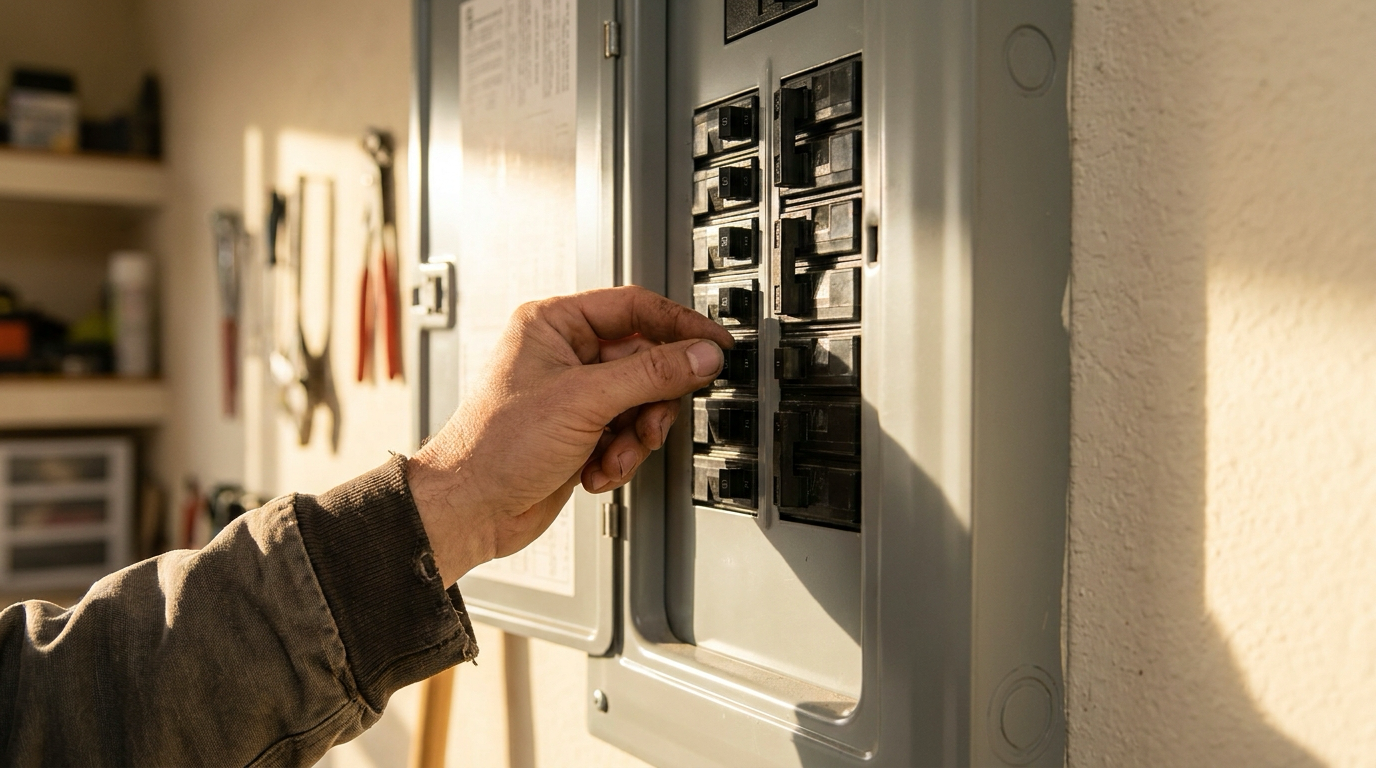
A breaker that keeps tripping is interrupting power because it detects a condition it is designed to respond to. Possible causes include an overloaded circuit, a short circuit, leakage to ground, arcing, a problem in connected equipment, a loose or damaged connection, or a failing breaker.
The timing and circumstances are useful observations, but they are not a diagnosis. The breaker type, its markings, the equipment nameplate, the circuit configuration and electrical testing determine what is actually happening.
Do not keep resetting a breaker to see whether the problem clears. If there is smoke, arcing, a burning odor, unusual heat, buzzing, discoloration, water near electrical equipment or a shock, move away from the hazard. For smoke or fire, leave the area and contact emergency services.
What can make a breaker trip repeatedly?
Several different protective functions may be involved:
- Overcurrent protection responds when current exceeds what the circuit and breaker are designed to carry. This can result from too much connected load, a fault or equipment drawing abnormal current.
- Short-circuit protection responds to a low-resistance fault path. A qualified electrician must locate the damaged conductor, connection or equipment rather than simply replace the breaker.
- GFCI protection responds when current leaves its intended path. Moisture, damaged cords, failed equipment and wiring faults are among the possibilities.
- AFCI protection looks for electrical patterns associated with arcing. An AFCI breaker also provides overcurrent protection, and a dual-function breaker may combine AFCI and GFCI protection.
The label and buttons on the device help identify which protection is present. A plain receptacle can also be protected by a GFCI located upstream, so the absence of test and reset buttons at one outlet does not prove the circuit lacks GFCI protection.
An electrician doing electrical repair and troubleshooting can identify the breaker type, measure the circuit and separate a wiring fault from a problem in connected equipment.
Does trip timing reveal the cause?
Timing helps you describe the symptom. It does not prove the cause.
A trip after several appliances begin running can be consistent with an overload. A trip at the moment one appliance starts can point attention toward that appliance, its starting current, the circuit or a connection. A trip with everything readily accessible unplugged can indicate a fixed-wiring problem, but it can also involve equipment you did not disconnect, an upstream device or the breaker itself.
Write down:
- Which breaker tripped and what its label says
- Whether it has test or reset controls
- What equipment was operating or starting
- Whether the trip followed rain, outdoor water exposure or an equipment cycle
- Whether the problem affects one circuit, several circuits or only part of the property
- Any sound, odor, heat, discoloration, damage or prior electrical work
Those details give the electrician a better starting point without asking you to remove a panel cover or touch electrical components.
Why might the problem appear during hot weather?
Hot weather can change how long cooling equipment, pumps, dehumidifiers and other loads operate. Heat can also affect equipment performance and the temperature around electrical components. Neither observation proves that ambient heat caused the trip or that nothing has failed.
The correct assessment depends on the actual load, conductor and breaker condition, equipment nameplate, installation instructions and applicable manufacturer data. A circuit that operated previously can still develop a loose connection, damaged equipment or another fault.
Do not treat a summer-only pattern as permission to keep resetting the breaker. Report the conditions and let the measurements identify the cause.
What if the air-conditioner breaker trips?
An air-conditioning trip can involve the HVAC equipment, the electrical circuit or both. The useful dividing line is not simply whether the day is hot.
An HVAC technician can evaluate the compressor, fan, capacitor, refrigerant system and other equipment components. An electrician can evaluate the breaker, conductors, disconnect, connections and whether the circuit matches the equipment nameplate and installation requirements.
Stop operating the system if the breaker will not hold after one safe reset, trips again, or there is heat, damage, buzzing, arcing or a burning odor. Do not install a larger breaker as a workaround.
Other dedicated equipment deserves its own diagnosis. See the guides to a well-pump breaker that keeps tripping and a water heater that keeps tripping its breaker for the distinctions that matter with those loads.
Why might a GFCI trip during rain?
Rain-related timing makes moisture exposure an important possibility, but it does not establish where the fault is. Water can reach an outdoor receptacle, cord, light, pump, appliance, junction box or another downstream part of the circuit.
Outdoor equipment must match its actual exposure. A protected damp location and a location exposed directly to water are not the same. Covers, enclosures, cords and connected equipment all need to be appropriate for the conditions and installed according to their listings and instructions.
If a device or box is wet, damaged or discolored, do not touch it or try to dry it while energized. Have the circuit evaluated. Replacing GFCI outlets at random can leave the real downstream fault in place. The Florida GFCI guide explains how receptacle-level and upstream protection differ.
Why can an AFCI breaker trip with nothing plugged in?
Unplugging portable devices does not remove every possible condition from a circuit. Fixed lights, hardwired equipment, concealed cable, shared wiring conditions and connections can remain involved.
An AFCI trip can relate to an arcing condition, an equipment compatibility issue, a circuit configuration problem, overcurrent or the breaker. A dual-function device may also be responding to leakage to ground. The breaker’s indicator and manufacturer troubleshooting procedure can help a qualified electrician interpret the event, but the trip should not be dismissed as a nuisance without evaluation.
Can the breaker itself be faulty?
Yes, but replacing it should follow an assessment of the circuit. A damaged breaker, poor connection or problem where the breaker connects to the panel can cause abnormal operation. So can a legitimate overload or fault elsewhere.
Do not touch breakers to compare temperature and do not remove the panel cover. Report visible discoloration, unusual sounds, odor or a handle that will not remain in position without repeatedly operating it.
If the property has Federal Pacific Stab-Lok or Zinsco equipment, the panel type warrants a separate evaluation. Read about Federal Pacific panels, why Zinsco panels fail and FPE or Zinsco replacement without assuming that panel brand explains every trip.
What should you do when a breaker trips?
Keep the response limited and stay outside the panel enclosure.
- Check for smoke, fire, arcing, odor, buzzing, visible damage, unusual heat, moisture or a shock. Do not reset the breaker if any of these is present.
- From a dry, safe location, turn off or unplug readily accessible equipment that lost power. Do not approach wet outlets, damaged cords or outdoor equipment in standing water.
- If there are no warning signs and the area is dry, one reset may show whether the breaker holds. Move the handle fully to OFF and then to ON without opening the panel or removing a cover.
- If it trips again, will not reset or trips immediately, stop. Leave the affected equipment off and arrange an electrical evaluation.
Never tape or hold a breaker on, repeatedly reset it, replace it with a larger one, or move breakers inside the panel. Breaker size must match the conductors, equipment and circuit design.
Does a tripping breaker mean the panel needs replacement?
Not by itself. One affected circuit may need a circuit-level repair. Several symptoms can justify a broader panel and service evaluation, including trips on different circuits, a tripping main breaker, heat or damage, poor breaker connections, or electrical additions that were never evaluated as a complete load.
Circuit space and service capacity are different questions. A full panel may lack room for another breaker without necessarily lacking electrical capacity. A subpanel can add circuit spaces, but it does not increase the utility service capacity. Actual loads and the proposed equipment must be evaluated before recommending a panel upgrade. The guide to how many amps a home needs explains why the answer cannot come from breaker slots alone.
That assessment must be property-specific. The age of a Tampa or Brandon neighborhood does not reveal the condition or capacity of an individual home’s electrical system. Homeowners in Tampa should base the decision on the equipment and measured load at their property.
What if part of the house loses power but no breaker looks tripped?
Do not assume the cause is inside or outside the panel. A partial outage can involve a branch circuit, a connection, panel or service equipment, or the utility supply.
Check whether nearby properties or utility outage information show a broader interruption, but do not open electrical equipment or approach damaged service components. If only your property is affected, lights are unusually bright or dim, or there is heat, buzzing, arcing or odor, arrange prompt qualified evaluation. The guide to half the house losing power covers this symptom separately.
How are permits handled in Hillsborough County?
Permit responsibility depends on the work and the authority serving the property. Hillsborough County’s published exempt-work list includes a limited electrical exemption for qualifying low-voltage work in an existing single-family residence. That does not create a blanket exemption for breaker replacement, new branch circuits or panel work.
Cities within Hillsborough County can administer their own building departments. The property’s actual jurisdiction, not only its mailing address, determines which authority reviews the work. Ask the selected contractor to explain whether a permit and inspection apply and who will handle them. Tampa Electrical Pro does not perform the work or pull permits.
Frequently asked questions
Is it safe to keep resetting a breaker?
No. Repeated resets re-energize a circuit before the cause is known. If the area is dry and there are no warning signs, one reset may be reasonable. Stop if it trips again or will not hold.
Can I install a larger breaker to stop the trips?
No. A larger breaker can leave conductors or equipment without the protection intended for the circuit. The correct remedy depends on the measured load, wiring, equipment and fault condition.
How can I tell whether the breaker or circuit is faulty?
You usually cannot confirm that from timing alone. An electrician compares the breaker and conductors with the connected load, equipment nameplate, connections and test results.
Should I call an electrician or an HVAC company?
For an air-conditioning trip, either side may need evaluation. HVAC service addresses faults inside the cooling equipment. An electrician addresses the breaker, circuit, disconnect and electrical connections. Heat, arcing, odor or visible electrical damage calls for prompt electrical attention.
Does a full panel prove I need a service upgrade?
No. It establishes that circuit space needs evaluation. Service capacity is a separate load question, and a subpanel adds spaces without increasing utility capacity.
Get the cause evaluated before restoring the circuit
Tampa Electrical Pro connects customers with independent licensed and insured electricians serving Tampa Bay. The selected contractor determines scheduling, diagnosis, scope, permitting and price.
If a breaker trips repeatedly, leave the affected circuit off until it can be evaluated. If there is smoke or fire, leave the hazard area and contact emergency services. For sparking, burning odor, buzzing, heat, shocks or visible electrical damage, request qualified help through the emergency electrician service without attempting another reset.