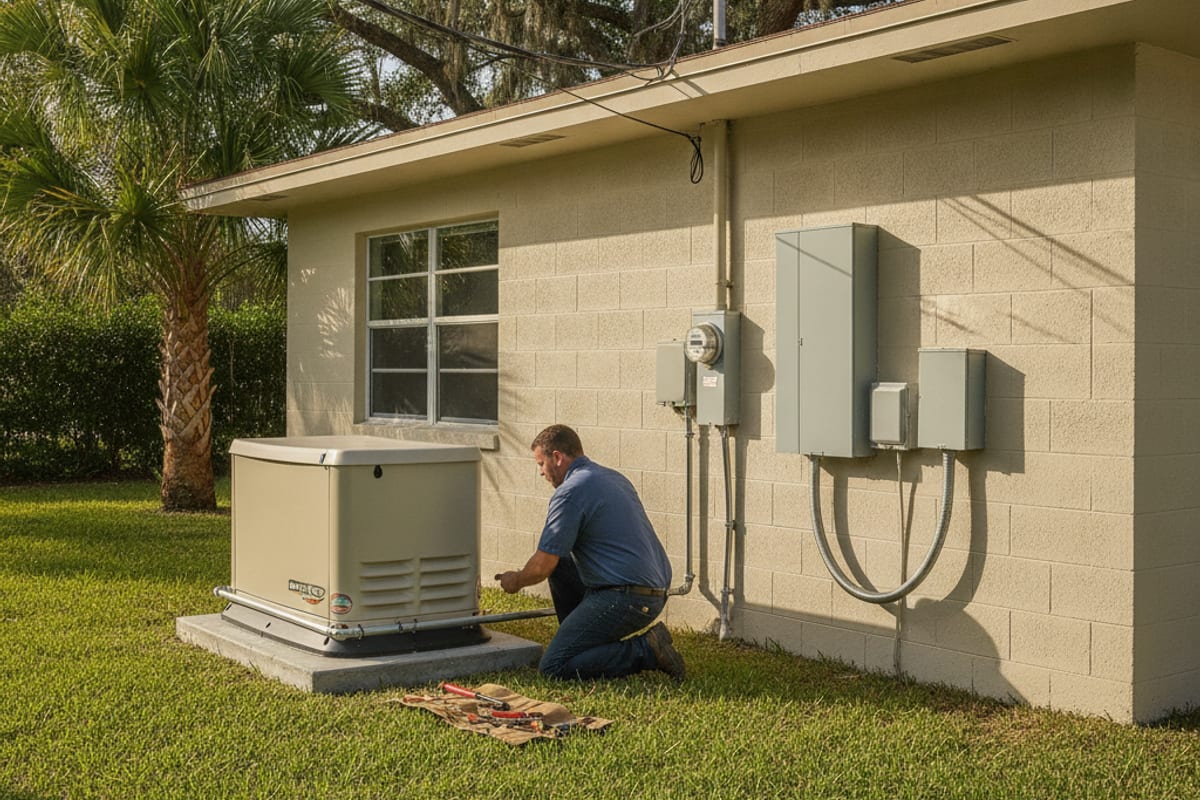
A generator installation in Tampa is not just dropping a unit on a pad and running a cord. It’s reading the house, sizing the machine to the loads you actually want backed up, installing transfer equipment that keeps your house isolated from Tampa Electric while the generator runs, and integrating that all with the existing panel and meter. A tight timeline or a low budget can make you guess at those steps. A licensed electrician does the read and the calculation first.
What the electrician reads on a Tampa home
The install starts with the house itself. Every home has a different service size, panel age, available circuit space, and essential load. A 100-amp panel in a Seminole Heights bungalow with a window unit air conditioner and an electric water heater is a very different job from a 200-amp panel in a South Tampa renovation with central air, an electric range, and a heat pump water heater.
The electrician looks at the meter, the mast, the main breaker, and the condition of the service entrance. Old aluminum conductors, corrosion around the meter can, or a panel that is already at capacity tells a story. In an older Hillsborough home with original copper service, the decision might be simple: the feeder can carry a generator and the circuits can hold transfer equipment. In a house with already-tight panel space or aging aluminum wiring, that is the moment a panel upgrade conversation starts.
Load calculation is not optional. The electrician reads the breakers, the circuit layout, and what you actually want to run during an outage. That list is the job. If you want the refrigerator, lights, your well pump, the air handler, and your bedroom outlets all backed up, the electrician designs a transfer path for those specific circuits. The wattage on the panel labels adds up. The essential list times the diversity factor is what the generator has to carry. Running a 300,000-BTU window unit plus an electric water heater plus refrigeration at once is a real load. Picking a generator by square footage is guessing.
How transfer equipment actually isolates the utility
Transfer equipment is the lock that keeps your generator and Tampa Electric from both powering the house at the same time. Without that isolation, generator current can backfeed onto utility lines. Line workers can meet that current. Anyone plugged into a “dead” outlet in the house can meet it too. Isolation is not a nice add-on. It is the legal and safety requirement.
An automatic transfer switch is the most common path. When utility power drops, the switch moves the essential circuits from Tampa Electric to the generator. When power returns, it moves them back. The generator never sits in parallel with the utility. A standby unit is sized, transferred in, and transferred out. An interlock kit on the main breaker takes a different form but does the same job: it mechanically prevents the generator breaker and the main from being on together.
The transfer equipment sits at the panel or on its own enclosure near the panel. Conduit runs from the generator pad to that transfer point. The electrician sizes the conduit and the wire from the pad for the generator’s full output, not guessed from a brochure. A 20-kilowatt generator pulling 100 amps at 240 volts is a real load on that conductor. Undersizing it creates fire risk. The code review for your address catches size mismatches. The electrician ahead of the inspector gets it right the first time.
Sizing the generator: load list, not guessing
A good size question for an electrician is “what stays up?” A bad one is “how big should my generator be?” The second one makes the electrician guess. The first one gives a list. Write the list first. Keep the lights on in three rooms, the refrigerator, the air handler, the water heater, and the bedside lamp. That is a list. The electrician loads that onto the transfer path and calculates the connected load and the starting load (air handlers pull heavy startup current). That calculation tells you the generator size that actually fits the load, not a generic size for the house.
A Tampa Bay household in June, with hurricane season already here, should also put reality on that list. Central air in a Midtown home on a 95-degree day is 3,500 to 5,000 watts of continuous draw just for cooling. If you want cooling on the list, the generator has to be able to start and run it. If you are willing to go without cooling in a short outage and just keep the refrigerator and lights, the generator is much smaller and the cost moves with it.
Panel space is another hard constraint. If your panel is already at 90% capacity and you need transfer equipment plus a dedicated generator breaker, there is no room. That is when a panel upgrade sits alongside the generator as a separate bid. A 100-amp service with a full panel might actually need a 150-amp or 200-amp upgrade to land the transfer switch. A bigger service upgrade means a bigger utility meter, a bigger mast, and possibly a bigger utility connection. Those are coordination steps with Tampa Electric and the permitting authority for your address.
The installation process and what it touches
The install itself is a sequence. The electrician pulls any required permits. The authority for your address (City of Tampa, Hillsborough County, Pinellas County, Temple Terrace, or a local agency) reviews the plans and schedule. During the appointment, the electrician cuts power to the circuits being transferred, disconnects the old work if any panel modifications are needed, lands the transfer equipment, runs conduit from the panel or transfer enclosure to the generator pad location, and wires the pad itself for the generator connection.
The generator sits on a concrete pad that the electrician checks for level and proper drainage. Fuel piping runs from the pad to the meter if natural gas is the supply, or the generator gets a fuel feed as part of its setup if propane. The electrician does not plumb the gas line, but coordinates with a licensed gas plumber on that run. Those are separate trades. The electrician verifies that the gas supply is sized for the generator’s consumption and that a regulator sits at the meter, not a guess about Btu-per-hour from the street.
After the rough-in, the utility’s meter technician typically swaps the meter to a new multi-function model that supports the transfer, or verifies that the existing meter can coexist with the transfer switch. That is a coordination call between the electrician and Tampa Electric’s connection division. The inspection follows. The authority inspects the pad, the conduit, the transfer equipment, the connections at the panel, and the meter setup.
Why a panel upgrade might be part of the job
If the load list fits the panel you have, no upgrade is needed. If transfer equipment and a generator breaker don’t fit, or if your service is already strained, an upgrade sits next to the generator. A 100-amp service upgrade to 150 or 200 amps is a distinct project with its own permitting step, its own inspection, and its own cost. The electrician does not assume a panel upgrade. They read the panel, calculate what transfer equipment is needed, confirm there is space, and if there is not, they flag it as a separate bid.
Panel work also depends on the panel brand. Some older panels like Federal Pacific or Zinsco are no longer made and have limited breaker availability. A modern Siemens, Square D, or Cutler-Hammer panel has off-the-shelf transfer equipment and plenty of replacement breakers. If your home has an older panel, the electrician notes that upfront, because it may change the transfer equipment choice or the upgrade timeline.
What the permitting authority checks
The reviewing authority for your address sets the standard. Inside the City of Tampa, that is the city’s electrical office. Unincorporated Hillsborough is the county. Temple Terrace, Pinellas Park, and other municipalities each have their own requirements. The electrician confirms which authority reviews your address and pulls the permit with them.
The review typically checks clearance distances from the generator pad to property lines, openings, and combustible materials. Manufacturers’ instructions set the minimum clearances. Local code might set a higher bar. A tight Seminole Heights side yard, a South Tampa lot line, or a New Tampa setback from a sidewalk are three different lot puzzles. No published distance belongs on this estimate. The listed equipment and the local review set it.
The inspection also confirms that the fuel supply is correct, the conduit is sized and protected, the transfer equipment is listed and installed per its nameplate, and the wiring from the pad meets code for the amperage it carries. The generator is not energized until the inspection is signed off.
What changes the cost
This site publishes $10,000 to $18,000 for a whole-home generator installation in Tampa. That is this site’s range, not a market survey. What moves the number is the pad location, the conduit run from the panel to the pad, the transfer equipment, the fuel supply path, whether a panel upgrade is needed, and the authority’s permit fee.
A generator 20 feet from the panel on a flat lot is a different cost from one 100 feet away, up a slope, or through a crawlspace. Fuel piping from a meter to the pad, trenching, and any utility coordination add cost. Transfer equipment varies: an automatic transfer switch is more costly than an interlock kit, but it is also more transparent to the user. A panel upgrade, when needed, runs separate from the generator. The selected contractor prices the job after the walkthrough, not from a template.
FAQ
What size generator do I need for my Tampa home?
Start with a list of what must stay up: refrigerator, essential lighting, air handler, water heater, well pump if you have one. Do not guess from the house’s size. The electrician calculates the connected load and the starting load from that list and sizes the generator from that, not from square footage.
Does generator installation require a permit in Tampa?
Yes. The electrician pulls the permit with the authority for your address before the work starts. Unpermitted work voids the warranty and can cause insurance claims to be denied. The permit is a standard cost of the job.
Can I install a generator myself in Tampa?
Electrical connections between a generator and house wiring, including transfer equipment and any panel modifications, must be done by a licensed electrician. A homeowner can pour the pad, prepare the site, or schedule the fuel supply. The electrical work is not DIY.
How long does generator installation take?
A straightforward install on a home with adequate panel space typically takes one to three days: rough-in on day one, meter swap and final connections on day two, and inspection on day three or later. An install that requires panel work or site preparation can take longer. The electrician provides a timeline after the walkthrough.
What’s the difference between standby and portable generator installation?
A standby unit sits on a permanent pad with transfer equipment wired into the panel. It runs automatically when power drops. A portable on an inlet gets wheeled out, plugged in, and started manually. Standby requires full installation. A portable needs an inlet and transfer path but no pad or permanent fuel supply. The costs are very different.
When should I schedule generator installation?
Hurricane season runs June through November in Tampa. Many homeowners schedule installs in spring, before the busy season. If you lose power in summer and want a solution by fall, schedule sooner. Permit queues and contractor availability can affect timeline.
When to call us
A licensed electrician should handle the full generator installation: sizing, transfer equipment, conduit, connections, permitting, and inspections. Tampa Electrical Pro matches homeowners with independent licensed and insured electricians for that work. Call us at (813) 850-0320.