The first split that actually helps is whether one circuit is dark or the whole house is. A branch breaker that tripped after the microwave and a toaster shared a kitchen circuit is a different problem from a main that will not reset. Heat, buzzing, or a burning odor at the panel is a third problem. It is not something to wait out.
Main breaker, a branch breaker, or the bus
Power arrives at your Tampa Electric meter first. From there the service conductors land on the main breaker, and a metal bus feeds every branch breaker in the panel. That path is how you sort a dead outlet from a dark house. If the living room is out and the rest of the house is still on, you are looking at one branch. If both sides of the house are dark and the neighbors still have lights, the main, the meter, or the service path is in play.
You can read breaker handle positions on the face of the panel. Leave the inner cover where it is. A branch handle sitting between on and off has tripped. A main handle in the off position, or a main that will not stay on, is a whole-house event. Tracing which rooms sit on which breaker is circuit work, and that walk-through lives in our guide to troubleshooting an electrical circuit.
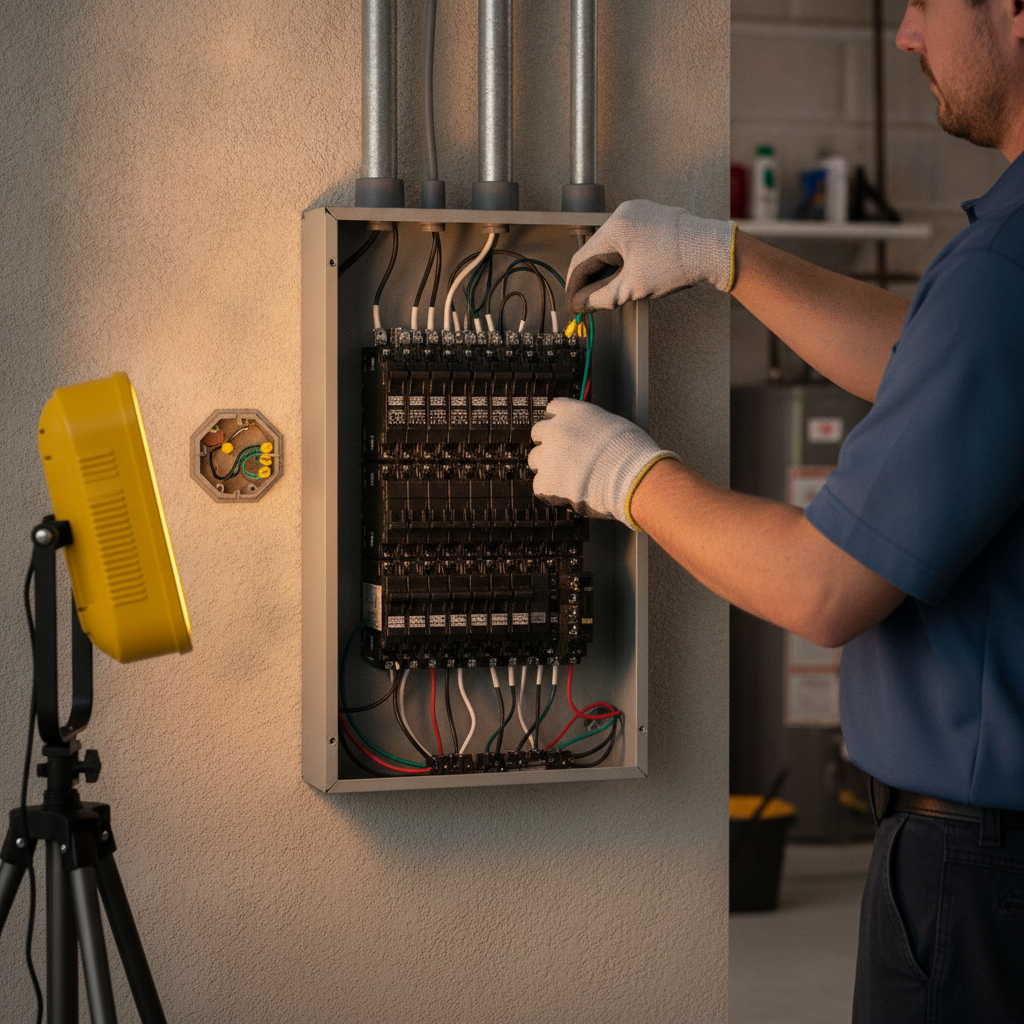
The bus is the bar the breakers clip onto. A failed branch breaker can look like a dead circuit even when the wiring in the wall is fine. A loose or burned connection at a lug can heat the bus even when every handle looks normal. Those are inside-the-panel problems. They are not a homeowner reset. The electricians we send for electrical repair in Tampa identify whether the fault is the breaker, the landing, or the bus before anyone talks about replacement.
A main that trips with almost nothing running is not an overloaded hair dryer. Something is drawing across the whole service, the main itself has failed, or the utility side is unstable. Do not keep forcing that handle. Tampa Electric tells customers that a device which repeatedly trips a breaker should be unplugged and looked at, and that people who are not qualified electricians should not repair electrical products themselves. That is the right line at the panel too.
Half the house dark, with the other half fine, often points at one of the two hot legs. That can be a double-pole breaker, a bus problem on one side, or a lost hot at the meter or weatherhead. After a storm, Tampa Electric is responsible for storm-related damage to the electric meter and the service line. Customers are responsible for damage to the weatherhead, riser, and meter box. Fair-weather heat at the panel, or a breaker that will not reset on a clear afternoon in Town ‘n’ Country, is still an electrician call. It is not a reason to pull the inner cover.
In a typical South Tampa layout the meter sits on the street-facing block wall and the panel is in the garage. That distance does not tell you which part failed. It only tells you the electrician has two places to look: the utility landing and the distribution panel. The same split shows up on a slab house in Riverview, where the panel is inside, just off the foyer, and the meter is around the corner on the exterior wall.
Heat, buzzing, and a breaker that will not reset
Heat you can feel on the panel cover, a buzzing or crackling sound, discoloration around a breaker, or a burning odor are inspection signs, not puzzles to sit with. The Electrical Safety Foundation International groups those with shocks and frequent trips and says a home showing any of them needs its electrical system inspected by a qualified electrician as soon as possible. Unexplained flicker belongs in that same bucket. A web page cannot tell you the smell is dust, the air handler, or a harmless motor.
A breaker that will not reset is telling you either the mechanism is damaged or the fault is still on the circuit. Resetting it over and over does not clear a short, a ground fault, or a failed breaker. It restresses the connection. If the handle feels spongy, will not latch, or trips the instant you turn it on, stop. Unplug what you can on that circuit from the room side. Then wait for a licensed electrician. Do not remove the inner cover to check a wire.
Buzzing at the panel is often a connection under load, a failing breaker, or movement at the bus. It can also be a contactor or a dimmer elsewhere that you are hearing through the enclosure. Where the sound sits matters, which is why we keep a separate page on intermittent buzzing from an electrical panel. The useful move is still the same. Treat unexplained noise at the panel as a prompt inspection.
Smoke or visible fire is not a troubleshooting step. Leave the area and contact emergency services. Water on or in the equipment is the same kind of stop. Energizing wet gear is a hazard. After flooding, Tampa Electric will not reconnect a flooded home until a licensed electrician has inspected the system. Once repairs are made, that electrician has to obtain verification from the local building inspection authority before power can be restored.
The electricians we send work with the authority that actually reviews that address. City of Tampa, unincorporated Hillsborough, Temple Terrace, and Largo each have their own building department. Pinellas County Building serves unincorporated Pinellas plus Belleair Beach, Belleair Shore, Indian Rocks Beach, Kenneth City, Oldsmar, and Safety Harbor. Other Pinellas cities keep a separate local department. A mailing city is not the reviewing office. Florida certified electrical contractors can work statewide. Registered contractors work in their authorized local jurisdictions. Specialty licenses have a bounded scope. The contractor on the job pulls any permit the authority requires. This brand matches you with that contractor. It does not pull the permit.
Service capacity vs circuit space
Running out of breaker slots and running out of service capacity are two different walls. Circuit space is physical. It is empty slots, or room for a two-pole breaker, in this panel. Service capacity is how much load the service and the main can carry. A house in Apollo Beach can have a main with headroom and a panel packed so tight there is nowhere to land a new 240-volt circuit. Another house can have empty slots and a main already carrying the range, the dryer, the air handler, and a pool pump.
| What you are looking at | Circuit space | Service capacity |
|---|---|---|
| What it is | Empty slots, or room for a two-pole breaker, in this panel. | How much load the service and the main can carry. |
| What it looks like | You want a new circuit and every slot is full. | The range, dryer, air handler, and pool pump already share the main. |
| What does not fix it | Putting two circuits into one slot. | Counting empty plastic as spare capacity. |
A new hardwired load is not judged by empty slots alone. An EV charger is a continuous load. The vehicle, the daily range, and how long the car sits parked all affect the right charging setup, and the electrician evaluates electrical capacity rather than counting open spaces. A panel upgrade is the path when the service itself is the limit. Filling a spare slot is the path when the panel has room and the main can carry the added load. Putting two circuits in one slot does not add service capacity. It only changes how the bus is occupied.
Standby generators are easy to mix up with service size. A professionally installed standby unit with transfer equipment that isolates the house from the utility supplies backup power. It does not add utility load by itself. Portable generators power individual appliances through properly rated outdoor cords. They do not get backfed into house wiring through an outlet. Direct backfeeding is unsafe. Turning the main off is not a substitute for transfer isolation.
Cost follows the work, not a blog average. A slot filler and a new circuit is a different job from replacing the panel and raising the service. Access, the route of new conductors, whether the meter enclosure has to move, and what the reviewing office requires at that property all move the number. The selected contractor prices the job after seeing the equipment. This site publishes a 100 amp to 200 amp panel-upgrade range of $2,500 to $4,500 as a site figure, not a Tampa market study and not a quote. That band is for that upgrade path. It is not a claim that a house needs 200 amp service. Many troubleshooting visits never get that far. They stop at a failed breaker, a burned landing, or a circuit that needed to be split.
How to tell if the panel itself is the problem
A failing panel is a pattern the electrician can point at, not a feeling about the age of the house. Heat or discoloration at the enclosure, a main that will not hold, breakers that will not reset, noise at the bus, or a service that cannot accept the loads you already run all point at the equipment. A single tripped kitchen breaker after two appliances shared a circuit usually points at the circuit. Build year, neighbourhood, and sale price do not establish what is in the panel. The electrician reads the labels, the handle positions, the condition of the landings, and the actual loads.
How do I tell if my electrical panel is bad?
Look at what the panel is doing under ordinary use. Repeated trips with a light load, a main that will not stay on, heat on the cover, buzzing, discoloration, or a burning odor are the practical signs. Scorch marks around breakers belong in that list. A panel that simply looks old is not, by itself, a diagnosis. The electricians we send confirm the cause at the property. They do not guess from the subdivision or the year on the tax record.
What happens if a panel is not grounded?
Grounding gives a fault a clear return path so a breaker can open. If that path is missing or open, a fault can energize a metal enclosure, a box, or an appliance frame instead of tripping. You would not know from the handles. GFCI protection can still be provided by devices at different points in a circuit, and a GFCI can work without an equipment ground. Absence of test and reset buttons on a receptacle does not prove there is no upstream protection. An open equipment-ground path is still a qualified inspection, not a homeowner jumper.
The main switch on my panel will not stay on. What can I do?
Stop resetting it. Unplug what you can from the room side so the next visit starts with less load on the bus. Check whether neighbors still have power, which sorts a utility outage from a house problem. Then call for a licensed electrician. The main handle is not a light switch. Forcing it closed on a fault or a failed mechanism is how a small problem becomes a burned landing.
When to call us
Call when a breaker will not reset, when the main will not stay on, or when you have heat, buzzing, odor, or unexplained flicker at the panel. Smoke or fire means leaving the area and contacting emergency services first. The electricians we send are licensed and insured, and they sort a failed branch breaker from a bus or service problem on site. Call us at (813) 850-0320.