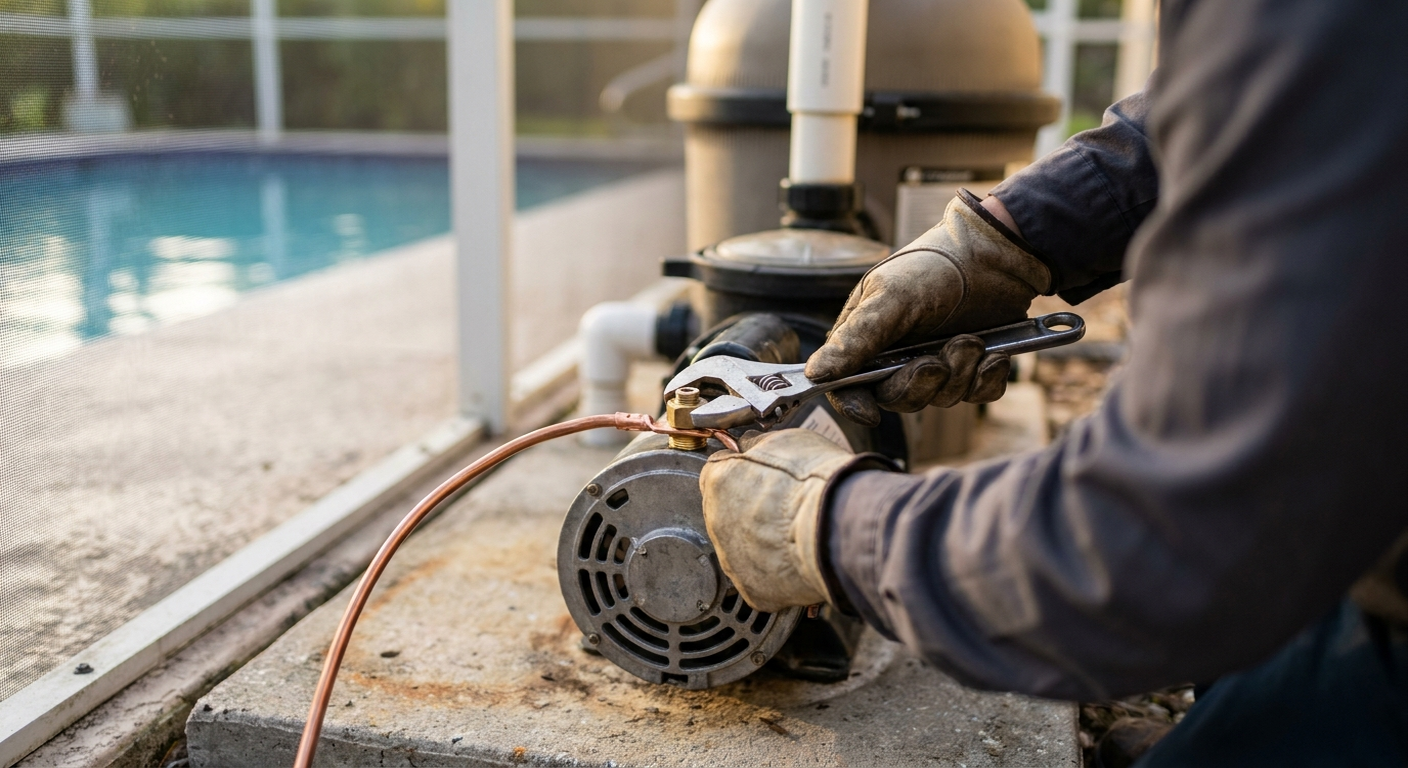
Pool bonding, equipment grounding and GFCI protection address different electrical hazards. Bonding helps reduce voltage differences among conductive parts around the pool. Equipment grounding provides a fault-current path. A GFCI detects an electrical imbalance and can disconnect the circuit. A safe pool installation may depend on all three, but none of them makes a pool shock-proof.
Pool electrical work falls under pool-specific requirements, including NEC Article 680 as adopted and applied by the authority responsible for the property. The applicable rules depend on the project, equipment and jurisdiction. A generic checklist cannot confirm whether a particular pool complies.
Bonding, grounding and GFCI protection are not interchangeable
Bonding
A pool’s bonding network connects conductive components that are required to remain at substantially the same electrical potential. This reduces the chance that someone will bridge a dangerous voltage difference while touching the water, deck equipment or a metal component.
Bonding does not clear every fault, guarantee that no voltage difference exists or make it safe to enter water when someone feels a shock or tingling sensation.
Equipment grounding
Equipment grounding connects electrical equipment to the grounding path for the circuit. If an energized conductor contacts an equipment enclosure or another grounded component, that path helps the protective device operate.
The grounding conductor and the bonding network have related safety purposes, but one is not a substitute for the other.
GFCI protection
A GFCI monitors current leaving and returning through a circuit. An imbalance can indicate that current is taking an unintended path, so the device disconnects the circuit to help protect people from ground-fault shock.
A GFCI does not create an equipment ground, and a GFCI receptacle by itself does not replace the circuit’s overcurrent protection. One properly connected GFCI device may protect downstream outlets, so the lack of test and reset buttons on a particular receptacle does not prove that it has no GFCI protection. The CPSC GFCI fact sheet explains these distinctions.
What a pool electrical evaluation should determine
The useful question is not simply whether a bare copper wire is visible. An electrician needs to identify how the complete installation is arranged and whether its parts remain connected as intended.
The evaluation may include:
- The pool’s construction and the conductive components present around it
- Accessible bonding connections at pumps, heaters, lights, rails, ladders and other equipment
- The pool-water bonding arrangement where the applicable requirements call for one
- Continuity through the bonding network using appropriate test methods
- Equipment-grounding paths for connected electrical equipment
- GFCI protection at the correct point in each applicable circuit
- Overcurrent protection, circuit condition and compatibility with the connected equipment
- Corrosion, physical damage, loose connections or alterations that may have affected the installation
- Equipment labels, installation instructions and ratings for the actual exposure
A visible conductor is only one clue. It does not prove that concealed connections are intact. Likewise, not seeing a bonding conductor at one location does not establish that the entire network is absent or ineffective. Do not open equipment, remove covers or touch conductors to investigate it yourself.
Changes that can affect the bonding network
Pool electrical safety should be reviewed when work changes equipment or conductive components around the pool. Relevant projects can include replacing a pump, heater or light; adding controls; changing rails or ladders; resurfacing the pool; altering the deck; or converting components to different materials.
A pump or heater replacement is not only a mechanical swap. The installer needs to evaluate the new equipment’s connections, bonding provisions, grounding, controls, circuit protection and environmental rating. A pool-light project also involves more than selecting a fixture, as explained in our guide to pool light replacement.
Adding equipment does not automatically prove that the electrical service or panel must be replaced. Available breaker spaces, circuit capacity and total service capacity are separate questions. A subpanel can add circuit spaces, but it does not add utility service capacity. Actual loads and the selected equipment should guide any panel-capacity evaluation.
Pool circuits can also interact with landscape lighting and permanently installed spas. Hot tub wiring has its own equipment and circuit considerations and should not be treated as an extension-cord project.
Warning signs around a pool
Do not continue swimming after anyone feels tingling or a shock in the water, on a rail or around pool equipment. Keep people out of the pool and arrange a qualified electrical evaluation. If a person appears to be receiving an electrical shock in the water, call 911 and do not enter the water to attempt a rescue.
Smoke, fire, arcing or a strong burning odor calls for leaving the hazard area and contacting emergency services. Do not approach wet, damaged or energized equipment.
A pump, heater or light circuit that trips a breaker or GFCI also needs diagnosis. Possible causes include moisture intrusion, damaged wiring, deteriorated connections, an equipment fault or a problem with the protective device. The timing of a trip, including whether it occurred after rain, does not establish the cause by itself. Do not repeatedly reset the circuit or replace the GFCI without determining why it operated.
For these symptoms, treat the problem as an electrical repair rather than routine pool maintenance.
Pool electrical permits and contractor scope
The permitting authority depends on the property’s jurisdiction and the work being performed. A Tampa Bay mailing address alone does not identify the correct building department.
For unincorporated Hillsborough County projects, the county’s published permit-exemption information does not exempt ordinary alteration, replacement or relocation of electrical wiring systems. Properties inside a municipality may be handled by that city instead.
Pinellas County also has several building authorities. Largo operates its own Building Division, while the county serves unincorporated areas and specified partner cities. The Pinellas County building-department directory helps identify the appropriate authority.
Ask the responsible department how it classifies the proposed work before construction begins. Existing equipment replacement, new wiring and broader pool renovations may have different review needs.
Florida electrical credentials also have different scopes. Certified electrical contractors can work statewide, registered contractors work within their authorized local jurisdictions, and specialty licenses have bounded scopes. The selected business should have an active credential appropriate for the electrical work and location. Do not assume that every pool credential authorizes every electrical task or that every individual worker must personally hold the same contractor-license category.
Tampa Electrical Pro is a referral service. We connect customers with independent licensed and insured electricians serving Tampa Bay, including Carrollwood. The selected contractor determines scheduling, scope, permits, workmanship and price.
If the property also has a dock or boat lift, that equipment presents a separate set of electrical questions. See our guide to dock and boat lift electrical work rather than applying a pool checklist to the waterfront installation.
For help finding an electrician to evaluate pool bonding, grounding or GFCI protection, call Tampa Electrical Pro at (813) 850-0320.
Frequently asked questions
Does an existing pool have to meet every current requirement?
There is no universal answer based only on the pool’s age. The responsible building authority and selected contractor need to consider the original installation, the adopted requirements and the scope of any proposed alteration. Replacing equipment or renovating part of a pool does not automatically establish that every unrelated component must be rebuilt, but the new work still needs an appropriate review.
How can I tell whether my pool is bonded?
A visible bonding conductor or lug can show part of the installation, but appearance alone cannot confirm the complete network. A qualified electrician can identify the connected components and perform continuity testing without relying on assumptions about concealed work. Do not touch or disconnect pool equipment to inspect it.
Can I replace a pool light myself?
Pool-light work can involve water exposure, circuit isolation, equipment grounding, bonding, GFCI protection and product-specific installation requirements. The permitting authority determines whether the proposed work needs a permit, and the installer must have the appropriate credential and scope. Keep the pool out of use if a light is damaged, behaving unexpectedly or associated with tingling or tripping.
Is a bonding conductor the same as a ground wire?
No. Bonding helps reduce voltage differences among connected conductive parts. Equipment grounding provides a fault-current path associated with the electrical circuit. Both may be necessary, but they perform different jobs.
Why does my pool equipment keep tripping the GFCI?
A trip indicates that the protective device detected a condition it was designed to respond to, or that the device or circuit needs evaluation. Moisture, damaged conductors, deteriorated connections and faults within a pump, heater or light are among the possibilities. Testing is needed to identify the cause. Do not keep resetting the device to maintain operation.
Do I need a permit for pool electrical work in Hillsborough County?
Hillsborough County does not list ordinary alteration, replacement or relocation of electrical wiring systems as exempt work. A city may be the permitting authority for properties inside its limits, and the exact answer depends on the proposed scope. Confirm the jurisdiction and permit path before work starts.
Are the rules different in Pinellas County?
The electrical safety principles remain the same, but permitting and inspection administration varies by jurisdiction. Pinellas County is not the building authority for every address in the county. Determine whether the property is handled by the county or a municipality such as Largo before relying on a permit answer.