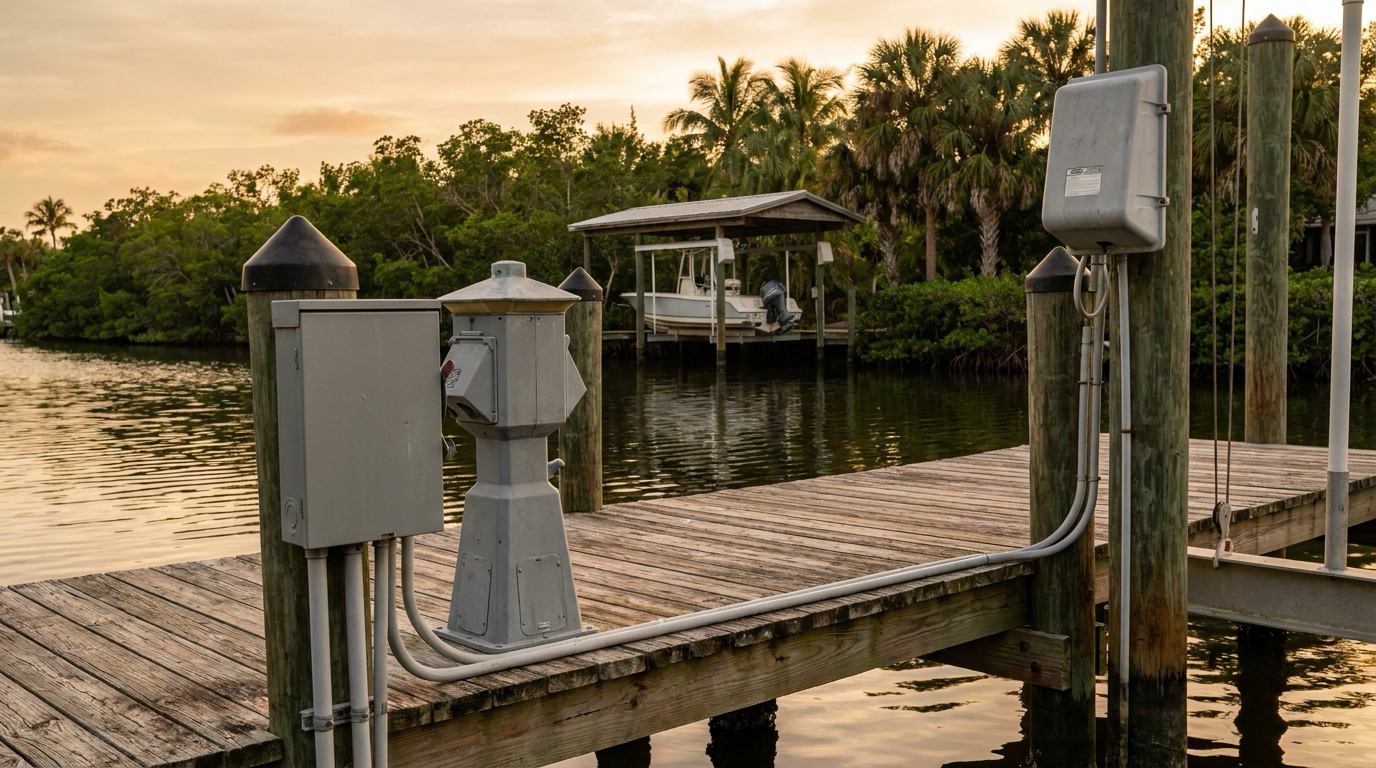
Dock and boat-lift wiring needs a marine-specific electrical review. A fault in a boat, lift motor, shore-power connection, or dock circuit can energize the surrounding water without creating an obvious warning at the surface.
The safe rule is direct: do not swim near powered docks, boats, marinas, or launch ramps. Ground-fault protection, a current detector, or switching off one property’s dock circuit does not guarantee that the water is safe.
Why dock electrical work needs separate planning
NEC Article 555 addresses electrical installations associated with marinas, boatyards, and docking facilities. The requirements applied to a particular residential dock depend on the adopted code, the work being performed, the equipment involved, and the authority with jurisdiction over the property.
That makes the first inspection important. An electrician needs to identify what feeds the dock, which equipment is connected, how the system disconnects, and whether the wiring and protective devices match the installation and exposure. A light, boat lift, receptacle, and shore-power connection do not necessarily have the same electrical needs.
How electricity in the water becomes dangerous
Faulty boat or dock wiring can allow alternating current to enter the water. A person in that water may lose muscle control and become unable to swim to safety.
The Electrical Safety Foundation International advises people not to swim near boats, marinas, or launch ramps. If someone appears to be receiving an electrical shock in the water, do not enter the water. Call 911 and shut off power only if that can be done from a safe location.
Fresh, brackish, and salt water conduct electricity differently, but water type is not a reliable green light for swimming. Other boats, neighboring docks, submerged wiring, and utility-side conditions can introduce hazards outside one property owner’s control.
What ground-fault protection can and cannot do
A GFCI detects an imbalance between current leaving and returning on a circuit and interrupts the circuit when it detects a ground fault. That protection is different from grounding and from ordinary overcurrent protection.
A GFCI receptacle can protect properly connected downstream outlets, so the absence of test and reset buttons on one receptacle does not prove that it lacks upstream protection. A replacement GFCI also does not create an equipment-grounding path where none exists. The CPSC GFCI fact sheet recommends following the manufacturer’s testing instructions and not testing wet or damaged equipment.
Protective devices reduce risk, but they do not make swimming around powered docks safe. The Electric Shock Drowning Prevention Association treats current detectors as warnings, not permission to enter the water.
What 2020 NEC 555.35 requires on a dock
Florida’s adopted electrical code is the 2020 NEC through the Florida Building Code, 8th Edition (2023). On that edition, 2020 NEC 555.35 splits dock ground-fault protection into personnel GFCI and equipment GFPE. Those are not the same device.
For other than floating buildings, 555.35(A)(1) requires receptacles providing shore power, installed under 555.33(A), to have individual GFPE set to open at currents not exceeding 30 milliamperes. 555.35(A)(3) requires feeder and branch-circuit conductors installed on docking facilities to have GFPE set to open at currents not exceeding 100 milliamperes, with coordination at the feeder overcurrent device permitted. 555.35(A)(2) requires all 125-volt, single-phase, 15- and 20-ampere receptacles for other than shore power to be protected as GFCI for personnel. Leviton’s 2020 reprint describes that personnel protection as Class A GFCI in the 4 to 6 milliampere range.
Boat-hoist GFCI is a separate 2020 rule. 2020 NEC 555.9, formerly 210.8(C), requires GFCI protection for personnel on outlets not exceeding 240 volts that supply boat hoists installed at dwelling-unit docking facilities. That hoist rule is not the 30 mA or 100 mA GFPE threshold.
Which of these applies depends on the adopted edition, the authority for the property, and whether the equipment is a hoist outlet, a shore-power receptacle, or a dock feeder. The 2023 NEC later moved boat-hoist GFCI into 555.35(C) and reorganized the feeder and branch-circuit rows, so do not copy 2023 numbering onto a 2020 job.
What an electrician should evaluate
A useful dock inspection follows the actual equipment and wiring rather than relying on the age or location of the property. The review may include:
- The power source, disconnecting method, and circuits serving the dock
- The condition and compatibility of ground-fault and overcurrent protection
- Grounding and bonding paths associated with the installed equipment
- Lift-motor wiring, controls, connections, and manufacturer labeling
- Shore-power equipment and any boats connected to it
- Junction boxes, fittings, receptacles, and enclosures exposed to moisture, spray, or flooding
- Signs of corrosion, water intrusion, heat, damaged insulation, or loose equipment
- Safe access for maintenance and emergency isolation
Salt air, spray, standing water, vibration, and physical movement can all affect electrical equipment. Products and enclosures must be selected for their actual exposure and installed according to their listings and instructions.
Do not open dock electrical equipment, remove covers, or test equipment that is wet or damaged. If there is smoke, arcing, a burning odor, visible damage, or evidence that equipment is energized unexpectedly, stay clear and contact emergency services when appropriate.
Planning a new boat-lift or dock circuit
Before selecting equipment, gather the lift or shore-power model information and identify whether the project uses an existing circuit or needs a new one. The electrician can then evaluate the proposed load, wiring route, available circuit space, service capacity, controls, exposure, and required isolation.
Circuit space and service capacity are separate questions. A panel with no open breaker positions does not automatically need a service upgrade. A subpanel may provide additional circuit spaces, but it does not add electrical service capacity. The actual loads and equipment condition determine whether a panel upgrade belongs in the project.
Access also matters. Wiring routed through a yard, seawall area, finished structure, or moving dock section presents different installation questions. These conditions should be identified before equipment placement is finalized.
Permits and licensing around Tampa Bay
Permit requirements and reviewing authorities depend on the property’s actual jurisdiction and the project scope. Tampa, incorporated municipalities, and unincorporated county areas can use different departments and processes. A mailing address alone may not identify the correct authority.
The selected contractor should confirm whether the work is a repair, equipment replacement, altered circuit, or new installation and determine which permits and inspections apply. Verify that the electrical contractor’s active license category covers the work and the jurisdiction. Florida certified and registered contractors do not have identical geographic authority, and specialty licenses have defined scopes.
Tampa Electrical Pro is a referral service. We connect waterfront property owners with independent licensed and insured electricians. Scheduling, permits, scope, workmanship, and pricing are determined by the selected contractor.
Coordinating related dock work
Dock electrical projects often overlap with other systems, but each part should keep its own purpose. GFCI protection addresses ground-fault shock protection. Landscape and dock lighting needs equipment suited to its exposure. Electrical repair and troubleshooting focuses on a specific fault or symptom rather than assuming the panel is the cause.
For waterfront service near Madeira Beach or elsewhere in Hillsborough, Pinellas, or Pasco County, call Tampa Electrical Pro at (813) 850-0320 to request a referral.
Frequently asked questions
Is it safe to swim near my dock if the power is off?
Do not treat one switch or disconnect as proof that the water is safe. Another dock, boat, submerged cable, or electrical source may still energize the water. Safety organizations advise against swimming near powered docks, boats, marinas, and launch ramps.
How can I tell whether my dock has GFCI protection?
A visible test button is not the only possibility because an upstream device may protect downstream equipment. An electrician can trace the circuit, identify the protective device, confirm how it is connected, and test it according to the manufacturer’s instructions. Do not handle or test wet or damaged equipment.
Why does my boat lift keep tripping?
A trip can result from several conditions, including a fault in the motor, damaged wiring, moisture intrusion, a connection problem, or an issue elsewhere on the circuit. Stop using the equipment and have the circuit inspected. Do not repeatedly reset the device, replace it with a larger breaker, or bypass ground-fault protection.
Can I wire my own boat lift?
Dock and lift wiring combines electricity, water exposure, moving equipment, and jurisdiction-specific requirements. A qualified electrical contractor should evaluate and perform the connection. The applicable authority determines the permit and inspection requirements for the specific property and scope.
Does an older dock have to meet every current requirement?
There is no safe blanket answer based only on age. Existing conditions, previous approvals, equipment replacement, alterations, damage, and new work can affect what the authority requires. An electrician and the applicable permitting office can define the scope without assuming that the whole dock is exempt or must be rebuilt.
What should I do if someone is being shocked in the water?
Do not enter the water. Call 911. Shut off power only if the disconnect can be reached and operated from a safe location. Keep others away until emergency responders or qualified personnel say the area is safe.