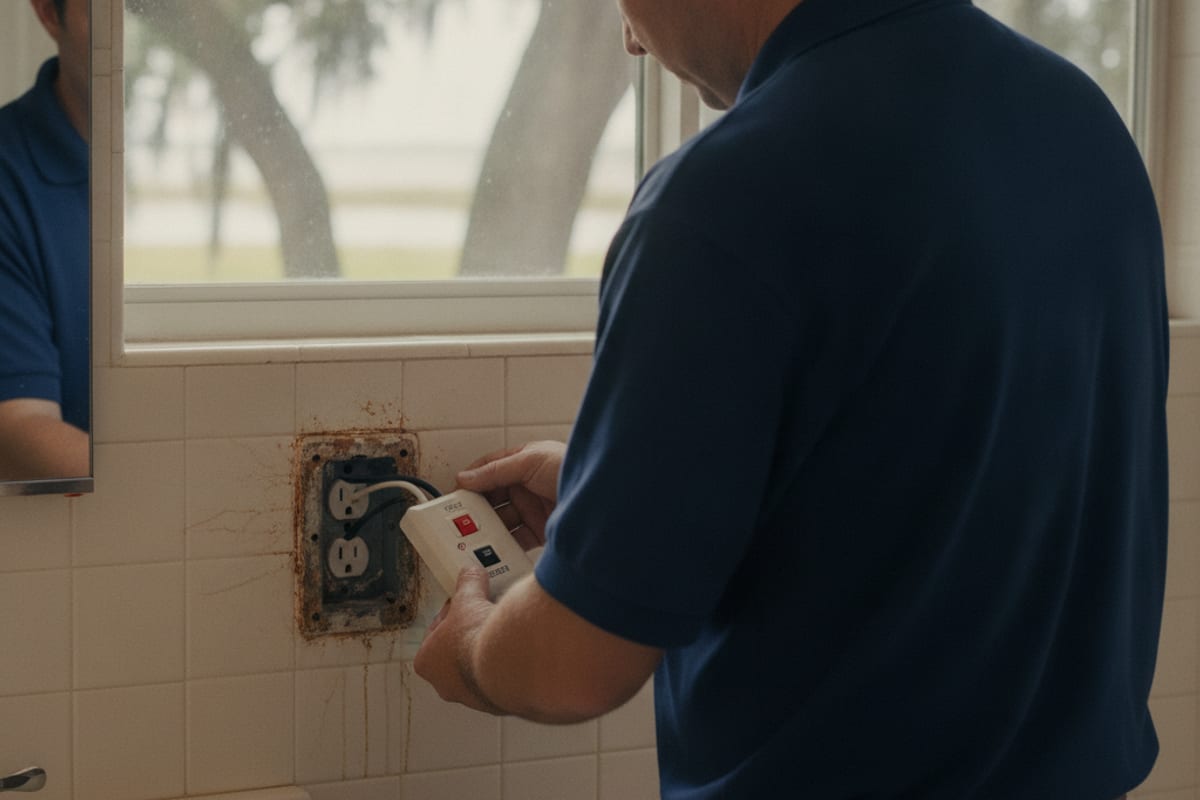
GFCI protection helps reduce the risk of shock when electricity takes an unintended path to ground. If a device in your New Port Richey home keeps tripping, the right next step depends on where the problem occurs, what else is connected to the circuit, and whether water exposure or damaged equipment is present.
A tripped GFCI may be responding to a real fault. It can also indicate a failed device, a problem farther downstream, or equipment that needs inspection. Treat repeated trips as information, not an invitation to keep resetting the circuit.
What a GFCI does
A GFCI monitors the current leaving and returning through a circuit. It disconnects power when it detects an imbalance consistent with current escaping along another path. This is different from ordinary overcurrent protection.
A GFCI receptacle provides ground-fault protection, but it is not a circuit breaker. A GFCI breaker combines ground-fault protection with overcurrent protection for the circuit. The U.S. Consumer Product Safety Commission’s GFCI fact sheet explains these functions and the distinction between GFCI protection and equipment grounding.
Where GFCI protection may be needed
The applicable requirements depend on the project, the receptacle, the location, and the authority responsible for the property. The 2020 NEC text reproduced by Leviton includes covered residential locations such as bathrooms, specified garage and accessory areas, outdoors, crawlspaces, basements, kitchen-counter locations, laundry areas, boathouses, indoor damp or wet locations, and receptacles within the stated proximity of sinks, bathtubs, or showers. Exceptions and separate provisions apply.
That list should not be reduced to a claim that every receptacle in those areas is governed identically. Kitchen-counter coverage, for example, is a distinct condition rather than merely an extension of the sink-distance rule. Pool and dock installations also have separate requirements.
For an existing home, a qualified electrician can identify the circuit, equipment, exposure, and jurisdiction before recommending a repair or update.
Why a GFCI may keep tripping
Repeated tripping can have several causes:
- Water or moisture may have reached a receptacle, enclosure, cord, appliance, or another part of the protected circuit.
- A connected appliance or tool may have a ground fault.
- Wiring or a connection on the protected circuit may be damaged.
- The GFCI device itself may have failed.
- A downstream receptacle or piece of equipment may be protected by a GFCI located somewhere else on the circuit.
The timing of a trip can help narrow the inspection, but it does not prove the cause. A trip during rain may point toward an exposed part of the circuit, yet the receptacle, enclosure, cover, cord, connected equipment, and downstream wiring still need to be evaluated.
Do not test or handle wet, damaged, hot, or discolored electrical equipment. Burning odor, buzzing or crackling, shocks, or repeated trips call for prompt inspection by a qualified electrician. If there is smoke or fire, leave the hazard area and contact emergency services.
Outdoor GFCI repairs
Outdoor electrical equipment must be suited to its actual exposure. A protected porch, an open wall, a pool area, and a dock do not present the same conditions. The receptacle, enclosure, cover, connected cord, and other equipment should be evaluated together.
Visible corrosion, water marks, a loose cover, cracked materials, or a damaged enclosure can expand the repair beyond replacing the GFCI device. The electrician may need to determine whether the affected conductors and connections remain suitable before restoring power.
A cover should not automatically be treated as the complete repair. If a GFCI trips when it rains, the source may be at that box or elsewhere on the protected circuit.
GFCI protection on an ungrounded circuit
GFCI protection and equipment grounding are not the same thing. According to the CPSC, a GFCI can provide shock protection on an existing circuit without an equipment grounding conductor when it is installed and labeled appropriately. The replacement does not create an equipment ground.
That distinction matters in older wiring. Installing a GFCI device may address ground-fault protection, but it does not make grounding-dependent equipment behave as though a grounding conductor were present. The electrician should identify the existing wiring and explain whether the scope is a labeled device replacement, new grounded wiring, or another correction.
GFCI receptacle or GFCI breaker
A GFCI receptacle can protect itself and properly connected receptacles downstream. This means a plain-looking receptacle without TEST and RESET buttons may still have upstream GFCI protection.
A GFCI breaker protects the applicable circuit from the panel and also provides overcurrent protection. The better location depends on the circuit layout, compatibility of the panel and breaker, accessibility of the reset point, and which outlets or equipment should be protected.
Before replacing several devices, ask the electrician to map the circuit and confirm whether protection is already being supplied upstream. That can prevent unnecessary replacements and make future resetting easier to understand.
What changes the installation or repair scope
Useful scope questions include:
- Is this a device replacement or a new receptacle location?
- Is GFCI protection already present upstream?
- Does the existing circuit have an equipment grounding conductor?
- Is the location indoors, damp, wet, or directly exposed to weather?
- Are the enclosure, cover, conductors, and connections in usable condition?
- Does the problem occur with one appliance, several devices, rain, or no connected load?
- Will the work involve one circuit or several areas of the home?
- Does the selected authority require a permit or inspection for the actual scope?
These details affect materials, access, troubleshooting, and labor. Scheduling and pricing are determined by the selected electrician after the scope is established.
Testing an accessible, undamaged GFCI
For an accessible GFCI that is dry and shows no damage, follow the device manufacturer’s TEST and RESET instructions. The CPSC advises routine testing and testing after a power outage. A device that does not trip or reset as instructed should be evaluated.
Do not remove a cover, open a panel, touch exposed wiring, or continue resetting a circuit that trips again. Testing buttons are for the installed device’s normal user test, not for diagnosing damaged or energized wiring.
Frequently asked questions
Does every protected outlet need TEST and RESET buttons?
No. A correctly connected GFCI receptacle can protect downstream outlets. A GFCI breaker can also protect outlets on its circuit. An electrician can trace the circuit and verify the protection rather than judging it by appearance alone.
Can a GFCI work without a ground wire?
A GFCI can provide ground-fault shock protection on an existing ungrounded circuit when installed and labeled appropriately. It does not create an equipment ground, so grounding and GFCI protection should not be treated as interchangeable.
Why does the GFCI trip when it rains?
Rain-related timing suggests checking weather-exposed components, but it does not identify the failed part by itself. The enclosure, cover, receptacle, cords, connected equipment, and downstream wiring may all be relevant.
Is a GFCI breaker better than a GFCI receptacle?
Neither option is automatically better. Circuit layout, panel compatibility, reset access, and the equipment requiring protection determine which arrangement is suitable.
Should I keep resetting a GFCI that trips?
No. Disconnect accessible plug-in equipment if it is safe to do so, and arrange an inspection when the device trips repeatedly or will not reset normally. Do not handle wet or damaged equipment.
Arrange a GFCI inspection in New Port Richey
Tampa Electrical Pro refers New Port Richey customers to independent licensed and insured electricians. The selected electrician determines the diagnosis, scope, permit needs, scheduling, and price.
Call (813) 850-0320 for help with GFCI outlet installation or electrical repairs. Explain where the device is located, what was connected when it tripped, whether the problem repeats, and whether you have noticed water, heat, discoloration, noise, or odor.