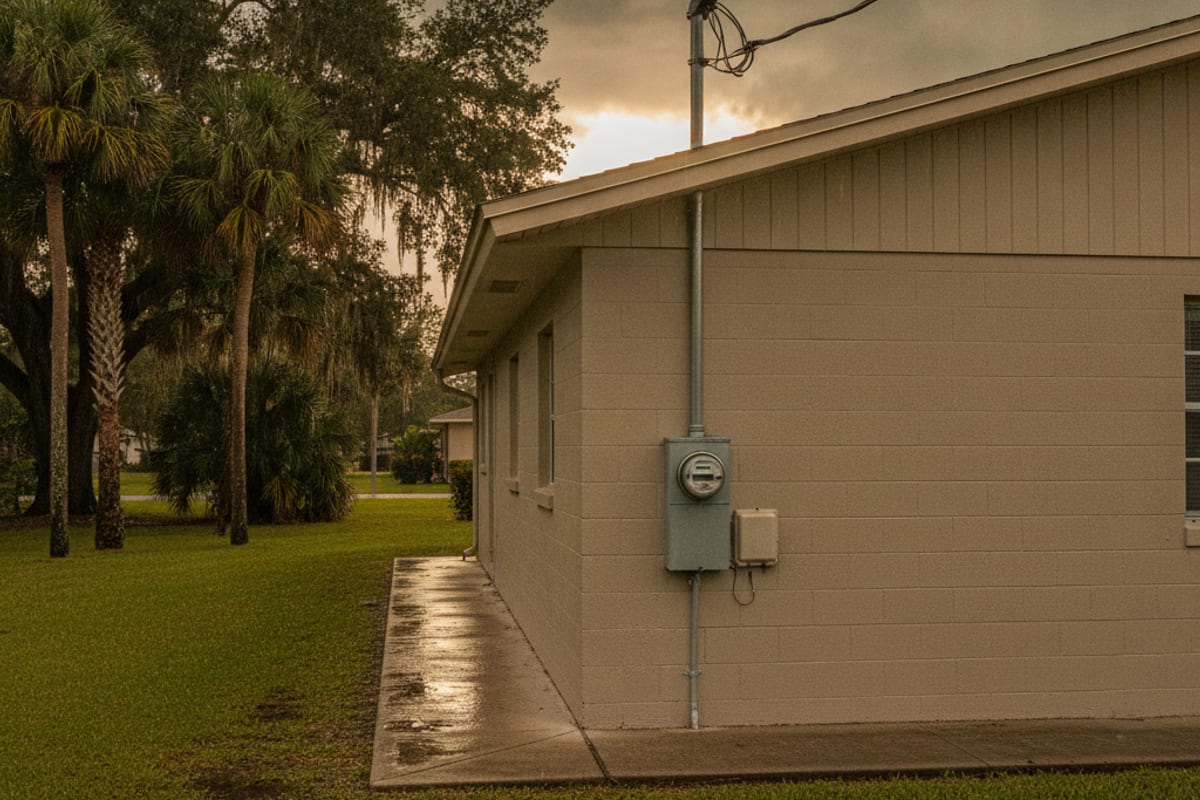
Leave the power off and get the service equipment looked at before anything gets switched back on. That is the short answer, and the reason is that a strike does two different kinds of damage at once. There is the part you can see, like a scorched weatherhead or a breaker that will not reset, and there is the part you cannot, where connections inside the panel and inside appliances took a hit that only shows up weeks later as something that stops working.
The second thing to know is that the repair is split between two parties outside your house, and calling the wrong one costs you days.
Lightning reaches a house three ways
The National Weather Service states it plainly: “There are three main ways lightning enters structures: a direct strike, through wires or pipes that extend outside the structure or through the ground.” That matters because only one of those three leaves a mark on the roof. A strike to a pine two lots over can still put energy into your home through the ground or along the utility line, and the house looks untouched from the curb.
Once the energy is inside, it does not stay in one system. The NWS notes that lightning “can travel through the electrical, phone, plumbing, and radio/television reception systems,” and also through metal wires or bars inside concrete walls and flooring. That is why a strike takes out a thermostat, a garage door opener and a well pump in the same afternoon with nothing in common between them except that they were all connected to something that ran outside.
Distance is not the protection people assume it is. The same NWS indoor lightning page says lightning “generates electric surges that can damage electronic equipment some distance from the actual strike,” and, bluntly, that “typical surge protectors will not protect equipment from a lightning strike.” A power strip is built for the small repetitive surges that ride in off the grid every week. It is not built for this.
The scale is the whole story
A household circuit runs at 120 volts and a general-purpose branch circuit is protected at 15 amps. The NWS puts a typical lightning flash at “about 300 million Volts and about 30,000 Amps.” Those two numbers sit on the same NWS page for comparison, and the gap between them explains the behaviour that confuses homeowners afterward.
Protective devices are sized for faults, not for that. A breaker is designed to open on an overload or a short circuit that develops over milliseconds to seconds in a system running at normal voltage. A lightning transient arrives and leaves faster than any mechanical device can respond to it, which is why a breaker can look perfectly fine and still be sitting on contacts that were degraded by what passed through. The same goes for GFCI and AFCI devices, which depend on sensing electronics that a transient can quietly impair.
So the useful question after a strike is not whether the breakers tripped. It is whether the equipment still protects the way it is supposed to.
Who repairs what, outside your house
This is the part worth reading twice, because it decides who you call first. Tampa Electric publishes the split on its damaged meter equipment page: “Tampa Electric is responsible for any storm-related damage to the electric meter and service line. Customers are responsible for damage to the Weatherhead, riser and meter box.”
The utility defines each part on that same page, and the definitions are worth having in your head before you stand in the side yard pointing at things.
| Part | What it is, in the utility’s words | Who handles storm damage |
|---|---|---|
| Service line | ”Carries electricity from the neighborhood power pole to your home.” | Tampa Electric |
| Weatherhead | ”The rounded pipe on your roof that receives service lines.” | The customer |
| Riser | ”The pipe that contains service lines and connects your Weather head to your meter box.” | The customer |
| Electric meter | ”Continuously records the amount of electricity in use in your home.” | Tampa Electric |
| Meter box | ”Where your meter is mounted and encases the cable connection to your breaker panel.” | The customer |
Tampa Electric’s stated reason for publishing that is so a customer knows “whether to call Tampa Electric or a licensed electrician to make repairs.” On a typical Tampa Bay single-story house all five of those parts live within a few feet of each other on one exterior wall, usually the side yard, which is exactly why people assume one phone call covers the lot. It does not. If the riser is pulled loose from the block wall or the meter box is split, that is an electrician’s job and the utility is waiting on it. The ownership question comes up again any time the service equipment needs work, and who replaces the meter box goes through it in more detail.
That split is scoped to storm damage and to who you call. It does not settle who pays for a meter box that has simply been rusting quietly for fifteen years.
What an electrician actually looks at
The inspection works inward from where the energy came in. At the service point, the weatherhead, riser and meter box get checked for separation, cracking and heat marking, since those carry the full service and sit outdoors. Inside the panel, the work is about connections and components: whether lugs and bus connections took heat, whether breakers still operate and reset properly, whether any GFCI or AFCI device still trips on its test, and whether the panel’s own surge device, if one is fitted, has done its job and indicated end of life.
Then the grounding and bonding system, which is the part most homeowners never think about and the part that most determines where energy goes next time. A grounding electrode conductor that is corroded, undersized or no longer making a solid connection at the rod changes the path, and the path is the whole game with a transient. How ground rods are installed and why the connection matters covers the mechanics of that side.
Branch circuits get walked after that, and the symptom pattern usually tells you where to look first. Dead receptacles with no tripped breaker, a circuit that works intermittently, hardwired equipment that powers up but behaves oddly, smoke alarms chirping on a circuit that fed something that was hit. An outlet that is dead with nothing tripped has a handful of ordinary explanations, and a strike adds one more.
If half the house is out and the rest is fine, that is a different conversation again, and it points at the service or a feeder rather than at any one circuit. The usual causes of losing power to half a house are worth ruling in or out before anyone opens the panel.
When it stops being an inspection and becomes an emergency
Some things after a storm do not wait for a scheduled visit. A burning or acrid smell near the panel or a receptacle, visible scorching, a buzzing or crackling panel, a riser hanging off the wall with conductors exposed, or any water sitting near electrical equipment. In those cases the main gets shut off if it can be done safely and the call goes out the same day rather than the same week. Emergency electrical service exists for exactly that category, and a burning smell in particular is one of the few electrical symptoms that is never worth sleeping on.
Everything else, including the long list of small devices that mysteriously stopped working, belongs with ordinary electrical repair and diagnosis once the house is confirmed safe.
What changes the odds next time
Anyone who has spent a summer here knows this is a recurring problem rather than a one-off, so the question is what is worth doing between storms. Two things actually move the needle, and neither is a power strip.
The first is a surge protective device installed at the service equipment, which intercepts transients arriving on the service conductors before they get distributed through the panel. It is a layered idea rather than a magic box: the device at the panel handles what comes in on the service, and point-of-use protection at sensitive equipment handles what the first layer lets through and what originates inside the house. How the layers work together explains where each type belongs, and panel surge protection is the installation side of it.
The second is the grounding and bonding system being in genuinely good condition, because a surge device can only shunt energy to ground if there is a solid low-resistance path for it to shunt to. A surge device landed on a grounding system that is corroded at the rod is a device working with one hand tied.
Neither of those makes a house lightning proof. The NWS is clear that typical surge protection will not stop a direct strike. What they do is handle the far more common case: the energy that arrives through the service line, the ground or a neighbouring structure, which is most of what damages equipment in a Florida summer.
Frequently asked questions
Should I turn the main breaker off after a strike?
If the house is showing signs of damage, like scorching, a burning smell, a buzzing panel or visible damage at the service equipment, shutting the main off is the right move if you can reach it safely and the panel itself looks and sounds normal to approach. If the panel is the thing that is buzzing, scorched or hot, do not touch it, leave the house and call from outside.
Can lightning damage wiring without leaving any visible sign?
Yes, and that is the normal case rather than the exception. The NWS describes lightning entering through wires and pipes that run outside the structure and through the ground, and generating surges that damage equipment at a distance from the strike. None of those routes necessarily leaves a mark anyone can see from the yard.
Nothing looks wrong and the power came back. Do I still need an electrician?
If the only evidence is a close strike and everything is working, an inspection is a judgement call rather than an emergency. If anything is behaving differently, a breaker that will not reset, dead receptacles, a GFCI that will not hold, appliances misbehaving, or any smell or sound from the panel, that is worth having looked at rather than waiting to see whether it settles down.
My meter box is damaged. Do I call the utility or an electrician?
An electrician. Tampa Electric publishes that customers are responsible for storm damage to the weatherhead, riser and meter box, while the utility handles storm damage to the meter itself and the service line. Repairs on your side generally need to be made before the utility can finish on theirs.
Will a whole-house surge protector stop this from happening again?
Not entirely. The NWS states that typical surge protectors will not protect equipment from a lightning strike, and that applies to a direct hit. A device at the panel is aimed at the much more common path, which is a transient arriving on the service conductors from a strike somewhere nearby, and it works best paired with sound grounding and point-of-use protection at sensitive equipment.
When to call us
Storm damage at the service point, a panel that is scorched, buzzing or will not hold a breaker, and any post-strike inspection of grounding, bonding or surge protection all need a licensed electrician. The same goes for the slower version, where equipment around the house starts failing in the weeks after a close strike and nobody can find a common cause. We match Tampa Bay homeowners with independent licensed and insured electricians who handle this work, and they set the scope and the price after seeing the property.
Call us at (813) 850-0320.