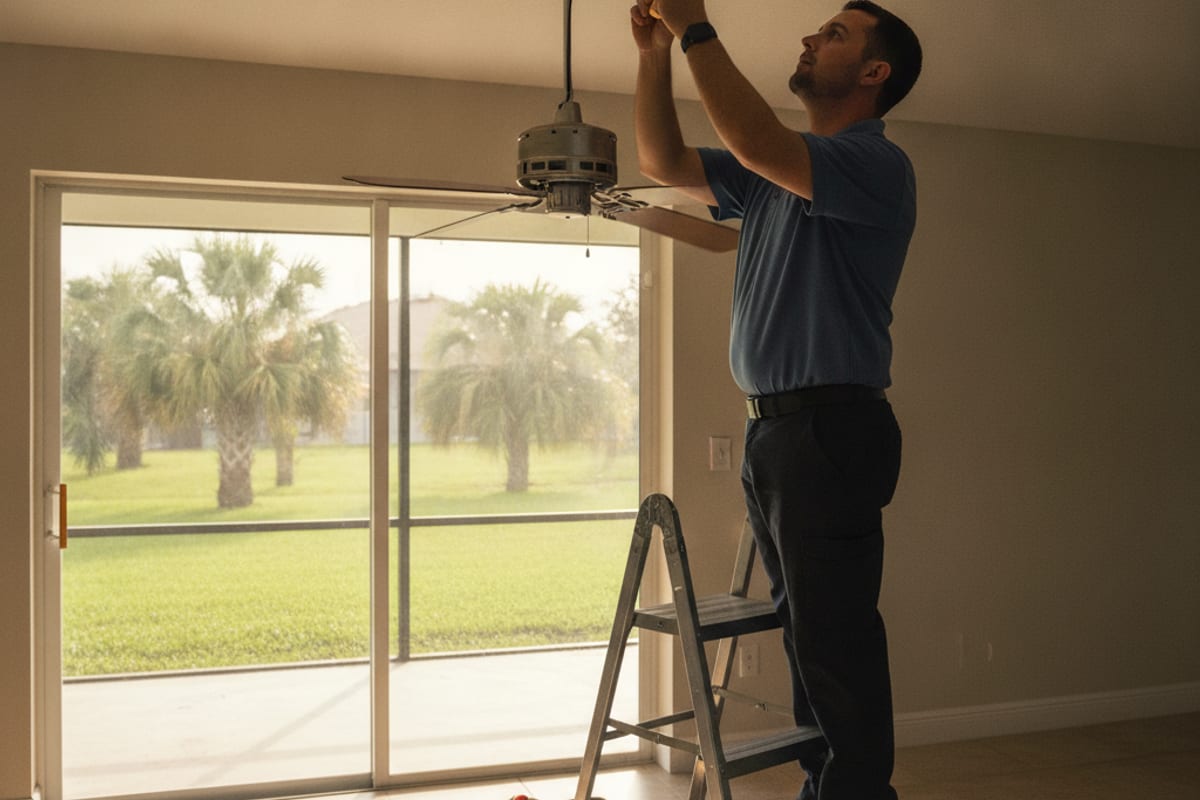
Split the problem before you touch anything. If the light still comes on and the blades sit still, the failure is almost always inside the fan, and the short list is the capacitor, the speed switch and the remote receiver. If nothing comes on at all, the fan itself is usually fine and the supply feeding it is not.
That one split saves most people an afternoon, because the two halves get fixed in completely different places. One is a part inside the motor housing. The other is at the wall switch, in the ceiling box, or back at the panel.
The light tells you which half is broken
The light kit and the motor share one hot conductor coming out of the ceiling, then part ways inside the fan. Pull chains, a wall control or a remote receiver switch them separately from that point on. So the light is not a courtesy feature during a diagnosis, it is a live test of whether power is arriving at all.
Light on, blades still, means power got to the fan and something downstream of that split failed. Nothing on at all means the power never arrived, and you can stop thinking about capacitors and start thinking about the breaker, the switch and the connections overhead.
When the light works and the blades do not
A ceiling fan motor needs a capacitor to turn. The capacitor shifts the phase of the current going to one set of windings, and that offset is what gives the rotor something to push against when it starts and what holds each speed apart from the others. Lose it and the motor still has voltage, just no reason to rotate.
The symptoms are specific enough to name. A fan that hums but will not start, a fan that runs on one speed no matter where the switch sits, and a fan whose speeds come out in the wrong order are all classic capacitor behaviour. That last one is the clearest signal of the three, because nothing else in the fan makes medium slower than low.
The pull-chain switch is the other common failure, and it fails mechanically rather than electrically. The tell is physical. The chain pulls with no click, or it clicks through a position that does nothing, or it came off in your hand. A switch that has been cycled a few thousand times in a Florida living room that runs its fans most of the year is a wear item, not a defect.
Remote-controlled fans add a third candidate: the receiver module tucked up in the canopy above the motor. When a receiver starts to go, the fan answers the remote sometimes and ignores it other times, or the light responds while the motor does not. That intermittence is the signature, and it is worth recognizing before anyone pulls the fan down, because the receiver is a separate part from the motor underneath it.
When nothing comes on at all
Start at the wall, because two switches confuse more people than any part inside the fan does. Plenty of rooms are wired with one switch for the light and one for the motor, and a second switch that somebody flipped months ago will present as a completely dead fan. Flip both.
From there the path runs back through the breaker and into the ceiling box. A tripped breaker is obvious. A loose connection at a wire nut inside the box is not, and it behaves like an intermittent fault that comes back on when someone bumps the fan. If the rest of the room went out with the fan, the problem is the circuit rather than the fixture, and our write-up on an outlet that quit with no tripped breaker walks the same logic. If the breaker keeps going after you reset it, stop resetting it and read why a breaker trips repeatedly instead.
There is one wiring mistake that deserves its own paragraph, because it kills fans quietly. A standard lighting dimmer is not a fan speed control. A dimmer built for a bulb chops the voltage waveform in a way a filament does not mind and a motor does, so a fan on a lighting dimmer hums, runs warm, and loses its control or its motor far earlier than it should. Fan speed controls are a separate device for exactly this reason. If a fan and a dimmer share a wall plate, that is the first thing to sort out.
A fan that hums and will not turn should be switched off
Humming with no rotation means the motor is drawing current and converting essentially all of it to heat instead of movement. Nothing about that gets better with time, and leaving it energized overnight while you decide is the one genuinely bad option. Kill it at the wall, and at the breaker if the wall switch does not clearly cut it.
The same applies to a fan that has started running hot to the touch, or a fan that smells like hot varnish when it has been on for a while. At that point the question stops being which part failed and becomes whether the thing stays on the ceiling, which is a conversation for a licensed electrician rather than a parts search. Electrical repair work on an energized circuit overhead is not a good first project, and a fan that is hot or smelling warm right now belongs with an emergency electrician rather than on a waiting list.
A wobble is usually the box, not the blades
Everyone reaches for blade balancing kits first, and the wobble usually starts higher up. A ceiling fan is a moving load hanging off a box that was often installed to hold a light fixture, and those are not the same job. Hunter’s own support documentation describes a fan-rated box as one “used to house electrical wire connections and properly support heavy fixtures such as your Hunter Fan,” and notes that it is “Typically marked ‘Approved for Ceiling Fans’ or ‘Rated for 75lbs’” and “should be mounted to a ceiling joist, woodblock, or an adjustable brace.”
There is a quick tell for the wrong box that costs nothing to check. The same Hunter article says that if the fan’s ceiling bracket “is too wide for your electrical box, it’s most likely not a ceiling fan rated electrical box.” A bracket that overhangs the box it is bolted to is telling you the support underneath was never meant for this.
Replacing a light box with a fan-rated box means getting at the framing above the ceiling, which is why it shows up as its own line when a fan swap turns into real work. We cover what moves that number in the piece on ceiling fan installation cost in Tampa, and the ceiling fan installation page explains how the match works when a homeowner would rather hand the whole thing off.
Lanai and porch fans come down to the rating
An outdoor fan that has stopped working is worth checking against its own rating before anyone decides the unit was simply bad. Hunter sorts them into three environments and the line between the outdoor two is exposure, not temperature. Its support page states that “Damp rated fans are designed for use in damp locations but not exposed directly to any water,” with covered porches, kitchens, bathrooms and laundry rooms given as the common places, while wet-rated fans “are designed to withstand exposure to water in outdoor locations”.
That distinction decides more than the warranty. A screened lanai in Riverview with the screens on three sides reads as covered until a storm comes across at an angle and puts water on the motor housing. A fan hung off an open frame over a Gulfport patio was never really covered at all. Hunter notes that its damp and wet-rated fans use “rust-resistant stainless steel” hardware and blade materials that hold their shape in the elements, which is a product difference, not a maintenance habit you can substitute for.
So when a porch fan dies, the useful question is whether the fan on the hook was ever listed for where it was hung. If it was not, replacing it with the same thing buys a repeat. Our notes on running fans through a Florida summer and on which direction a fan should turn cover the rest of getting real use out of one.
Repairing it or replacing it
| What you are looking at | Points toward repair | Points toward replacement |
|---|---|---|
| What failed | A capacitor, a pull-chain switch or a remote receiver, all of them discrete parts | The motor itself, or a housing that has lost its finish and its fasteners |
| Parts availability | The model is current and the part is still sold for it | The fan is discontinued and the control module has no equivalent |
| The box above it | Already fan-rated and solidly attached | Not fan-rated, so the ceiling work happens either way |
| Where it hangs | Indoor, and the fan is listed for where it is | Outdoors under exposure the unit was never listed for |
| How it behaves | One clear symptom you can point at | Several unrelated symptoms at once, including heat or odor |
The honest version is that a single named failure on a fan that is still sold usually favours the repair, and anything involving the motor or the box tends to tip the other way once someone is already on a ladder with the canopy down. The electrician who looks at it can tell you which column you are in within a few minutes.
Frequently asked questions
Why does my ceiling fan hum but not spin?
That combination points at the capacitor more often than anything else. The motor is receiving voltage and has no phase offset to start rotating with, so the current goes to heat instead of motion. Switch the fan off rather than leaving it humming, because a stalled motor has no way to shed that heat.
The light works but the fan does not. Is the fan dead?
Not necessarily, and the light working is actually good news. It proves power is reaching the fan, which rules out the breaker, the wall switch and the connections in the ceiling box in one step. What remains is the capacitor, the speed switch or the remote receiver, and all three are parts inside the housing rather than the motor itself.
Can I put my ceiling fan on a regular dimmer?
No. A lighting dimmer shapes the voltage waveform for a bulb, and a fan motor responds to that by humming, running warm and failing early. Fan speed controls are built as a separate device. If a fan is currently on a lighting dimmer, that is worth changing regardless of whether the fan is working today.
What makes a ceiling fan wobble?
A fan is a moving load, and the mount carries it. Hunter describes a fan-rated box as one marked “Approved for Ceiling Fans” or “Rated for 75lbs” and mounted to a joist, a woodblock or an adjustable brace, and says a ceiling bracket too wide for the box is a sign the box is not fan rated. Blade balancing helps a fan that is otherwise solid, and it will not fix a box that was installed for a light fixture.
Does an outdoor fan need to be wet rated?
It depends on whether water actually reaches it. Hunter’s own guidance puts damp-rated fans in covered spots that are not directly exposed to water and wet-rated fans in outdoor locations that take direct water. A screened lanai that takes wind-driven rain is not the same as a deep covered porch, so the listing has to match the spot rather than the label on the patio.
When to call us
Anything past swapping a pull chain on a fan you can safely reach means working on an energized circuit over your head, and a fan that hums, runs hot or smells warm should be switched off and looked at rather than reset. The same goes for a fan hanging on a box that was never rated to carry it, because that is ceiling work, not fixture work. Tampa Electrical Pro matches homeowners across Tampa Bay with licensed and insured electricians who handle fan repairs, replacements and the box behind them. Call us at (813) 850-0320.