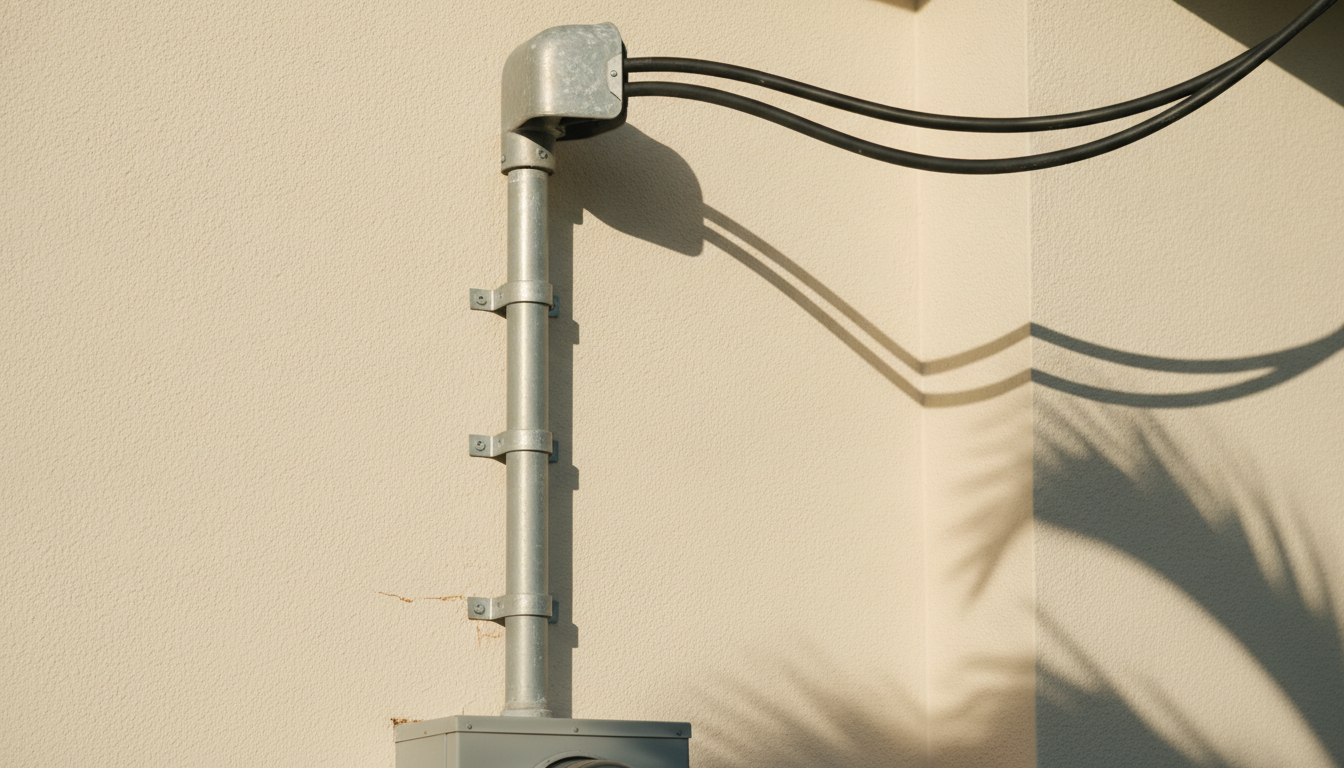
On Tampa Electric service, the customer is responsible for the meter box. Tampa Electric’s Damaged Meter Equipment page assigns storm-related damage to the meter and the service line to the utility, and the weatherhead, riser and meter box to the customer; the retail tariff on file separately requires the customer to replace a deteriorated meter socket or enclosure.
That split is specific to Tampa Electric. A page written for another state’s utility cannot tell you who has to replace a rusted or loose box here.
Duke Energy Florida uses a similar customer-side split
Pinellas and Pasco readers on Duke Energy Florida should not apply Tampa Electric’s tariff as their rule. Duke’s Florida meter and service connection damage page states: “For residential installations in Florida, Duke Energy installs and maintains the overhead service line, underground service line and electric meter.” It continues: “Installation and maintenance of the attachment hardware, weatherhead, riser and meter box are the customer’s responsibility.”
Duke’s own mobile-home exception is on that same page: “Customers living in mobile homes are responsible for the service pole and for the service line that runs from the service pole attachment to the meter. Customers are also responsible for their meter box, as previously explained.”
That is Duke’s published Florida split, not a Tampa Electric tariff sheet.
After a storm, the split is the meter versus the box
Tampa Electric’s Damaged Meter Equipment page is written so a customer knows “whether to call Tampa Electric or a licensed electrician to make repairs.” The split it publishes is scoped to storm-related damage.
It says: “Tampa Electric is responsible for any storm-related damage to the electric meter and service line.”
It also says: “Customers are responsible for damage to the Weatherhead, riser and meter box.”
Those two sentences do not decide a rusted or loose enclosure in fair weather.
The same page names the parts. The service line “Carries electricity from the neighborhood power pole to your home.” The weatherhead is “The rounded pipe on your roof that receives service lines.” Tampa Electric describes the riser as the pipe that contains service lines and connects the weatherhead to the meter box. The meter box is “Where your meter is mounted and encases the cable connection to your breaker panel.”
If a storm left the enclosure displaced, wet or damaged, stay back and report the outage. Unexplained flicker, hot or discolored plates, buzzing, crackling, a burning odor, shocks or frequent trips call for prompt qualified inspection. If there is smoke or fire, leave the hazard area and contact emergency services.
A partial outage that takes out half the house can start on either side of this boundary. Lights out in several rooms do not prove whether the utility supply or the customer-owned equipment failed.
A deteriorated box in fair weather is still the customer’s to replace
The general obligation is in Tampa Electric’s retail tariff, Section 5, Seventh Revised Sheet No. 5.520, effective August 4, 2026.
Paragraph 4.1 General: “The customer must provide a self-contained meter socket or meter enclosure on his premises.”
Paragraph 4.1.1 Security: “All meter sockets and enclosures which become deteriorated shall be replaced by the customer.”
A rusted or loose box still has to be replaced by the customer even when no storm is involved. The storm page answers storm-related damage. Sheet 5.520 answers deteriorated equipment.
That replacement duty is an obligation owed to Tampa Electric. It does not say who is legally permitted to do the work. Florida certified electrical contractors can work statewide. Registered contractors work within their authorized local jurisdictions. Specialty licenses have bounded scope. EC is not the only lawful category for all electrical work. Verify active status, scope and the jurisdiction that actually governs the property.
If permitting is part of the job, confirm the building authority from the property. Largo has its own Building Division. Pinellas County serves unincorporated areas and specified partner cities. Temple Terrace properties use the city authority, not an automatic unincorporated Hillsborough referral.
Tampa Electric designates where the metering equipment goes
Sheet 5.520, paragraph 4.2: “Tampa Electric shall designate the metering equipment location for new installations and for relocation or upgrade of existing metering equipment.” The same sheet says: “Meters for individual residences shall be outdoors on the front or adjacent side walls of the building.”
A replacement is not automatically a like-for-like swap in the same place. The tariff gives Tampa Electric that designation when the work is new, a relocation or an upgrade of existing metering equipment. It does not publish a fee, a form, an approval window or a call sequence, and it does not say that a same-spot enclosure swap triggers a new location designation.
The enclosure type comes from Tampa Electric’s approved list
Sheet 5.520, paragraph 4.1: “The type shall be determined from the Company’s approved list and the location shall be determined by the Company.”
Tenth Revised Sheet No. 5.560, effective February 20, 2012, states: “Self-contained meter socket enclosures are limited to 400 amperes or less.” Above that metering limit, the tariff requires current-transformer metering. That is a limit on self-contained sockets. It is not a panel-sizing recommendation, and it is not a reason to treat every meter-box job as a service-capacity upgrade.
Tampa Electric maintains an approved metering equipment list for self-contained meter socket enclosures and an approved instrument transformer-rated meter sockets list on its website. Sheet 5.560 is a current tariff sheet with a 2012 effective date, which is not a newly written 2026 rule.
Customers cannot connect or disconnect Tampa Electric equipment
Eleventh Revised Sheet No. 5.170, effective October 25, 2002, paragraph 2.15, is why the order of operations is fixed rather than negotiable.
“Meter sockets and customer electric service risers are not to be attached to Tampa Electric poles.”
“Customers are not allowed to make connections to or disconnections from Tampa Electric equipment.”
Connection and disconnection work must be performed by Tampa Electric personnel unless Tampa Electric authorizes otherwise.
The customer provides the enclosure. A licensed electrician can assess and install customer-side equipment. The utility connection is still Tampa Electric’s to make or break unless the company authorizes otherwise.
The ownership line sits at the load-side terminals of the metering equipment
Fourth Revised Sheet No. 5.450, effective March 29, 2001, paragraph 3.5.3, covers the exemplified case where the point of delivery is at a single self-contained meter. In that case, “the ownership line shall be the load side terminals of the metering equipment.”
That is the precise boundary. Upstream of those terminals you are looking at Tampa Electric’s metering equipment and supply. Downstream is customer-owned wiring toward the panel. A dark half of the house does not, by itself, tell you which side of that line failed.
The same exemplified paragraph has the customer install a 200 ampere self-contained meter socket on the outside of the building at a location specified by the Company, and supply and install a rigid metal conduit system from the bottom of the meter socket to Company specifications. That 200 ampere socket is the tariff’s illustrated case for that arrangement. It is not a claim that every Tampa Bay home has, needs or must upgrade to 200 amp service.
If the equipment that actually needs work is the panelboard rather than the meter enclosure, that is a different project. See breaker panel replacement in Tampa when the change is the panel.
Clear space, height, and mounting once the box is up
These figures are Tampa Electric tariff requirements for metering equipment. They are not a Florida Building Code rule.
Eleventh Revised Sheet No. 5.530, effective May 14, 2014:
“A clear space of 48” shall be maintained at all times in front of all meters and metering equipment for reading and testing.”
“A meter socket shall be so located that the center of the meter will be not less than 4’6” nor more than 5’0” above finished grade”
“Meter sockets or enclosures shall have at least three inches clearance in all directions from any adjacent switch or device unless specific approval from the company is obtained before installation.”
“The meter socket or enclosure must be fastened securely to the supporting structure, square and plumb in all directions. Wooden pegs shall not be used for mounting sockets or enclosures.”
Sheet 5.530 is current. Its effective date is 2014. Sheet 5.520 is effective August 4, 2026. Those clearance and mounting rules were not rewritten by the later sheet.
Places Tampa Electric will not put a meter
Sheet 5.520 lists locations where “Meters and main switches will not be placed”: “transformer vaults, attics, coal or other bins, bathrooms, bedrooms, display windows, laundries and other places subject to dampness or possible flooding, or in garages where meters may be subject to vehicle damage.” The same sheet adds “within three (3) feet of doors”, “within five (5) feet of fuel tanks” and “within three (3) feet of natural gas meters and regulator vents.”
That is Tampa Electric’s own tariff list, not a code citation.
The tariff does not address grandfathering. An existing meter that already sits in one of those places is not, by itself, evidence of a violation, a hazard or a required relocation. If the work is a relocation or an upgrade of existing metering equipment, Tampa Electric designates the location. That is a different question from treating the current spot as automatically unlawful.
The seal is why the can stays closed
Sheet 5.520, paragraph 4.1.1: seals “shall not be broken or tampered with except in cases of emergency or with permission of the Company.”
The enclosure is customer-provided. The meter inside it remains Tampa Electric equipment. The seal is how that boundary is marked. A homeowner does not get to open the can to inspect the interior, and turning the main breaker off does not create permission. The emergency exception is not a DIY repair method. If the equipment is damaged or wet, stay away from it.
Remote disconnect is a smart-meter capability, not a box-replacement method
Tampa Electric’s About Your Meter page lists “Remote service capabilities” among smart-meter benefits. Those capabilities “help support many service connection and disconnection requests without requiring an on-site visit.”
That is the published capability, and it is the end of the claim.
It does not mean a meter-box replacement is handled remotely, that no field visit occurs, that power is restored on any schedule, or that a homeowner can request a remote disconnect so construction can start. Many connection and disconnection requests can be supported without an on-site visit. A box replacement is not thereby one of those requests.
Frequently asked questions
Who pays to replace a deteriorated meter box?
The tariff places the replacement obligation on the customer when the socket or enclosure has become deteriorated. After storm-related damage, Tampa Electric is responsible for the meter and the service line, and the customer is responsible for the weatherhead, riser and meter box. Those two sources answer who is obliged to provide which part.
Can I replace the meter box myself?
You cannot break or tamper with the seal except in an emergency or with Tampa Electric’s permission, and you cannot make connections to or disconnections from Tampa Electric equipment. Meter sockets and customer risers may not be attached to Tampa Electric poles. Providing the enclosure is the customer’s duty. The work that touches Tampa Electric’s connection is Tampa Electric’s unless the company authorizes otherwise.
Does Tampa Electric have to pull the meter?
Customers are not allowed to make connections to or disconnections from Tampa Electric equipment. That work is performed by Tampa Electric personnel unless Tampa Electric authorizes otherwise.
Can I move the meter when the box is replaced?
Tampa Electric designates the location for new installations and for relocation or upgrade of existing metering equipment. A replacement is not automatically a same-spot swap.
Why does the electrician need Tampa Electric involved?
The enclosure, the meter and the utility connection are not the same object. The customer provides the box. Tampa Electric supplies the meter, designates location when the tariff says it does, and performs connections and disconnections unless it authorizes otherwise. An electrician assessing electrical repair on the customer side still cannot treat Tampa Electric’s connection as something to break.
What if a storm knocked the meter box loose?
Tampa Electric is responsible for storm-related damage to the electric meter and the service line. Customers are responsible for damage to the weatherhead, riser and meter box. Report the outage to Tampa Electric. Stay away from displaced, wet or damaged equipment. If there is smoke or fire, leave and contact emergency services. If a later inspection is looking at service-equipment condition rather than storm damage, the electrical section of a Tampa Bay 4-point inspection records panel and wiring facts. It does not rewrite the tariff.
If the box is deteriorated, loose or storm-damaged on the customer side, have a licensed electrician assess the customer-owned equipment. Call (813) 850-0320 to request a referral. Tampa Electrical Pro refers homeowners to independent licensed and insured electricians serving Tampa Bay. The selected contractor sets scheduling, scope, permits, workmanship and price after seeing the actual arrangement.
If the evaluation turns from the meter enclosure to the panel or to service capacity, start from panel upgrade rather than treating those as the same job.