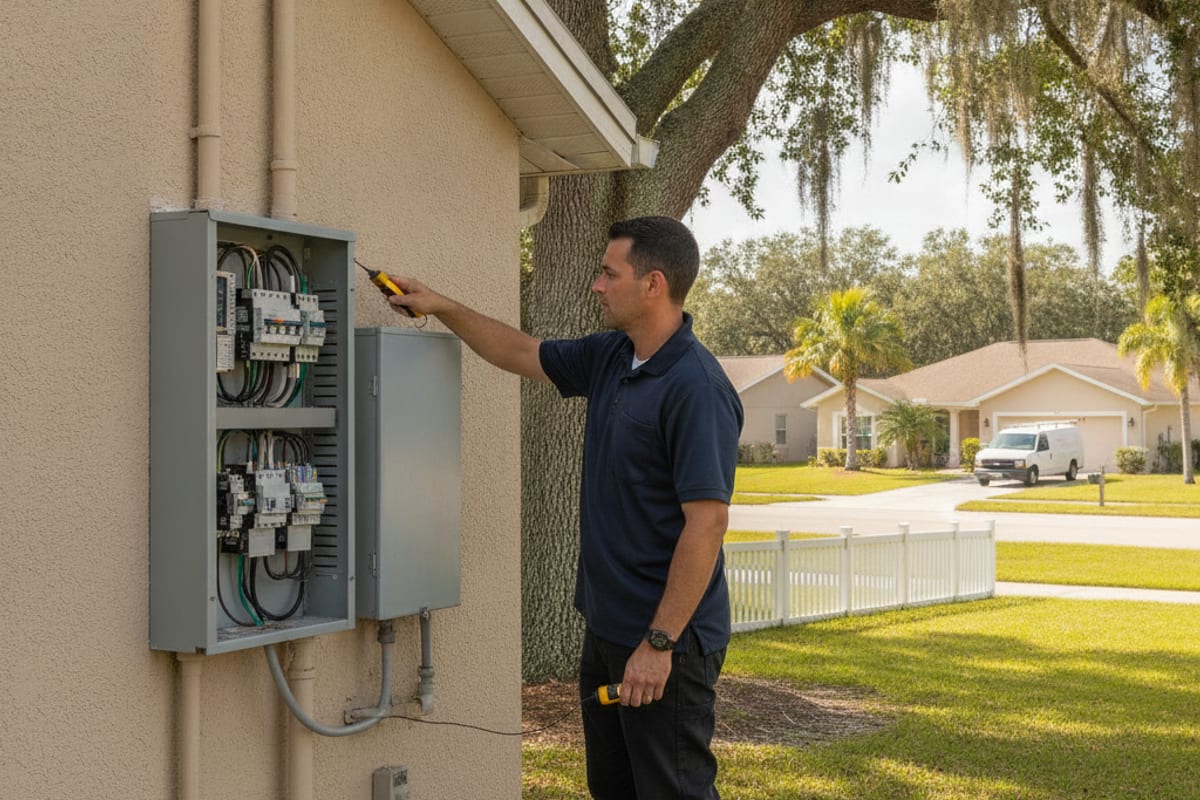
Electrical work in Riverview can range from tracing a failed circuit to planning a panel change, EV charger, generator, or outdoor installation. The right approach depends on the observed condition, the equipment being added, the property’s electrical capacity, and the authority that has jurisdiction over the address.
Tampa Electrical Pro refers Riverview customers to independent licensed and insured electricians. The selected contractor evaluates the work, confirms permitting and inspection requirements, and provides the project scope, schedule, and price.
Central Florida heat and humidity demand preventive inspection
Riverview’s inland heat and humidity create predictable wear patterns on electrical equipment. Moisture accumulation inside panels, corrosion at terminal connections, and deteriorating insulation aren’t unique to Riverview, but the climate accelerates them. An exterior panel that looks fine from a distance may have internal corrosion or water intrusion that needs investigation.
An electrician inspecting your electrical equipment may look for moisture marks, corroded terminals, loose connections, discolored bus bars, and equipment that no longer suits its environment. Don’t remove a panel cover or reach inside wet, damaged, or energized equipment to investigate it yourself.
For outdoor fans, lights, and fixtures, the equipment rating matters. Damp-rated devices are intended for protected locations without direct water exposure. Wet-rated equipment is designed for full outdoor exposure. A screened lanai isn’t automatically protected from wind-driven rain, so the electrician should compare the actual location with the product listing and installation instructions.
Electrical warning signs need the right response
A dead receptacle can have several causes, including a tripped protective device, a failed device, or a fault elsewhere on the circuit. A plain outlet without test and reset buttons may also be protected by an upstream GFCI. That means looking at one receptacle doesn’t tell you the whole story.
Unexplained flickering or dimming, repeated breaker trips, buzzing or crackling, shocks, burning odors, and hot or discolored outlet plates call for prompt inspection by a qualified electrician. Widespread flicker can’t safely be declared a panel problem, a utility problem, or a harmless appliance effect without testing.
Don’t repeatedly reset a breaker that trips again, and don’t open electrical equipment to search for the cause. If there’s smoke or fire, leave the hazard area and contact emergency services.
Panel work starts with capacity, not appearances
A crowded panel and an overloaded electrical service are different problems. A panel can run out of circuit spaces while the service still has capacity. It can also have open spaces while the calculated load or equipment condition makes a proposed addition unsuitable.
A subpanel can create circuit space, but it doesn’t add utility service capacity. Likewise, replacing equipment isn’t automatically the same as increasing service capacity. Before adding a large new circuit, the electrician evaluates the existing service, panel condition, actual loads, equipment specifications, and the route for new wiring.
An EV charger installation illustrates why that distinction matters. Level 1 charging may cover daily driving for some drivers when suitable dedicated power and enough parked time are available. Level 2 charging uses 240 volts. The vehicle, daily driving needs, available charging time, equipment requirements, and electrical capacity determine the appropriate setup. App controls and charging schedules don’t by themselves prove that a charger manages the home’s service load.
Generator planning is a separate electrical decision
A standby generator supplies backup power during an outage. It doesn’t add a new utility load merely because it’s connected to the property. The electrical planning centers on transfer isolation, the loads selected for backup, equipment requirements, fuel, exhaust, and the condition of the existing system.
A fixed whole-home generator is professionally installed with equipment that isolates it from the utility. A portable generator may power individual appliances through properly rated outdoor cords, but it must not be connected directly to house wiring without suitable transfer equipment. Turning off the main breaker isn’t sufficient backfeed protection.
Fuel-burning generators create carbon monoxide, fire, and electrical hazards. Portable units belong outdoors, far from the home and away from openings. Fixed standby clearances come from the listed equipment instructions and the applicable local review, not from a generic portable-generator rule.
Permitting follows the property jurisdiction
A Riverview address in Hillsborough County doesn’t make the county the permitting authority for every property. Some areas fall under the City of Riverview’s building department, while others remain under unincorporated Hillsborough County. The Hillsborough County building and development services helps identify the appropriate department.
Whether a particular repair or installation needs a permit depends on the work and the authority with jurisdiction. Ask the selected contractor to identify that authority, describe the permitted scope when applicable, and explain who will coordinate inspections. Avoid blanket promises that every task is exempt or that every device replacement requires the same process.
How to evaluate an electrician
Florida uses more than one lawful electrical contractor category. Certified electrical contractors can work statewide, registered contractors work within their authorized local jurisdictions, and specialty licenses have limited scopes. EC isn’t the only possible lawful category for every type of electrical work.
Verify the contracting business’s active status, license scope, and authority for the location through the Florida electrical contractor resources. Don’t assume every person arriving at the property individually holds the contractor license.
Before approving work, ask for a written proposal that identifies:
- The problem or installation being evaluated
- Existing equipment that will remain or be replaced
- New circuits, wiring routes, access, and restoration included in the scope
- Equipment supplied by the customer or contractor
- Permit and inspection responsibilities, when applicable
- Price, payment terms, scheduling, and warranty terms offered by that contractor
- How changes discovered after work begins will be approved
These details are more useful than a generic price range because panel condition, access, routing, equipment, and the actual repair can change the job substantially.
Questions Riverview homeowners often ask
How much does electrical work cost in Riverview?
There isn’t one supported Riverview price for electrical repair or panel work. A receptacle replacement, hidden wiring fault, new circuit, and service-capacity change involve different labor, materials, access, equipment, and permitting. Compare written proposals against the same defined scope rather than comparing verbal totals that may include different work.
How long will the work take?
Timing depends on diagnosis, access, material availability, utility coordination, permitting, inspection, and whether additional defects are found. The selected contractor should give a schedule for the observed scope and update it if that scope changes.
Does a new receptacle require a permit?
The answer depends on whether the work is a device replacement, an extension, or a new circuit, as well as the rules of the authority serving the property. Have the contractor identify the correct jurisdiction and confirm the requirement for the specific work.
What does GFCI protection do?
GFCI protection reduces shock risk by interrupting power during a ground-fault condition. It can be provided at different points on a circuit, so a receptacle without test and reset buttons may still have upstream protection. GFCI, AFCI, and overcurrent protection perform different jobs and aren’t interchangeable.
What if the home has aluminum wiring?
First determine whether the aluminum is branch-circuit wiring, a feeder, or a service conductor. Those aren’t the same condition. Aluminum branch-circuit remediation requires an inventory of the affected connections. The CPSC guidance discusses copper rewiring and approved connector repair methods, including COPALUM and AlumiConn under specified conditions. The appropriate method depends on the actual wire, connections, and equipment.
What information should I collect before calling?
Note which rooms and devices are affected, whether the symptom is constant or intermittent, what was running when it occurred, and any recent equipment changes. For an installation, record the equipment model, proposed location, indoor or outdoor exposure, and whether an existing circuit is present. Don’t remove covers or approach damaged or wet electrical equipment to gather details.
Get connected with a Riverview electrician
For electrical help in Riverview, call Tampa Electrical Pro at (813) 850-0320. We’ll connect you with an independent licensed and insured electrician who can inspect the property and define the appropriate scope. The selected contractor determines scheduling, permits, workmanship terms, and pricing.