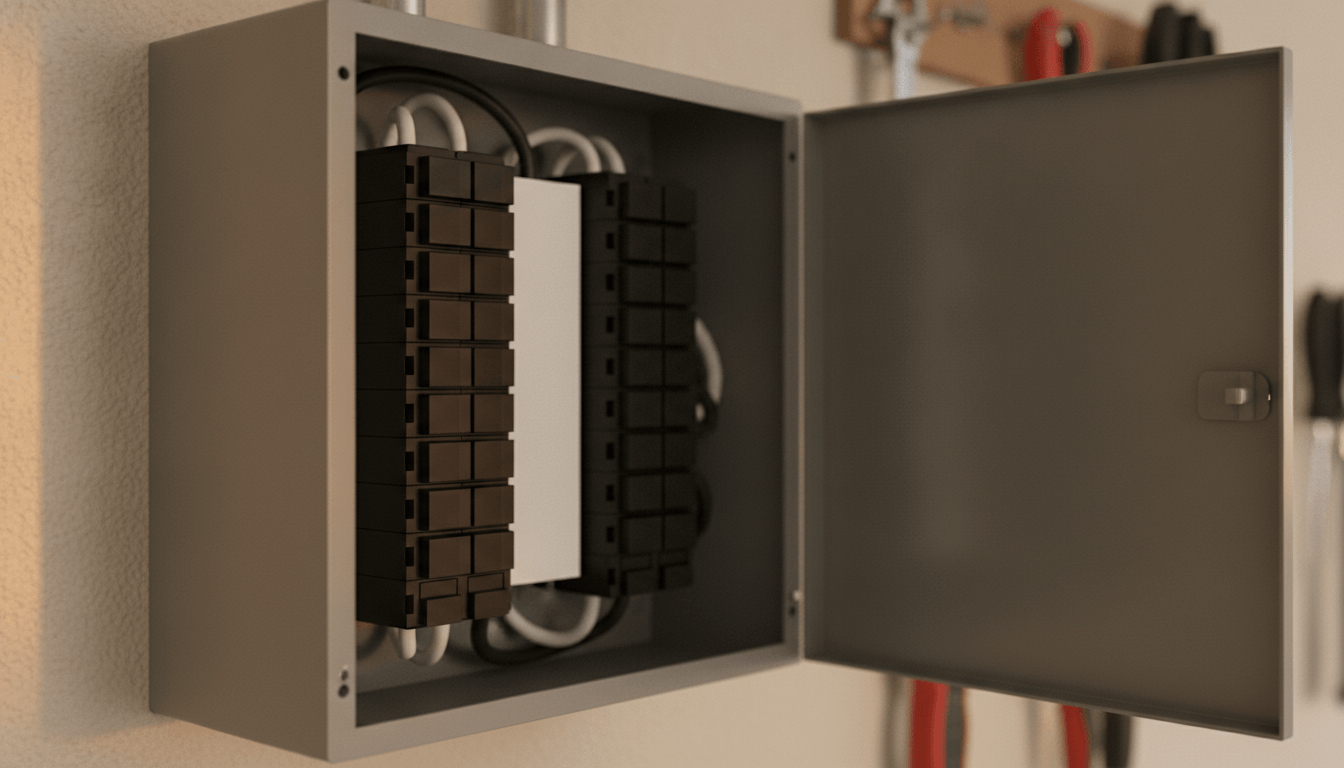
A double tapped breaker has two branch-circuit conductors secured beneath one breaker terminal. That arrangement isn’t automatically allowed or automatically defective. The breaker’s own listing and labeling decide whether the terminal accepts both conductors. In Florida, that detail can also affect a home insurance inspection.
What is a double tapped breaker?
A double tapped breaker has two conductors sharing one breaker terminal. Home inspectors may also call it a double tap or double lug.
The key detail is where those conductors meet. Two of them landed together under one terminal screw is the arrangement inspectors flag. One conductor on the breaker isn’t, whatever happens to that circuit further back in the panel.
A double tap can appear during an inspection even when everything seems normal. The breaker doesn’t need to be tripping when the inspector opens the panel. That makes it different from a breaker that keeps tripping, which announces a separate problem through repeated operation.
Counting the wires doesn’t settle it, though, and that’s where most of the advice online stops. What matters is what that specific terminal is approved to hold.
So both of the confident answers you’ll read are wrong. Every double tap is a violation, no. Every double tap is harmless, also no.
What decides whether a double tapped breaker is allowed?
The breaker’s own listing and labeling decide whether two conductors may share its terminal. An electrician reads that information on the installed equipment. The answer doesn’t come from appearance alone.
Miami-Dade County’s issued electrical inspection guidelines describe the first part of that review:
“Examination of equipment for safety verify that installations have been made in accordance with the instructions included in listing and labeling of materials and. NEC 90.7, 110.3 (B)”
The same guidelines tell residential inspectors what to examine inside the panel:
“Check overcurrent devices for compatibility with protection of conductors (terminals, ratings and ampacities). NEC 240.4, 110.14, 310.15”
Read those two lines together, because that’s the whole answer. A Florida building department tells its inspectors to check the installation against the instructions in the equipment’s own listing and labeling. It tells them, at the residential final, to check the overcurrent devices against the conductors at their terminals.
So the question of whether two conductors may share one breaker terminal is settled by that breaker’s own listing and labeling, not by a blanket rule. That’s why an inspector reads the label instead of failing every panel with a double tap in it. It’s also why nobody can answer this from a photo of your panel.
That cuts both ways, and it’s worth being blunt about it. The label might turn out to permit what you’ve got. It might not. Either way the answer is printed on the equipment already in your house, and somebody has to open the panel and read it.
Why does a double tap matter during a Florida insurance inspection?
Most Tampa Bay homeowners first hear the term from an insurance inspector, not from an electrician. That’s because the current Citizens Property Insurance 4-point form puts “Double taps” on its Hazards Present grid, one line over from “Improper breaker size”.
The current form is Sample Form Insp4pt 03 25, the March 2025 edition. It gives writing agents this instruction:
“Agents may not submit applications for properties with electrical, heating or plumbing systems not in good working order or with existing hazards/deficiencies.”
The same form sets the bar it’s measuring against: “Acceptable Condition means that each system is working as intended and there are no visible hazards or deficiencies.” And it limits who can sign what, in its own words: “A trade-specific, licensed professional may sign off only on the inspection form section for their trade. (e.g., an electrician may sign off only on the electrical section of the form.)”
Here’s the part that catches people, and it’s the reason the code nuance above won’t rescue you. The label decides whether your terminal legally holds two conductors. The Citizens form never asks that question. It’s a checkbox.
So if you’ve got a 4-point file open, the useful move isn’t arguing the code. It’s getting the label read, and correcting the termination before the form goes in if it isn’t listed for both wires.
Our guide to 4-point inspection electrical requirements in Tampa walks the rest of the Citizens form, and the electrical inspection cost guide covers what the inspection itself runs.
What an underwriter does after that isn’t something anyone can promise you. What you can control is narrower: identify the equipment, document what it’s approved to hold, and fix the terminations that don’t match.
What does correcting a double tap cost?
There’s no flat rate for this, and any electrician quoting one over the phone hasn’t seen your panel. What the correction costs tracks the panel, not the defect: the terminal, the space you’ve actually got, and whether the equipment supports a compatible arrangement at all.
What Tampa Electrical Pro does publish are the service ranges the work falls into:
| Possible scope | Published price |
|---|---|
| Service call or diagnostic, usually credited toward repair | $75 to $150 |
| Electrical repair including the diagnostic visit | $150 to $450 |
| Standard 100-amp to 200-amp panel upgrade | $2,500 to $4,500 |
| Electrical permit fee in Hillsborough and Pinellas | $75 to $150 |
Which band you land in gets decided at the panel, with the cover off.
Most of the time this stays inside ordinary electrical repair, because the panel already supports a compatible termination and the pros we send just have to move a wire onto one.
It changes when the panel doesn’t. Then the conversation turns into added capacity or replacement equipment, and that’s where sub-panel installation or a bigger project comes up.
Be careful with that step, though. A sub-panel isn’t an automatic answer to a double tap, and neither is swapping in a different style of breaker. The panel’s own listing and labeling still set what’s available.
The expensive branch is replacing the panel outright, at $2,500 to $4,500 for a standard 100-amp to 200-amp job. Our electrical panel upgrade cost guide breaks that project down, and the panel upgrade service page covers what’s involved.
Worth separating from all of this: if what actually failed the inspection was a receptacle rather than a panel terminal, that’s GFCI outlet installation work, priced and scoped on its own.
When does a double tap become a larger panel project?
It turns into a larger project when the panel can’t support a compatible correction, and the electrician has to work inside what that panel is actually approved to do.
Empty space isn’t the same as available space. A position that looks open doesn’t prove the arrangement you’d put in it is permitted, which is why the label gets read before anything gets quoted.
There’s a second reason a double tap can widen a job. Those same Florida inspection guidelines send the inspector through terminal ratings, ampacities, conductor protection and device compatibility, so a panel that produced one flag often produces a second.
None of that means one note on an inspection report equals a new panel. The pros we send start by asking whether it’s an ordinary repair. A panel upgrade only enters the conversation when the existing equipment can’t hold the arrangement the correction needs.
Here’s how that decision actually runs:
| Inspection finding | Practical next step |
|---|---|
| Terminal is listed for the installed conductors | Document the label and panel condition |
| Terminal isn’t listed for both conductors | Correct the incompatible termination |
| Existing panel supports a compatible arrangement | Keep the scope within the existing equipment |
| Existing panel can’t support the needed arrangement | Compare repair, sub-panel, and panel upgrade scopes |
A photo of the panel is a fine way to start the conversation. It just doesn’t finish it, because the label is what decides.
Does Hillsborough County require a permit for the correction?
Hillsborough County’s published exempt-work list doesn’t cover branch-circuit work inside an electrical panel. Its only electrical item under “No permit required” is:
“Low-voltage systems: The installation or repair of a low-voltage system in an existing single-family residence when the work is performed by the property owner or the work is performed by a non-owner, provided the total cost of labor and materials does not exceed $5,000”
A breaker terminal and the branch-circuit conductors on it aren’t a low-voltage system, so that exemption doesn’t reach this work.
The county also spells out what disqualifies its newer residential exemption, and one of the conditions is: “The work includes electrical, plumbing, structural, mechanical or gas work”. Panel work is electrical work.
Put those two together and Hillsborough’s own exempt list carries nothing that covers a termination correction inside a panel. The electrician doing the work confirms the permit scope.
Published electrical permit fees run $75 to $150 in Hillsborough and Pinellas, and that’s the permit line by itself, not the repair.
One last thing worth keeping straight: the permit and the insurance form are two different tracks. A clean permit record doesn’t tell you what an underwriter will do, and a checked box on a 4-point form doesn’t tell you what the equipment label says.
What should Tampa Bay homeowners do next?
Get the terminal and the label looked at first. Don’t authorize a panel replacement off two words on an inspection report.
Ask for plain answers to three things:
- Are two conductors actually landed under one breaker terminal?
- Is that terminal listed for both of them?
- Does the fix work inside what this panel is approved to do?
If you’ve got an open 4-point file, hand over its electrical page. It tells the electrician exactly what has to be documented before the form goes back in.
Tampa Electrical Pro matches homeowners with licensed electricians across Hillsborough, Pinellas, and Pasco counties. Call (813) 850-0320 to request help with a panel inspection or correction. North Pinellas homeowners can also visit the Palm Harbor electrician service page.
Frequently asked questions
Is a double tapped breaker always a violation?
No. The breaker’s own listing and labeling decide whether its terminal accepts two conductors. An electrician must read the installed equipment instead of applying a blanket rule.
Can a double tap affect a Citizens 4-point inspection?
Yes, it can appear on the form as a visible hazard entry. Citizens’ current Insp4pt 03 25 form lists “Double taps” under Hazards Present. The form doesn’t ask whether the breaker was listed for two conductors.
How can an electrician tell whether the double tap is allowed?
The electrician checks the breaker’s listing and labeling. Miami-Dade’s inspection guidelines pair that review with conductor and terminal compatibility checks at the residential final.
How much does correcting a double tapped breaker cost?
The site’s electrical repair range is $150 to $450, including diagnosis. A service call or diagnostic runs $75 to $150 and is usually credited toward repair. Neither figure is a dedicated double-tap price.
Does a double tap mean the entire panel needs replacement?
No. One double tap doesn’t automatically require a panel upgrade. Replacement becomes a separate option when the existing panel can’t support a compatible correction.
Is a double tapped neutral the same problem?
No. A double tapped breaker concerns conductors sharing a breaker terminal. A double tapped neutral concerns conductors sharing a neutral terminal, so it requires a separate evaluation.