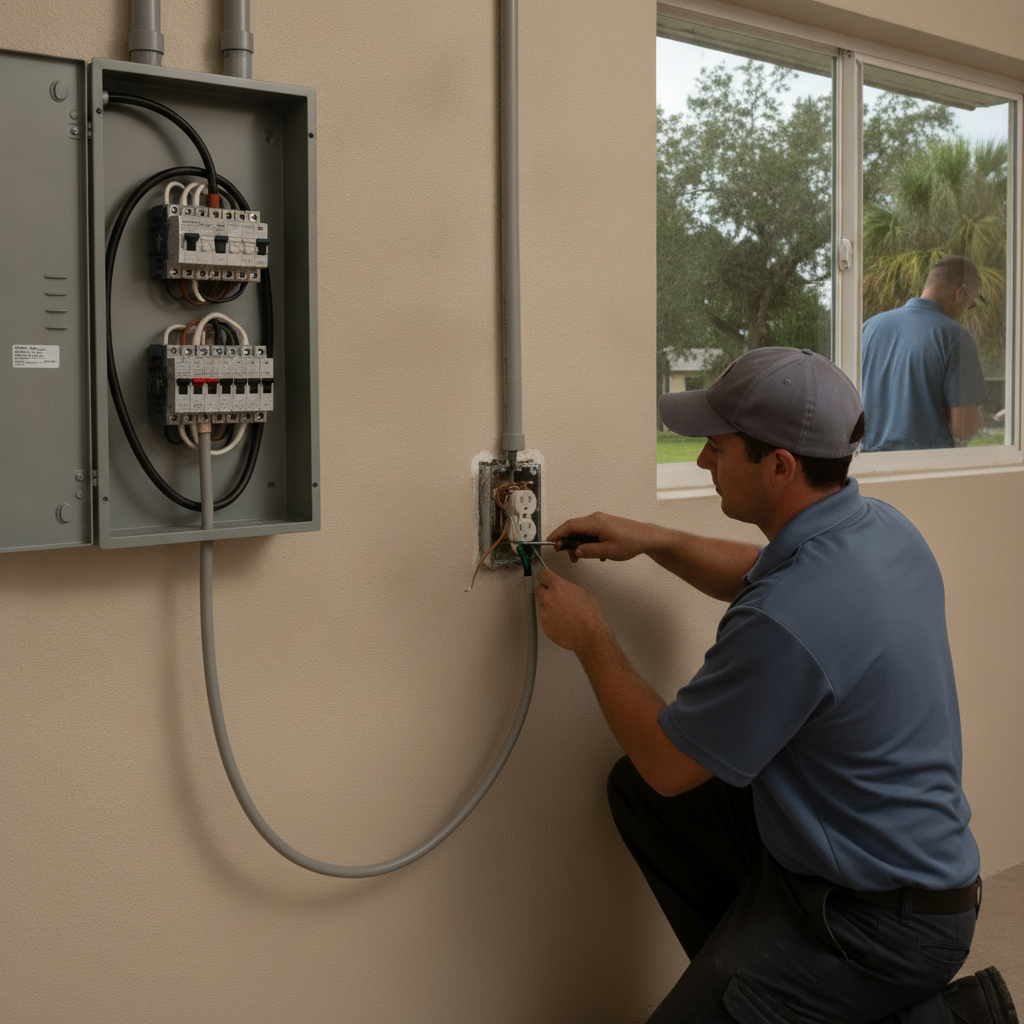
A two-slot receptacle is the plain clue that the box behind it has no equipment ground. The lamp still lights. The phone still charges. What is missing is a dedicated path that can carry fault current away from a metal case and back to the panel if a hot conductor comes loose inside a tool or an appliance.
That round third hole on a modern receptacle is not a style choice. It is the equipment-grounding connection. If someone swapped in a three-hole device without landing a ground, the outlet looks current and still is not grounded. That is the version that fools a renter, a buyer, and a plug-in surge strip.
How to tell a receptacle has no equipment ground
Two vertical slots and no round hole mean the device was built for a two-wire circuit: hot and neutral, nothing else. The circuit can still work. Ground is a safety conductor, not a working conductor. Plenty of lamps and phone chargers only have two prongs and never use that third pin.
Three holes do not settle it. In a Hyde Park plaster wall, a newer decorator receptacle can sit on cable that never had a grounding conductor. The third hole is empty air. A plug-in tester an electrician carries will show an open ground on that face. You should not pull the cover or probe inside the box. Tampa Electric’s home safety page is blunt: if plugs fit loosely, the wall outlet needs repair, and unless you are a qualified electrician you should not try to repair electrical products yourself.
A metal yoke and a metal box are not automatic proof either. Some metal boxes are fed by cable with no grounding conductor and no metallic raceway that can serve as one. Some plastic boxes have a ground wire that was never landed. The electrician has to identify the actual path, if any exists, from that yoke back to the grounding bus in the panel. Visual guessing from the neighborhood or the year on the tax roll does not do that job. For a wider look at what a dead or odd receptacle can mean, see how to tell if an electrical outlet is the problem.
What an ungrounded outlet does in a fault is simple. Current wants a return to the source. On a healthy two-wire circuit that return is the neutral, through the load. If a hot conductor shorts to the metal housing of a refrigerator, a window unit, or a shop tool, there is no equipment ground to dump that fault and trip a standard breaker. The housing can sit energized until someone touches it. A GFCI can still open on the imbalance. A plain breaker may not.
Cheater adapters, three-to-two taps, and a ground pin snapped off a cord do not create that path. They let a three-prong plug physically enter a two-slot face. The equipment ground is still missing. A three-prong extension cord plugged into an ungrounded receptacle is the same trick in a longer jacket.
Unexplained heat at a plate, buzzing, a burning odor, or a shock from a device is not a wait-and-see item. Those signs call for a qualified look, not another adapter. If there is smoke or fire, leave the area and contact emergency services.
GFCI labels vs actually grounding the box
A GFCI does not add a ground. It watches current leaving on the hot and coming back on the neutral. If those two do not match, it opens. That is why a GFCI can protect you at a receptacle that has no equipment ground at all. The U.S. Consumer Product Safety Commission has documented that these devices work without that third wire.
That is also why the sticker matters. A GFCI installed on an ungrounded circuit is usually marked No Equipment Ground. The label is not decoration. It tells the next person that the round hole, if the face has one, is not a path. A plug-in surge strip that depends on an equipment ground has nowhere to send extra energy. Shock protection and a grounded receptacle are different jobs.
GFCI protection can also sit upstream. A GFCI breaker, or a GFCI receptacle feeding load terminals, can protect plain receptacles farther down the same circuit. Missing test and reset buttons on a bedroom outlet does not prove the circuit has no GFCI. The electrician traces that. Kitchens, bathrooms, garages, laundry rooms, and outdoor devices are the usual places this comes up, and GFCI outlet installation is often the shock-protection piece of the work.
This site’s published range for a single GFCI receptacle is $100 to $175. A whole-home update of wet locations is $400 to $900. Those are this site’s published figures, not a Tampa average and not a quote. The electrician who sees the box, the cable, and the access sets the price.
A two-slot receptacle that stays two-slot is at least honest. Replacing it with a three-hole device and landing nothing on the ground screw is the opposite. It invites a three-prong plug and a false sense that the case of the appliance is referenced to the panel. Do not jumper the ground screw to the neutral at the receptacle to fake a ground. That bootleg connection can put fault voltage on every other grounded surface on the circuit.
If you are adding a 240 volt EV charger on a Riverview garage wall, that circuit is a continuous load the electrician sizes against real panel capacity. It is not a use case for a cheater plug on a two-slot receptacle. Same idea for a standby generator: fixed equipment is installed with transfer gear that isolates the house from the utility. A portable generator can run individual appliances on properly rated outdoor cords. It must never be backfed into house wiring through an outlet.
Rewire, pigtail, or replace the run
The lasting fix is an equipment-grounding path that is continuous back to the panel. How the electrician gets there depends on what is in the wall, not on the year the house was built.
Sometimes a metal box is already an equipment ground because a metallic raceway or armor is continuous to the panel. In that case a short pigtail from the receptacle’s ground screw to the box can complete the path at that device. The test is not a guess from the subdivision. The electrician verifies the path. A box set in concrete block can give a misleading reading, which is why this is not a homeowner probe-and-pigtail job.
If there is no path, the honest options are to pull a grounding conductor with the existing cable, replace the run with cable that includes an equipment-grounding conductor, or protect the location with a GFCI and label it. Fishing a new cable through Hyde Park plaster is a different day than an open attic above a drywall bedroom in Carrollwood. A detached Odessa garage at the end of a long run, maybe with a well pump on it, is another. Access, concealment, and the number of devices on the circuit are what move the labor. For the larger version of that conversation, see house rewiring cost in Tampa.
Do not diagnose the wire type from the age of the house. If the electrician opens a box and finds aluminum branch conductors, that is its own repair, not a grounding footnote. The CPSC publication on aluminum wiring describes a full connection inventory and approved methods such as COPALUM and AlumiConn under specified conditions, or a copper rewire. This site’s published ranges for those scopes are $2,000 to $5,000 for connector remediation and $8,000 to $18,000 for a full rewire, again as site-published figures, not a quote. Neighborhood age still does not prove aluminum is in the walls.
A crowded panel with no spare space, or a service that cannot take a new grounded run plus a charger, is when the conversation turns to a panel upgrade. Service capacity and circuit space are two different problems. This site’s published range for a 100 amp to 200 amp upgrade is $2,500 to $4,500. That band is not a claim that the house needs 200 amp service. It is the published scope for that upgrade when the selected contractor prices it after seeing the equipment.
Permits, when they apply, are pulled by the licensed contractor, never by this brand. The reviewing office follows the property. Largo has its own Building Division. Unincorporated Pinellas and some partner cities go through the county. Temple Terrace and the City of Tampa are their own shops. A mailing city is not the authority. Florida certified electrical contractors can work statewide; registered contractors work in their authorized jurisdictions. Specialty licenses have bounded scope. The electrician confirms the permit and inspection steps for that address.
| Path | What actually changes |
|---|---|
| A GFCI, labeled no equipment ground | Shock protection. No ground path. Surge strips that need a ground still have nowhere to dump. |
| Pigtail to a verified grounded metal box | The third hole becomes a real equipment ground at that receptacle. |
| New cable or a pulled grounding conductor | The run itself is grounded. Devices downstream can be landed properly. |
| Leave or restore a two-slot receptacle | The face matches the wiring. It does not add shock protection or a ground. |
How do you fix an ungrounded outlet?
An electrician either establishes a real equipment-grounding path back to the panel or installs GFCI protection and labels the device. A cheater adapter, a broken-off ground pin, and a three-hole swap with nothing on the ground screw do not fix it. Which path is right depends on the cable, the box, and the access in that wall.
How much does it cost to ground an outlet?
There is no per-outlet grounding price on this site. A GFCI at one receptacle sits in this site’s published $100 to $175 range, which is not a Tampa average and not a quote. Pulling a new run is driven by plaster versus drywall, attic or crawl access, how many devices share the cable, and whether aluminum or another wiring method shows up in the box. The selected contractor prices the work after seeing the property.
Can you sell a house with ungrounded outlets?
A four-point or buyer’s electrical inspection will often note two-slot receptacles and three-hole devices with no ground. That note is not a ban on a sale. It is a punch-list item. Buyers ask what was done. Honest GFCI labels and documented grounded rewires both read clearly. Invented three-hole faces do not.
When to call us
When the face of the receptacle and the wiring behind it do not match, or when a device shows an open ground, that is licensed electrical work. The electricians we send are licensed and insured, and they confirm permit steps with the authority for the address. Call us at (813) 850-0320.