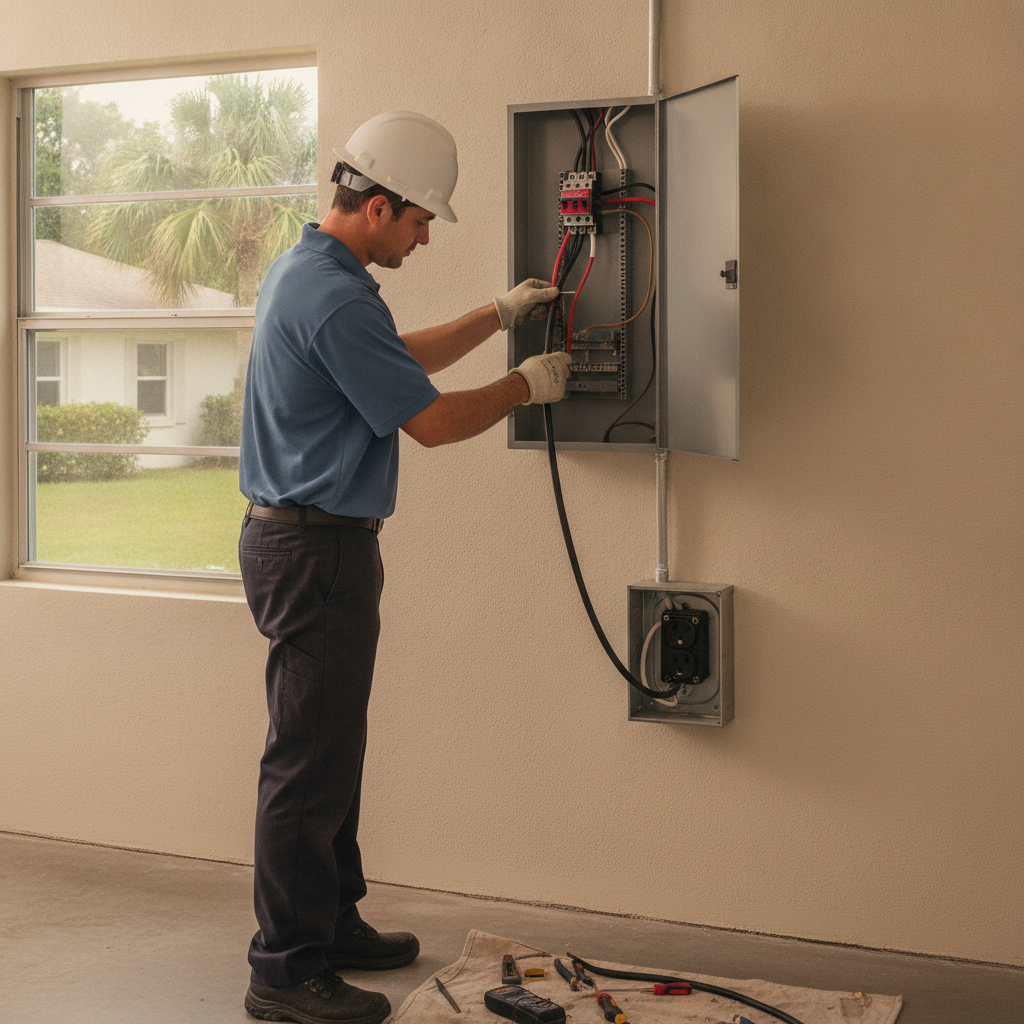
The crate is sitting in a Riverview garage, and the back of the old range shows either a three-slot receptacle or a painted wall where a gas line used to land. That picture is the job: a dedicated 240-volt receptacle for the electric range, a two-pole breaker in the panel, and a cord that matches both.
A regular kitchen outlet will not power an electric range. The range pulls from both legs of the home’s 240-volt service. It needs its own circuit so the cooktop and the oven are not sharing a breaker with the dishwasher or the microwave. The electricians we send size that circuit to the range in the room, not to a guess from the neighborhood or the year the house was built.
If the wall already has a range receptacle, the work is matching it to the new appliance. If the kitchen is switching from gas to electric, they are running a new circuit from the panel.
3-prong vs 4-prong range cords
The cord and the receptacle have to be the same shape. A 4-prong cord will not land on a 3-prong receptacle, and forcing that fit is how a range ends up with a missing ground path or a floating neutral.
A 3-prong range receptacle has two hot slots and a third pin that carries the neutral and the equipment ground together. A 4-prong receptacle splits those jobs. Two slots are still the hots. One pin is the neutral that the clock, the controls, and the oven light use. One pin is a dedicated equipment ground back to the panel.
That split exists because of how a U.S. house is wired. Each hot leg is about 120 volts to the neutral. The two hots together are 240 volts, and that is what the heating elements want. Lights and electronics on the range often need that 120-volt path to a real neutral. On a 3-prong hookup, the chassis of the range is tied to the combined neutral-and-ground conductor. On a 4-prong hookup, the chassis has its own ground, and the neutral stays a current-carrying conductor only.
The wall may still have a 3-prong receptacle even when the new range ships with a 4-prong cord. Neither fact tells you what is inside the walls. The electrician reads the receptacle that is actually there, the nameplate on the new range, and whether the range’s bonding jumper is in the 3-prong or 4-prong position.
The same cord-and-receptacle mismatch shows up on dryers, which is why the 3-prong versus 4-prong dryer outlet question sounds familiar. The mechanism is the same. The kitchen run is still its own circuit.
| 3-prong receptacle | 4-prong receptacle | |
|---|---|---|
| What the extra pin does | The third pin carries both the neutral and the equipment ground | Neutral and ground each get their own pin |
| What you meet on site | A kitchen wall that still has the last range’s receptacle | The cord packed with most new electric ranges |
| What has to match | The receptacle, the cord, and the bonding jumper on the range | A separate ground path back to the panel |
Changing the cord without changing the receptacle, or the other way around, leaves that bonding jumper wrong. The jumper is the small strap or screw on the range that either ties the neutral to the chassis or leaves the chassis on the dedicated ground. It is not a homeowner adjustment. The electricians we send set the receptacle, the cord, and that jumper as one matched set.
A 3-prong receptacle that is loose, discolored, or warm to the touch is a repair, not a cord swap. Tampa Electric’s home safety guidance is plain on that point: if plugs fit loosely in a wall outlet, the outlet needs repair, and unless you are a qualified electrician you should not try to repair electrical products yourself.
What the circuit needs
The circuit is dedicated, 240 volts, and sized to the range’s nameplate. That nameplate is on the appliance, usually along the side or in the storage drawer. It is the only honest load figure in the room. A South Tampa galley and a Wesley Chapel open kitchen can take two different ranges. The circuit follows the listing on that range, not the zip code.
Two different problems show up at the panel, and they are easy to mix. Circuit space is whether two adjacent breaker slots are free for a two-pole breaker. Service capacity is whether the whole service can carry the range on top of the air conditioner, the water heater, and everything else already on the panel. A panel can look empty and still be short on capacity. It can look packed and still have room after the electrician rearranges branch breakers. The electrical load calculation is how that second question gets answered.
A house switching from gas to electric is adding a large 240-volt load that was never there. Town ‘n’ Country and West Tampa remodels hit this often when a gas cooktop comes out and a full electric range goes in. If the panel cannot take that load, or if there is no pair of slots for the two-pole breaker, the conversation moves to a panel upgrade. This site publishes a 100 amp to 200 amp panel upgrade band of $2,500 to $4,500. That is a site-published range, not a Tampa average and not a quote. The selected contractor prices the work after seeing the panel and the range.
The route is the other half of the circuit. Slab-on-grade kitchens across East Hillsborough and the South Shore often put the panel in the garage and the range on an interior wall. The run then goes through the attic, through cabinets, or through finished space. A Hyde Park plaster wall changes how that fishing happens. Length, access, and wall type move the labor. They do not change the fact that the range gets its own circuit.
This circuit does not share a breaker with the dishwasher, the microwave, or a 240-volt outlet meant for something else. A dryer receptacle in the laundry room is not a spare range outlet. The slots can look similar. The loads are not.
What the install includes
The electricians we send start with the range that is going in and the wall that is already there. They confirm whether the existing receptacle can stay, whether the cord on the new range matches it, and whether the panel has space and capacity for a dedicated two-pole circuit.
On a new run they de-energize the work, verify it is dead, install the cable and the box, land the two-pole breaker, and set a receptacle that matches the cord. The box usually sits in the wall behind the range so the cord is not stretched across the floor. On a swap they still verify the existing circuit before they reuse it. A painted-over box behind an old range is not proof the wiring is sound. A larger kitchen gut that also replaces small-appliance circuits is a different scope, closer to a kitchen rewire than to a single receptacle.
Kitchen counter GFCI devices are a separate job. The range receptacle sits behind the appliance. The small outlets along the backsplash are the ones people use for a mixer or a toaster. If the remodel is also updating those, that is GFCI outlet installation, not a substitute for the range circuit.
Permits, when they apply, are pulled by the licensed contractor, never by this brand. The reviewing office follows the property, not the mailing city. Unincorporated Pinellas work goes through Pinellas County’s building department map. Largo has its own Building Division. Temple Terrace publishes its own electrical applications. A South Tampa address is not a Largo job because the owner gets mail in Largo. The electrician confirms the permit and inspection steps with the authority for that address. Those steps are also why a Tampa electrical permit question belongs with the contractor on the job, not with a mailing label.
Florida certified electrical contractors can work statewide. Registered contractors work in the jurisdictions that issued them. Specialty licenses have a bounded scope. The electricians we send are licensed and insured. Confirming active status and the right category for the work is part of hiring.
If the existing range outlet is the problem, heat, a burning odor, buzzing, or a breaker that trips when the oven comes on, that is electrical repair. It is not a reset habit. Unexplained heat, odor, or repeated trips call for a qualified inspection. Smoke or fire means leaving the area and contacting emergency services.
Common questions
These are the two mismatches that stop a range from landing in a Tampa kitchen.
Does a new electric range need a new outlet?
Only if the receptacle, the cord, and the circuit do not already match the appliance. A range that arrives with a 4-prong cord will not use a 3-prong receptacle as-is. A kitchen that never had an electric range needs a new dedicated 240-volt circuit. Reusing a receptacle that is loose, discolored, or warm is not a match. It is a repair.
Can I run the range on an extension cord until the outlet is in?
No. Tampa Electric says extension cords are for temporary use and are not safe as permanent household wiring, and a range is not a lamp. The cooktop and oven belong on the dedicated receptacle the electrician installs. A dryer outlet in the laundry room is not a workaround either. That circuit already has a job.
When to call us
Call when a new electric range does not match the receptacle in the wall, when a kitchen is moving from gas to electric, or when the existing range outlet is loose, hot, or tripping the breaker. The electricians we send install the dedicated circuit and the matching receptacle. Call us at (813) 850-0320.