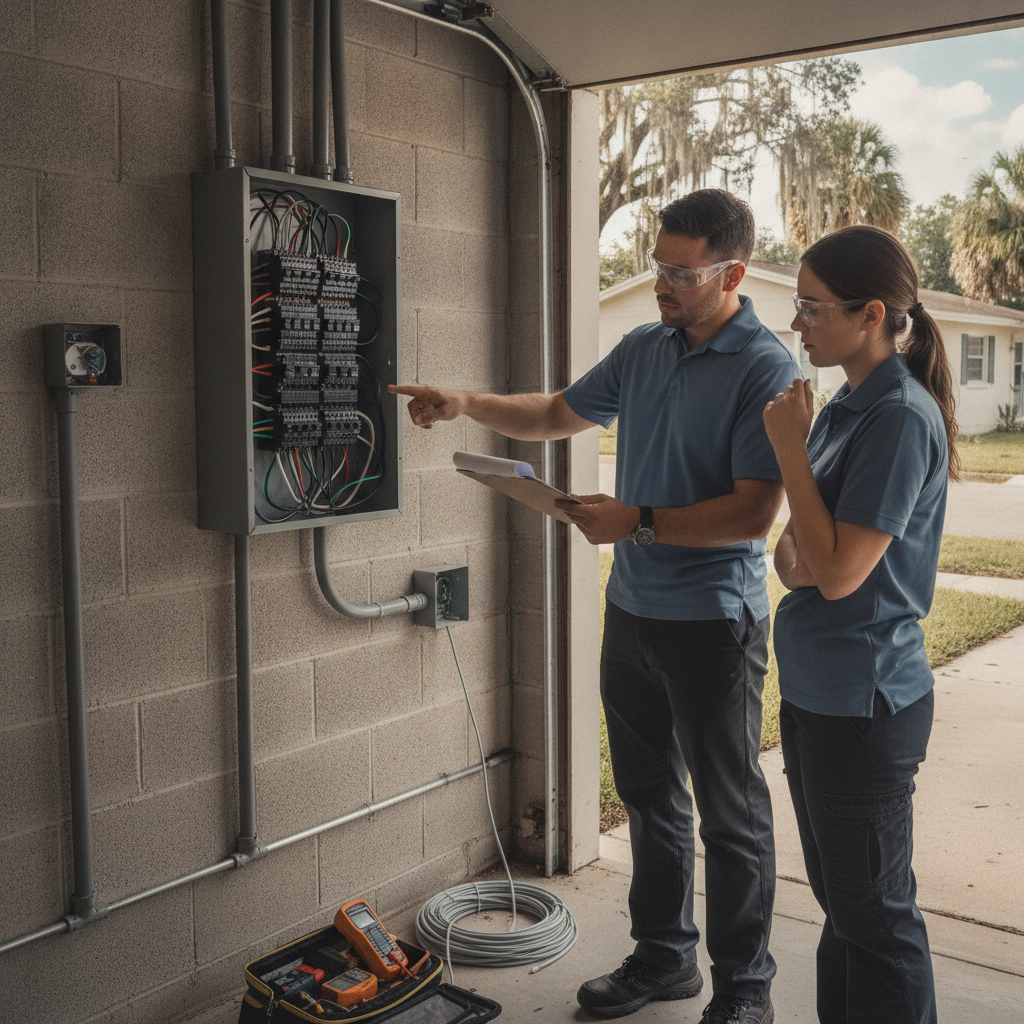
A new 240-volt charger on a Riverview garage wall, a heat pump in Lutz, or a standby pad behind a Palm Harbor house all start with the same decision: can this service take the extra load. An electrical load calculation is the worksheet that answers it. It is not a guess from the main-breaker handle, and it is not a quote.
What a load calc is
An electrical load calculation is a written inventory of how much power a house can demand from the utility at once, built so a licensed electrician can judge the service and the panel.
Two totals live on that sheet. Connected load is every nameplate added as if every appliance ran full-tilt at the same minute. Demand is the smaller number after the electrician accounts for how a house actually runs. The dryer, the range, and the air handler do not sit at maximum together for hours. Demand is the figure that gets compared to the service rating.
The sheet is also not the amperage stamped on the panel door. Service capacity is the limit of the utility-side conductors, the meter enclosure, and the main disconnect. The lowest of those parts sets what the house can draw. Circuit space is a different problem. A panel can have a generous main and still be packed with breakers, so a new 240-volt circuit has nowhere to land. Equipment replacement is a third problem again. A tired meter can on a concrete-block wall, a damaged riser, or a panel that needs to come out is not the same job as adding load.
That is why a charger quote and a panel upgrade quote should not be the same conversation until the load calculation is done. This site’s published range for a 100 amp to 200 amp panel upgrade is $2,500 to $4,500. That is a site figure, not a Tampa average and not the selected contractor’s price. The electrician who walks the property sets the actual number after seeing the run, the enclosure, and the panel.
The calculation also refuses a common shortcut: reading the main-breaker handle and calling the house a 200 amp house. Tampa Electric’s tariff uses a 200 ampere self-contained meter socket as an example for one kind of point of delivery. It does not mean every Hillsborough or Pinellas house has, needs, or must move to 200 amp service. Self-contained meter sockets on that tariff stop at 400 amperes. That ceiling is a metering limit, not a recommendation for your panel.
When Tampa Electric asks for one
Tampa Electric does not ask for a homeowner-built load sheet as the ticket for a new circuit. What the utility does publish is who owns which piece of gear at the meter, and who is allowed to touch it.
On a typical single-meter house, the ownership line is the load-side terminals of the metering equipment. The customer provides the meter socket, from the company’s approved list, at a location the company designates for a new install, a relocation, or an upgrade of existing metering. Customers are not allowed to make connections to or disconnections from Tampa Electric equipment. That work stays with the utility unless they authorize something else.
After a storm, Tampa Electric is responsible for damage to the electric meter and the service line. The customer is responsible for the weatherhead, the riser, and the meter box. That split is for storm-related damage. It tells you who to call about damaged equipment. It does not set a fair-weather repair price, and it is not the load calculation.
The load calculation is the electrician’s document for the panel, the new equipment, and the building department that reviews the address. Permits are pulled by the licensed contractor, never by this brand. The reviewing office follows the property, not the mailing city. Pinellas County handles unincorporated areas and named partner cities, and Largo runs its own Building Division. Temple Terrace publishes its own electrical applications. A Lutz mailing label on a house inside another city does not pick the office.
Florida certified electrical contractors may work statewide. Registered contractors work inside their authorized local jurisdictions, and specialty licenses have a bounded scope. The electrician who takes the job confirms the permit and inspection steps with the authority for that address.
If the job never touches the service or the meter enclosure, Tampa Electric may never see the worksheet. If the job does change the service equipment, the utility still designates the metering location. The load numbers stay on the electrician’s sheet.
What an electrician measures
The electrician starts with what is actually on the house, not with the neighborhood or the year on the tax roll.
Living area drives the general lighting and receptacle portion of the sheet. Fixed equipment goes on next at the nameplate: range, dryer, water heater, well pump, pool pump, air handler, heat strips. Heating and cooling are not stacked as if they both ran at full load. In a Tampa Bay house they fight the same weather, not each other, so the heavier HVAC path is the one that belongs in the demand total.
Then come the add-ons that triggered the visit. A Level 2 charger uses 240 volts. Charging is a continuous electrical load, so the full nameplate of the charger belongs on the sheet. The U.S. Department of Energy’s home charging guidance is clear that the vehicle, the daily range, and how long the car sits parked all affect the right charger, and that the electrician evaluates electrical capacity. Level 1 can cover daily driving for some drivers when the circuit and the overnight time actually fit. A smart charger’s app and timer do not, by themselves, prove the service can take the load.
This site’s published range for EV charger installation, when the existing panel capacity is already adequate, is $1,200 to $2,000. That figure does not cover a service upgrade. A load calculation that comes in high is how you find that out before anyone orders a wall unit.
A standby generator is a different animal. Fixed standby equipment is installed with transfer equipment that isolates the house from the utility. It supplies backup power. It does not add utility load by itself. A portable generator can run individual appliances on properly rated outdoor cords. It is never backfed into a dryer outlet or a household receptacle. If you are writing an essential-load list in Apollo Beach in late May, you are planning what the generator will carry in an outage, not adding those watts to the Tampa Electric service size.
Access changes the work even when the math does not. A charger on the far wall of a Riverview garage, with the panel on the other side of a slab house, is a long 240-volt run. A detached Odessa garage at the end of a drive, with a well pump already on that feeder, is a different route. Hyde Park plaster decides how a new circuit gets fished. None of those scenes diagnoses the wiring. They are why two houses with the same demand number are not the same job.
Unexplained flicker, a hot plate, buzzing, a burning odor, a shock, or a breaker that keeps tripping is not a load-calculation project. Tampa Electric’s home safety page flags overloaded circuits, loose outlets, and an appliance that repeatedly trips a breaker as reasons to unplug that appliance and have an electrician look. The electricians we send handle that as electrical repair, not as arithmetic. Smoke or fire means leave the hazard area and contact emergency services.
How 100 amp and 200 amp panels use the same sheet
You do not run a special 100 amp method and a special 200 amp method. You build demand once, then you compare it to the service you have.
A kitchen remodel is a clean picture of what belongs on the sheet and what does not. New counter receptacles may need GFCI protection for shock, and they also add to the small-appliance load on the calculation. Those are two different jobs that can share one visit. The GFCI device does not change how many watts the toaster draws. The load sheet does not replace the GFCI.
Laundry, a range, and a dryer show the same split. Their nameplates are large. They do not all sit at nameplate through a Tuesday afternoon, so the electrician applies diversity instead of adding every watt as if it were continuous. EV charging does sit for a long stretch, which is why it is treated as continuous and counted in full.
A 100 amp main can be the right fit for a smaller house with gas appliances and no charger. The same sheet on an all-electric house with a Level 2 charger and electric water heat can come in above that main. The electrician does not upgrade from the handle alone, and this brand does not tell you a house needs 200 amps from a zip code. A 200 amp panel with a 100 amp main is still a 100 amp service. A packed 200 amp panel with no spare slot still needs space even when the demand number looks fine.
If you already want the longer read on whether the panel itself is the constraint, start with whether your Tampa home needs a panel upgrade. The load calculation is the document that keeps that page from turning into a guess.
| What you are checking | What a passing result means | What it still does not settle | | Service and main rating | Calculated demand fits the lowest-rated part of the service | Empty breaker slots, or a panel that should be replaced on condition | | Circuit space | There is an open landing for the new breaker | Whether the service amperage is enough for the new load | | New equipment on the sheet | The charger, heat pump, or similar load was counted the right way | Permit steps, meter-socket listing, or utility location rules |
What is the formula for calculating electrical load?
There is no one-line homeowner formula that replaces the electrician’s sheet. The working shape is general lighting and receptacle load from the living area, plus fixed appliances at nameplate, plus the heavier of heating or cooling, plus continuous loads such as EV charging counted in full, then reduced by diversity so the total reflects what actually runs together. That demand is converted to amps on a 240-volt service and compared to the existing main, the conductors, and the meter enclosure. An online calculator skips the nameplate you cannot see, the run you have not walked, and the utility equipment on the wall.
How do I calculate load on a 100 amp or 200 amp panel?
You calculate demand once, then you ask whether that demand fits the service you have. The service size is the lowest rating among the service conductors, the meter enclosure, and the main disconnect. Adding a charger does not automatically force a 100 amp to 200 amp upgrade. The sheet, the route, and the enclosure decide, and the selected contractor prices the work after seeing the property.
Does a standby generator raise the utility load calculation?
A professionally installed standby generator with transfer isolation supplies backup power. It does not add load on the Tampa Electric service by itself. The essential-load list you write for hurricane season is a generator-planning document: which circuits the transfer equipment will carry when the utility is out. Portable generators belong outdoors, on cords rated for the appliances, never backfed into house wiring.
When to call us
Call when you are adding a 240-volt load, replacing HVAC, planning a kitchen or laundry change, or you have been told the panel is full and you want the actual demand, not a guess from the main-breaker handle. Tampa Electrical Pro matches you with independent licensed and insured electricians who build that sheet, confirm permit steps with the authority for the address, and price the work after they see the property. Call us at (813) 850-0320.