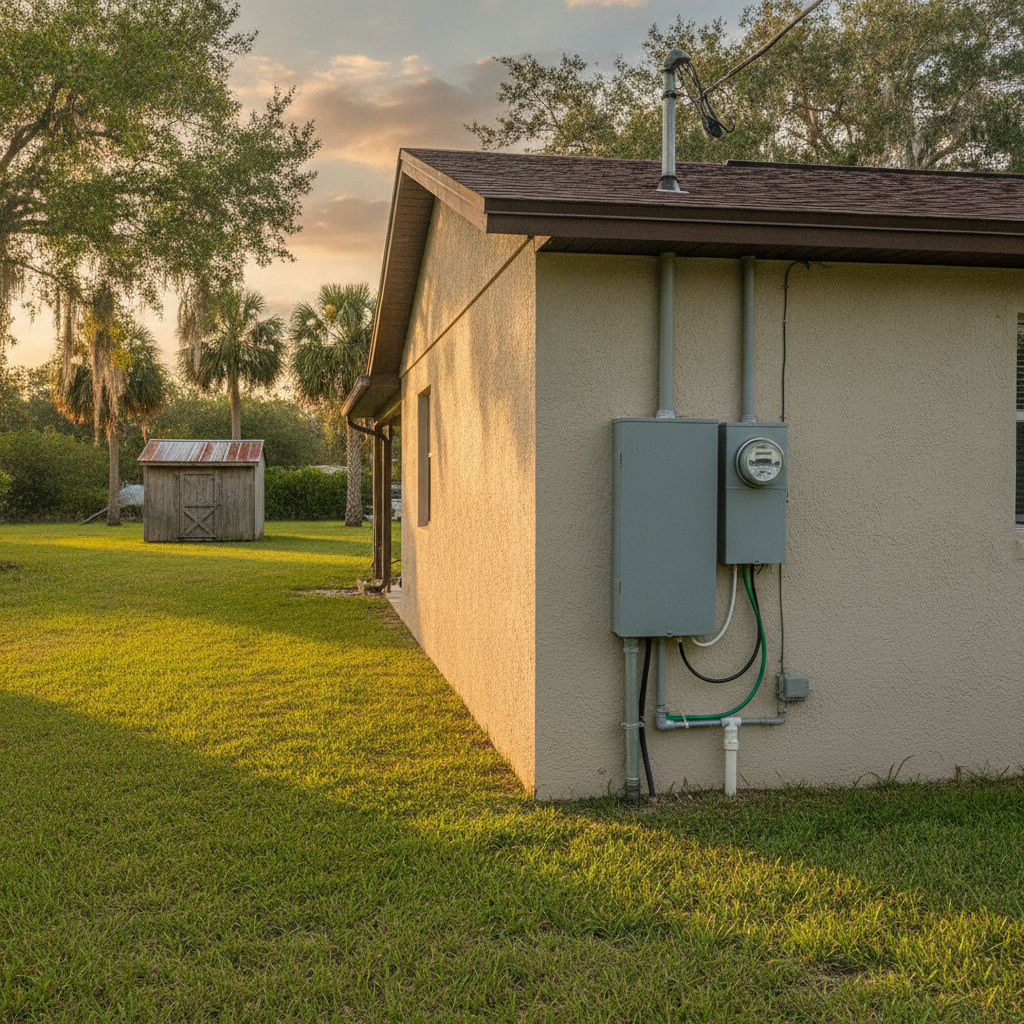
A Ruskin lot often puts the panel on the house and the real load at the far end of the yard. The electrician we send starts with that property, not a generic South Shore script. That walk-through is how a repair, a new circuit, or backup power gets a real scope.
What a licensed electrician looks at on a Ruskin property
The first pass is the service equipment, the panel, and the loads that actually run. Ruskin sits on Tampa’s South Shore in Hillsborough County, a mix of smaller lots near U.S. 41 and larger parcels with sheds, shops, and wells set well off the house. None of that tells anyone what is inside the walls. The electrician still has to read the labels on the equipment, follow the circuits that are in use, and see how the yard is laid out.
On a typical visit that starts at the street. Tampa Electric designates meter location on new work and on a relocation or upgrade, and the customer provides the meter socket on the premises. After a storm, Tampa Electric is responsible for damage to the meter and the service line, while the weatherhead, riser, and meter box sit on the customer side. That split is how you know whether the next call is the utility or a licensed electrician. Fair-weather rust, a loose enclosure, or heat at the can is still a job for the electrician to inspect, not a DIY cover pull.
Inside, service size and breaker space are two different problems. A panel can have spare slots and still be tight on capacity once the air handler, well, range, and a future charger are on the same service. A panel can also be full of breakers while the service itself still has room. The electrician reads the main, the bus, and the actual loads rather than guessing from the neighborhood or the year on the tax roll.
Warning signs get treated as a reason to stop and have the system inspected, not as a puzzle to diagnose from the driveway. Tampa Electric’s home-safety guidance is plain on the usual ones: a plug that sits loose in the receptacle, an extension cord used as permanent wiring, an appliance that keeps tripping a breaker or that has shocked someone. Unexplained flicker, a hot or discolored plate, buzzing, a burning odor, or a shock is the same class of problem. Smoke or fire means leaving the area and calling emergency services. Nobody on this side of the phone will tell you that a smell at the panel can wait.
For a dead circuit, a buzzing device, or a receptacle that has started to act up, that inspection is electrical repair work. The electricians we send are licensed and insured. They confirm permit and inspection steps with the authority that actually covers the address, because a Ruskin mailing label does not pick the reviewing office by itself. If you want the Ruskin service-area page rather than this explainer, it lives with our other South Shore coverage at electrician service in Ruskin.
Long runs, outbuildings, and well pumps
A long run is a voltage and access problem before it is a parts list. Copper has resistance. The farther a 240 volt circuit travels from the panel on the house to a pump house, a detached garage, or a shop at the back of a Ruskin lot, the more of that voltage is lost along the conductors. A well motor already asks for a heavy inrush when it starts. If the motor at the far shed is seeing a weaker supply at that moment, the breaker can trip, the motor can struggle, and the run itself becomes most of the labor.
That is why a pump on a short homerun next to the house and a pump at the end of a side yard are not the same job. The electrician measures the route: slab, stucco, a concrete-block wall, a fence line, a driveway that cannot be open-cut without a plan. Buried conductors, conduit, and a disconnect at the equipment all follow from what is on the ground, not from a South Shore average. A house in a newer subdivision with city water may have none of this. A parcel off 41 with a well and a pole barn may have all of it. The property decides.
Well pumps also share a panel with everything else that starts hard. If the lights dip when the pump kicks on, the question is whether that circuit is dedicated, whether the breaker is the right match for the motor, and whether the panel has the capacity and the spare space to feed it cleanly. A trip that keeps coming back is not a reset contest. When a well-pump breaker keeps tripping, the electrician looks at the motor, the wiring, and the protection on that circuit rather than swapping parts until something sticks.
Outbuildings raise a second fork: a long homerun to one load, or a feeder to a small panel in the shed that then serves lights, a freezer, and a bench circuit. Those are different scopes. A feeder needs its own overcurrent protection, a clear working spot at that second panel, and a route that can be maintained. A single homerun is simpler until the shed grows a second load and someone wants to tap the first circuit. The electrician maps what is there now and what the building is being asked to do.
Sun City Center sits next door on the same South Shore corridor, and the same long-run logic shows up on those lots when a well, a golf-cart charger, or a workshop sits off the house. The write-up for electrician services in Sun City Center covers that neighbor pattern. Ruskin still gets its own walk-through. A build year, a street name, or a nearby HOA does not establish aluminum branch wiring, a particular panel brand, or a well on the property.
Outdoor equipment has to match the exposure it actually sees. A receptacle under a roof overhang is not the same as one on an open wall that takes weather. GFCI protection can sit at the receptacle, in a deadfront, or upstream on the circuit, so a plain-looking outlet farther down the run is not proof that the circuit has no protection. The electrician tests what is installed instead of reading the face of one device and stopping.
Panel space and backup power
Panel space is the empty slots. Service capacity is whether the main and the conductors can carry the load you already have, plus the load you want to add. A Ruskin household writing an essential-load list in late May, with hurricane season on the calendar from June through November, runs into both at once. A standby generator does not add utility load by itself. It supplies backup power through transfer equipment that isolates the house from the utility so the generator cannot backfeed the lines. That isolation is the safety core of a fixed install. It is also why a generator is not a substitute for a service upgrade when the panel is already maxed on everyday use.
Portable units and standby units are different machines with different rules.
| Portable generator | Standby generator | |
|---|---|---|
| How it feeds loads | Individual appliances on properly rated outdoor cords | Transfer equipment isolates the house from the utility |
| Where it runs | Outdoors, far from the house and away from openings | A professional install, with clearances from the listed equipment and local review |
| What it does not do | It does not get backfed into house wiring through an outlet | It does not erase carbon monoxide, fire, or exhaust hazard |
Tampa Electric is direct on the portable path: cords to appliances, never a backfeed into the house wiring. The CPSC generator guidance is just as direct on placement. A portable generator belongs outdoors, far from the house, and away from windows, doors, and vents. It does not run in a garage, a home, a crawlspace, a basement, or a shed. Turning the main breaker off is not backfeed protection.
A fixed standby job is whole-home generator work for the electricians we send. Fuel, a pad, exhaust direction, and an essential-load list all sit in that scope. HOA rules on some South Shore streets can decide where a pad is even allowed, which is a siting constraint, not an electrical diagnosis. Restoration after a storm starts with health and safety facilities and then the greatest number of residential customers the utility can reach. It does not put one Ruskin street ahead of another on a standing schedule, and a generator is not a permanent cure for every outage. Fuel and maintained equipment still have to be part of the plan.
The same panel conversation shows up when someone wants a 240 volt charger in the garage. Level 1 can cover daily driving for some drivers with dedicated power and overnight time on the driveway. Level 2 uses 240 volts. The vehicle, the daily range, and how long the car actually sits decide which is the right fit, and the electrician evaluates electrical capacity rather than reading the main-breaker handle and declaring an upgrade. A charger on the far wall of a garage while the panel sits on the opposite side of the house means a longer 240 volt run. That run, not a brand name on the charger, is often most of the labor.
If the panel is out of slots, the next circuit has nowhere to land until space is made or the equipment is replaced. If the service is undersized for the loads already running, adding a pump, a charger, or generator accessory loads does not get solved by squeezing in one more breaker. Those are the two forks. The electrician names which one the house actually has.
Florida licenses and the questions Ruskin homeowners ask
Florida does not treat every electrical license as the same piece of paper. The job still has to be done by someone whose license actually covers that work at that address.
What is the difference between a certified electrician and a licensed electrician?
People often say “certified” when they mean a Florida certified electrical contractor. Florida’s electrical contractor FAQs draw the real line this way: certified electrical contractors can work statewide, registered contractors work inside their authorized local jurisdictions, and specialty licenses have a bounded scope. “Licensed” is the broader everyday word. EC is not the only lawful category for every electrical task, and no one on a crew is assumed to hold a contractor license just because they are on the job. The check is active status, the actual scope on the license, and the jurisdiction that covers the property.
How do you check if an electrician is licensed in Florida?
You look up the business on the state’s licensing records and read the license type, the status, and the jurisdiction. That lookup is how you confirm the company is allowed to pull the permit for the address, which the licensed contractor does, not this referral brand. Tampa Electrical Pro matches Ruskin homeowners with independent licensed and insured electricians. We do not hold the contractor license, we do not own the trucks, and we do not pull the permit.
What major city is Ruskin, Florida near?
Ruskin sits on the South Shore of Tampa Bay in Hillsborough County, south of Tampa along the U.S. 41 corridor, with Sun City Center and Apollo Beach as the close neighbors. Tampa is the major city people mean when they ask. The electrician still treats the property as the job, not the city name on the map.
Florida also has no single published hourly rate that covers every Ruskin visit. A breaker in an open, labeled panel and a buried run to a well house are priced after the electrician sees the route, the equipment, and the access. The selected contractor sets the number for that scope.
When to call us
Call when a Ruskin circuit is dead, a well or outbuilding run is tripping, the panel is out of space for a load you already need, or you want standby power installed with proper utility isolation. The electricians we send are licensed and insured, and they confirm permit and inspection steps with the authority for that address. Call us at (813) 850-0320.