The clearance rule that governs a Florida house is not printed in the Florida Building Code’s clearance section. Florida reserved that section and pointed to the National Electrical Code instead. And most of the numbers a search hands you are federal workplace standards written for employers, not the standard a building official applies to a home. So the honest answer to “how much room does my panel need” is that the governing text is NFPA 70 as adopted and enforced by whichever building department covers your address, and that department is the one to ask.
That matters because the question almost never arrives in the abstract. Something is already in the way. A shelf of paint cans. A water heater that got moved during a remodel. A closet door that will not swing all the way open. Or an electrician quoting a panel upgrade just said the panel has to move, and that changed the price of the job.
What Florida’s residential code actually says
Chapter 34 of the 2023 Florida Building Code, Residential, Eighth Edition is mostly empty where you would expect the electrical rules to be.
Section E3405 is titled Equipment Location and Clearances, and it reads RESERVED. So do E3402 Building Structure Protection, E3403 Inspection and Approval, E3404 General Equipment Requirements, E3406 Electrical Conductors and Connections, and E3407 Conductor and Terminal Identification. What the chapter does say is in Section E3401.1: “Electrical systems, equipment and components for buildings under the scope of this code shall comply with the applicable provisions of NFPA 70, National Electrical Code.”
Read that the right way around. RESERVED is not a hole in the law. It is a hand-off. Florida chose not to reprint the requirement in Chapter 34 and sent you to NFPA 70 for it, which means the requirement exists and lives somewhere else.
You can prove the hand-off was deliberate by looking a few lines down the same chapter. E3408, on ground-fault circuit-interrupter protection, is not reserved. It opens by naming the exact edition and article it is rewriting: “NFPA 70-20: National Electric Code, Article 210 (Branch Circuits), Section 210.8, Ground-Fault Circuit-Interrupter Protection for Personnel, is amended to read as follows:”. Florida wrote its own text where it wanted to. On clearances it did not, and the silence sits directly above a section that proves the state was willing to speak.
The numbers you were handed are workplace numbers
Search this question and you will land on the same set of figures over and over. Thirty inches wide. Six and a half feet of headroom. No storage in the space. Those are real, they are federal, and they come from the Occupational Safety and Health Administration.
29 CFR 1910.303 is the one most pages are quoting. Its own page identifies the body of law it belongs to as “Occupational Safety and Health Standards,” and the working-space language reads: “Sufficient access and working space shall be provided and maintained about all electric equipment to permit ready and safe operation and maintenance of such equipment.” From there it sets the width at “the width of the equipment or 762 mm (30 in.), whichever is greater,” requires that the space “permit at least a 90-degree opening of equipment doors or hinged panels,” limits equipment above or below the panel to not more than “153 mm (6 in.) beyond the front,” states plainly that “Working space required by this standard may not be used for storage,” requires at least one entrance of sufficient area, and sets headroom at 1.98 m (6.5 ft) for installations built on or after August 13, 2007. Depth is not a single figure at all. It comes from a table titled “Table S-1 Minimum Depth of Clear Working Space at Electric Equipment, 600 V or Less,” and the depth changes with the voltage and with the conditions on either side of the equipment.
The other standard that shows up is a worse fit, not a better one. 29 CFR 1926.403 belongs to the “Safety and Health Regulations for Construction,” and its text reads: “The employer shall ensure that electrical equipment is free from recognized hazards that are likely to cause death or serious physical harm to employees.” Employer. Employees. That one sentence tells you who the standard is written for, and it is not a homeowner in a Valrico garage.
None of this makes those figures wrong. It makes them the answer to a different question. They describe what an employer owes a worker at a workplace, and a homeowner who lands on that page has no way to know that from the page.
The four situations that bring people here
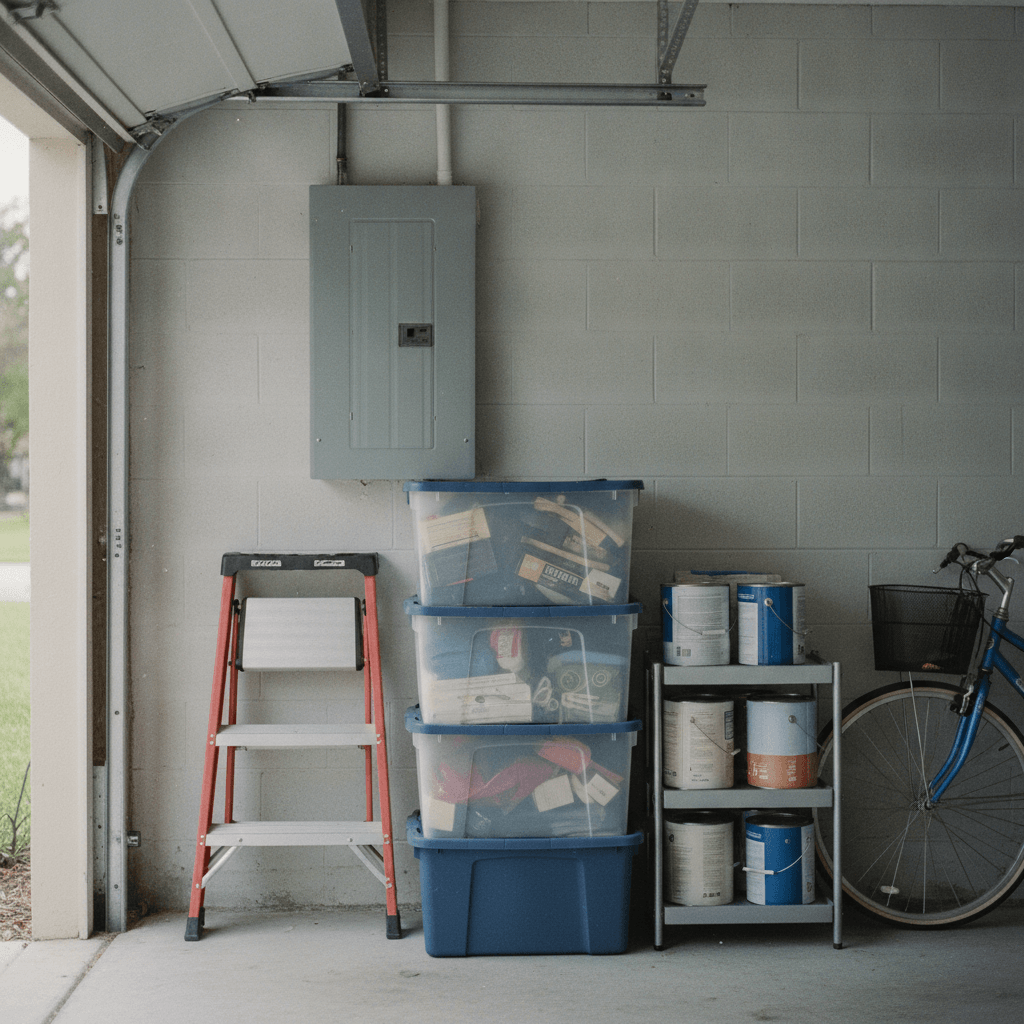
Storage in front of the panel. This is the most common one and the easiest to act on. Shelving, a stack of hurricane totes, a chest freezer, a bicycle. Whatever the governing dimension turns out to be, the practical standard is that a person has to be able to stand square in front of that panel and work on it safely, including swinging the door fully open, without moving anything first. Clearing it costs nothing and is worth doing the day you read this.
A panel in or behind something. A closet, a pantry, a laundry nook, behind a water heater that was relocated, inside a cabinet somebody built around it during a kitchen remodel. These are working-space questions because the obstruction is permanent and because the door swing and the approach path are part of what gets evaluated. An electrician has to see the actual enclosure, the actual wall, and the actual path to it. A photo is not enough.
A panel that has to move for an upgrade or a charger. This is where clearance turns into money. If the existing location cannot support the work, relocating the panel pulls the service conductors, the grounding and sometimes the meter into the scope. That is the difference between a panel swap and a much larger job, and it is worth asking about before you accept a quote. The same question comes up when you are planning where a sub-panel goes to feed a detached garage or an addition, since the new enclosure has to land somewhere with the same access.
An inspection flagged it. A four-point inspection for insurance looks at the panel, and a home inspection before a sale will note obstructed access. What the inspector writes is a finding, not a ruling. The jurisdiction decides what has to change, and a licensed electrician is who scopes the fix.
In all four, the honest limit is the same. Nobody can tell you from a description whether your panel location passes. The evaluation happens at the property, against the code edition your building department enforces.
Who actually decides, and it is probably not the county
The authority is whichever building department permits and inspects your address, applying NFPA 70 as adopted there. In Tampa Bay that is genuinely not obvious, because two houses a mile apart can answer to different departments.
Pinellas County is the clearest example. The county’s building permit page states that “Pinellas County Building and Development Review Services department serves unincorporated areas, Belleair Beach, Belleair Shore, Indian Rocks Beach, Kenneth City, Oldsmar and Safety Harbor.” Everyone else goes elsewhere: the county tells readers outside those areas to check its list of other building departments in Pinellas County to find theirs. Clearwater, St. Petersburg, Largo and the rest run their own permitting. The county also points to an address lookup tool, because a mailing address does not establish which jurisdiction you are in.
Hillsborough County works the same way. Residents inside Tampa, Plant City and Temple Terrace are directed to their own city government rather than to the county. If you are in unincorporated Hillsborough, the county building officials are the ones who inspect.
So the useful move is not to collect a number off the internet. It is to find out which department covers your address, then ask that department, or have the electrician you hire ask it, because they already know.
What to have ready when you call
Have the panel’s location in the house, what is in front of it and how far, what the door hits when it opens, and the name of the city or county on your property tax record rather than on your mail. A photo of the closed panel and of the room it sits in saves a trip. If you are already planning a panel upgrade, say so on the first call, because the clearance question and the upgrade scope are one conversation, not two.
One thing to leave alone. Do not open the panel, remove the cover, or move anything that is energized or wet to measure the space. If the panel is warm, buzzing, scorched or damp, stop reading and treat it as an emergency, not a clearance question.
Frequently asked questions
Does Florida have its own electrical panel clearance rule?
Not a printed one in the residential code’s clearance section. Section E3405, Equipment Location and Clearances, is marked RESERVED in Chapter 34 of the 2023 Florida Building Code, Residential, and E3401.1 sends you to NFPA 70, the National Electrical Code, instead. The requirement applies through that reference.
Why do search results give OSHA numbers for a house?
Because OSHA’s standards are free to read online and the National Electrical Code is not, so the figures that circulate most are the workplace ones. 29 CFR 1910.303 sits in the “Occupational Safety and Health Standards,” and the construction standard at 1926.403 is written in terms of what an employer owes employees. Neither was written for a private residence.
Can I store things in front of my electrical panel?
Keep the space clear regardless. OSHA’s workplace standard states that working space “may not be used for storage,” and the practical reason carries over to a house: an electrician or a firefighter may need to reach that panel immediately, with the door swinging fully open, and anything stacked in front is in the way at the worst possible moment.
Who do I ask whether my panel location passes?
The building department that permits and inspects your address, which may be your city rather than your county. Pinellas County only serves unincorporated areas plus Belleair Beach, Belleair Shore, Indian Rocks Beach, Kenneth City, Oldsmar and Safety Harbor, and directs everyone else to their own municipal department. A licensed electrician working in your area already knows which one that is.
When to call us
Panel location, access and relocation are licensed electrical work, and the evaluation has to happen at the property by someone who can open the enclosure safely. Tampa Electrical Pro matches Tampa Bay homeowners with independent licensed and insured electricians who handle panel work and repairs and who deal with the local building department as a matter of routine. Call us at (813) 850-0320.