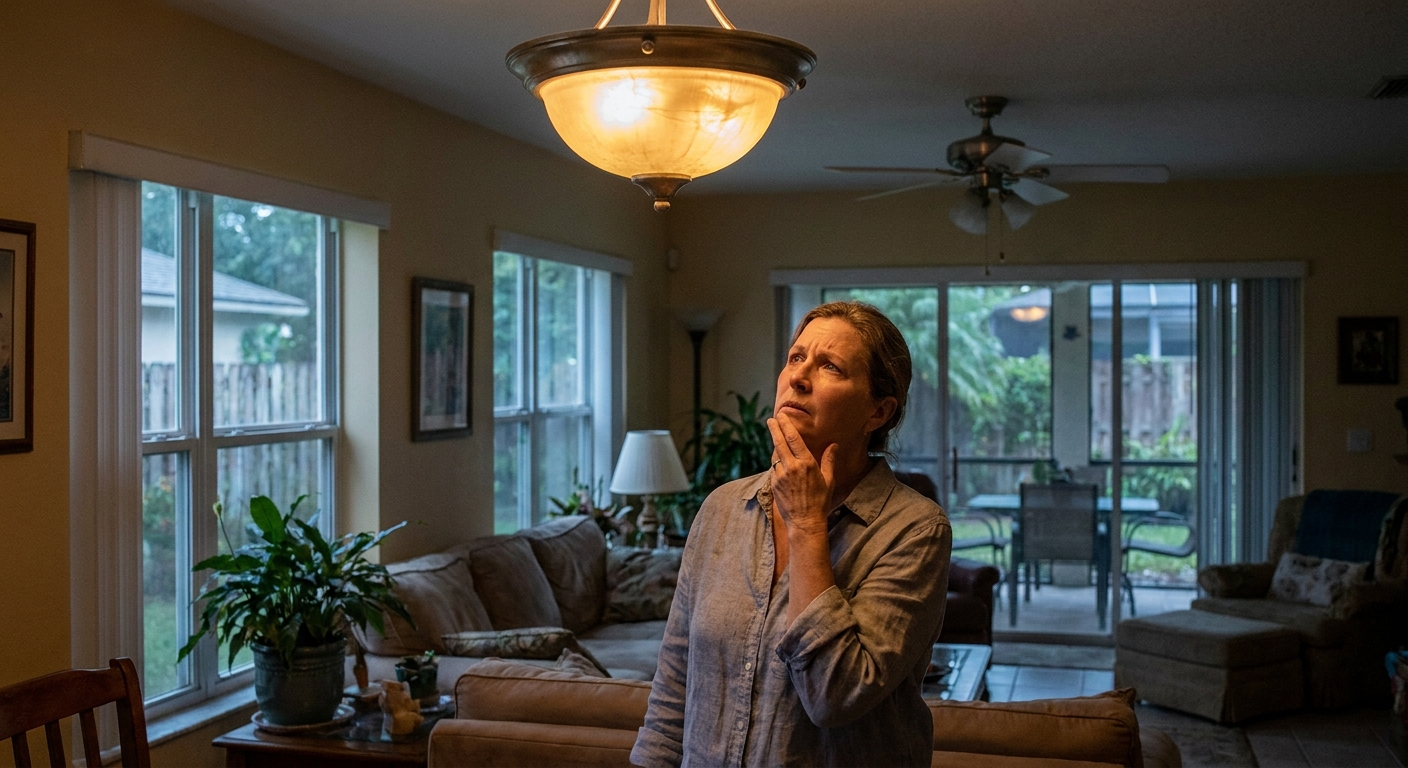
Electrical warning signs deserve attention, but a symptom usually isn’t enough to identify the cause. Flickering, heat, sounds and breaker trips can originate in a fixture, appliance, branch circuit, panel or utility supply. The useful first step is to note the pattern without opening equipment or creating another fault to test it.
1. Lights flicker or dim unexpectedly
One flickering LED may involve the bulb, its driver, the dimmer, the fixture or its connection. Several lights changing together, especially across different rooms, points to a broader problem that needs qualified inspection.
Notice whether the change happens at one fixture, on one circuit or throughout the home. Also note whether it coincides with a particular appliance starting. Those observations help an electrician narrow the inspection, but they don’t prove that the appliance, panel or utility connection is responsible.
Unexplained or widespread flickering should not be dismissed as cosmetic. If part of the home loses power or lights in different areas become unusually bright and dim, see the guide to half the house losing power and arrange prompt professional help.
2. A breaker trips repeatedly
A breaker trip is a protective response, not a diagnosis. The cause may involve the connected load, a damaged appliance, a circuit fault, a connection problem or the breaker itself.
If the breaker trips again during ordinary use, leave it off and have the circuit inspected. Don’t repeatedly reset it or deliberately add loads to see whether it trips. Our guide to breakers that keep tripping explains the information an electrician will need, including what was running and which rooms lost power.
3. An outlet or switch is hot or discolored
Heat, discoloration, warping or melting around a switch or receptacle calls for prompt attention. The symptom alone doesn’t reveal whether the issue is the device, its connection, the load or another part of the circuit.
Stop using the affected outlet or control if you can do so without touching a hot or damaged surface. Don’t remove the cover or reach behind the device. A licensed and insured electrician can inspect the device, wiring and connected load together.
4. You smell burning or see smoke
A burning or hot-plastic odor near electrical equipment can indicate overheating, but its source cannot be confirmed remotely. Avoid using nearby switches, receptacles or appliances and arrange prompt qualified inspection.
If there is smoke or fire, leave the hazard area and contact emergency services. Don’t open the panel or search inside walls for the source. After the immediate danger is addressed, the emergency electrician service page explains how Tampa Electrical Pro can connect you with an electrician.
5. An outlet, switch or panel buzzes or crackles
Not every electrical product is silent, and a sound alone does not prove that arcing is occurring. What matters is where the sound originates, whether it is new or changing, and whether it appears with heat, odor, flickering or power loss.
New buzzing or crackling from a switch, receptacle or electrical panel needs qualified inspection. Don’t remove a cover or place your hand on the equipment to investigate it.
6. You feel a shock or tingling sensation
A shock or tingling sensation from an appliance, switch, receptacle or other electrical equipment is a warning sign. Stop using the affected item and keep others away from it until a qualified electrician can determine whether the problem involves the equipment, grounding, protective device or circuit.
Water raises the stakes. Stay away from wet electrical equipment, damaged outdoor enclosures and any panel exposed to water.
7. Power disappears from part of the home
A partial outage can involve a tripped protective device, a circuit fault, service equipment or the utility supply. The affected rooms and the behavior of nearby lights are useful details, but they don’t establish the cause.
Don’t open the panel or repeatedly cycle breakers in search of an answer. If the outage follows heat, crackling, an odor or visible damage, keep clear and seek prompt help. If neighboring properties are also without power, report the outage to the utility while keeping electrical hazards inside the home isolated.
8. The home has two-prong receptacles or unclear GFCI protection
A two-prong receptacle indicates that an equipment grounding connection is not available at that outlet, but it does not by itself prove that the circuit is failing. An electrician can identify the wiring method and determine which options fit the circuit and the equipment you need to use.
GFCI protection can operate without an equipment grounding conductor, but installing a GFCI does not create that grounding path. A plain receptacle may also be protected by a GFCI located upstream, so the absence of test and reset buttons on one receptacle does not prove that protection is missing.
Tampa weather can change what needs inspection
Outdoor electrical equipment may be exposed to rain, humidity, salt air and storm damage. Cracked covers, damaged enclosures, corrosion or water near electrical equipment should be evaluated based on the actual condition and exposure, not the home’s neighborhood or age. The guide to corroded outdoor outlets covers what to observe without opening the device.
Never approach a wet or visibly damaged panel. Keep clear of downed lines and equipment affected by flooding or storm debris.
How to decide what to do next
Smoke or fire means leaving the hazard area and contacting emergency services. Burning odors, heat, discoloration, shocks, crackling, repeated trips and unexplained widespread flickering call for prompt qualified inspection. Two-prong receptacles without active warning signs can be evaluated as part of planned electrical work.
Before calling, note where the symptom occurred, whether it recurred, what equipment was running and whether water or storm damage is present. No hands-on test is needed.
Tampa Electrical Pro refers Tampa Bay customers to independent licensed and insured electricians. Call (813) 850-0320 to request a connection. The selected contractor determines the diagnosis, scope, scheduling and price after evaluating the property.