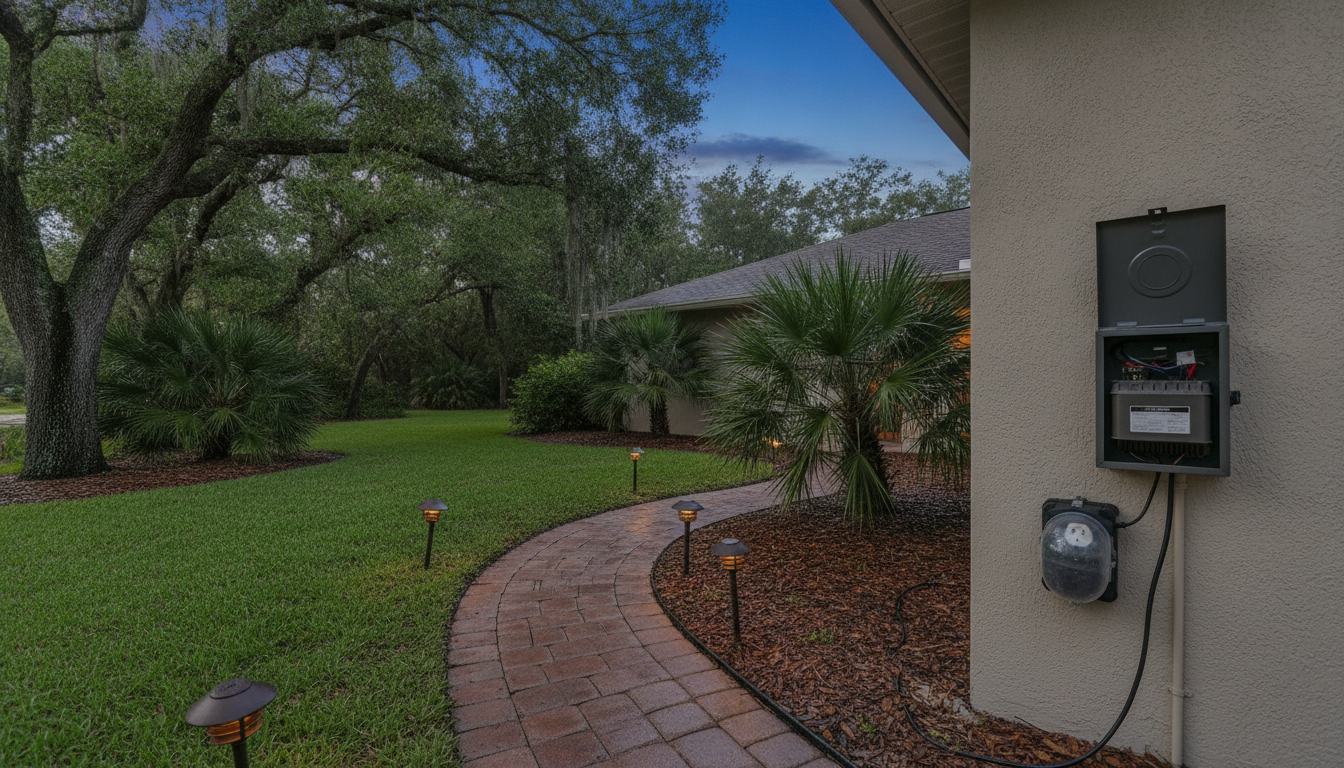
The pattern of failed lights can help narrow the search. When every fixture goes dark together, start with the power source and controls shared by the system. When one section or one fixture fails, focus on the connections and equipment serving that part of the run.
A dry, undamaged GFCI device can be tested and reset according to its instructions. Stop if a device, receptacle, transformer, or panel is wet, hot, discolored, buzzing, damaged, or giving off a burning odor. A fault that returns after a reset needs inspection rather than another reset.
Why is all my landscape lighting out?
A complete outage can begin at the receptacle, transformer, timer, photocell, or another shared part of the system. These observations help separate them without opening electrical equipment:
- Check whether other loads on the same accessible receptacle or circuit have also lost power.
- If the GFCI device is dry and undamaged, use its TEST and RESET controls according to the manufacturer’s instructions.
- Check the timer’s current time, schedule, and manual control.
- Make sure the photocell isn’t covered or receiving direct light from another fixture.
- Inspect the outside of the transformer, cord, plug, and visible cable for damage, heat, discoloration, or water exposure.
The receptacle feeding the transformer may have GFCI protection from another device or from the electrical panel. A receptacle without TEST and RESET buttons can still be protected upstream.
| What you see | Area to investigate | Possible explanation |
|---|---|---|
| Every fixture is dark | Shared receptacle, controls, transformer, or circuit | The interruption may be before the individual lighting runs |
| One known run is dark | Connections and cable serving that run | An open connection or damaged cable may have interrupted that branch |
| One fixture is dark | Lamp, fixture, and its connector | The problem may be limited to that location |
| Lights follow the wrong schedule | Timer and photocell | The control may be set incorrectly or reacting to nearby light |
| Far fixtures are dimmer | Connections, cable route, and system layout | Resistance or voltage drop may be affecting the end of the run |
| The system trips during wet weather | Exposed receptacles, covers, fixtures, and connections | Moisture may be reaching electrical components |
These patterns narrow the possibilities, but they don’t prove a diagnosis by themselves.
Why did only some landscape lights go out?
Start by identifying which fixtures still work and how the cable is routed. On a run where fixtures share a continuous cable path, the area between the last working fixture and the first dark fixture is a useful place to inspect for visible damage or a failed connection.
Recent digging, edging, planting, or irrigation work can also help identify where a buried cable may have been disturbed. Don’t dig into an unknown cable route or handle exposed conductors.
Dim fixtures call for a different investigation than dark ones. Corrosion or a poor connection can add resistance and reduce the voltage available farther along a run. The cable length, conductor size, transformer output, connections, and how the fixtures are divided among runs can all matter.
Replacing every lamp won’t repair an open connection or damaged cable. Confirm the affected part of the system before buying replacement equipment.
Is it the transformer, timer, or photocell?
A timer’s manual-on control is a useful check. If the lights turn on manually but not on schedule, the result points toward the timer settings or photocell. It doesn’t prove that every connection in the system is sound.
A photocell responds to the light reaching its sensor. A porch light, streetlight, or other nearby source can keep the system off after sunset. Leaves, mulch, or overgrown plants can block the sensor and make the lights operate at the wrong time.
If the controls appear to call for light but the system remains dark, the transformer and wiring need further testing. A transformer can receive power without delivering the expected output. That distinction requires measurements, which is where electrical repair and diagnostics can help.
How weather exposure affects outdoor connections
Water reaching a worn connector can corrode the conductors and increase resistance. The result may be dimming, an intermittent outage, or a dead section of the run.
Weather also affects the line-voltage receptacle and cover feeding a plug-in transformer. Corrosion, damaged covers, and failed seals deserve attention because that side of the system carries household voltage. Our guide to corroded outdoor outlets explains the warning signs.
Match fixtures, connectors, transformers, receptacle covers, and other outdoor equipment to their actual exposure. A protected location and a location receiving direct rain or irrigation don’t present the same conditions.
Which repairs belong on the low-voltage side?
A plug-in landscape-lighting system has two distinct sides. Household voltage supplies the receptacle and transformer input. The transformer then supplies the landscape-lighting circuit.
Replacing a compatible low-voltage fixture or repairing an accessible low-voltage connection is different from altering a receptacle, hardwiring a transformer, adding a circuit, or working inside an electrical panel. Have a qualified electrician handle hardwired or line-voltage work.
Florida electrical licenses also have different scopes. Certified electrical contractors may work statewide, registered contractors work within their authorized local jurisdictions, and specialty licenses have bounded scopes. Verify that the business’s active license covers the proposed work and the property’s jurisdiction rather than assuming one license category fits every landscape-lighting job.
Does landscape-lighting repair need a permit?
First determine which permitting authority serves the property. A Tampa Bay mailing address alone doesn’t identify the jurisdiction.
For properties under Hillsborough County’s authority, the county’s work-exempt-from-permits guidance provides a narrow exemption for installing or repairing a low-voltage system in an existing single-family residence. It applies when the homeowner performs the work or when a non-owner performs work whose total labor and material cost doesn’t exceed $5,000.
That exemption doesn’t cover a new household-voltage circuit or changes to the receptacle and wiring feeding the transformer. A project that touches both sides of the transformer may therefore contain different scopes. Confirm the permit path with the authority serving the property before work begins.
How can I check for GFCI protection?
GFCI protection may come from the outdoor receptacle, an upstream GFCI device, or a GFCI breaker. The absence of buttons on one receptacle doesn’t establish that the circuit has no protection.
Use the protective device’s test procedure according to its instructions. If a test doesn’t disconnect the protected load, the device or circuit needs qualified inspection. Don’t operate a device that is wet, visibly damaged, hot, buzzing, or discolored.
GFCI shock protection, overcurrent protection, and arc-fault protection serve different purposes. One doesn’t substitute for all the others. Where Florida code requires GFCI protection explains those distinctions, while GFCI outlet installation covers replacement work.
What affects landscape-lighting repair cost?
The largest scope difference is whether the failure stays on the low-voltage lighting run or reaches the household-voltage supply.
A contractor will also need to determine:
- whether one fixture, one run, or the entire system is affected
- whether the cable route and connections are accessible
- whether digging or irrigation work may have damaged buried cable
- whether the timer, photocell, transformer, or receptacle is involved
- whether damaged equipment can be replaced compatibly
- whether the repair requires changes to the receptacle or circuit
Resetting a control isn’t the same scope as locating a buried cable break. A receptacle or circuit failure also requires different work from replacing a low-voltage fixture. The selected contractor determines pricing after identifying the actual failure and repair scope.
If repeated repairs have made replacement worth considering, the landscape lighting service page explains the broader installation scope. Our Tampa landscape-lighting ideas guide covers fixture placement and design decisions without treating every failed system as a replacement project.
Frequently asked questions
Why did all my landscape lights stop working?
The cause may be a shared receptacle, protective device, control, transformer, or connection. Check accessible controls and the outside condition of the equipment first, but don’t open electrical enclosures or repeatedly reset a fault.
Why does only part of my landscape lighting work?
Map the working and dark fixtures against the known cable route. On a shared run, the transition between the last working fixture and first dark fixture can help locate a failed connection or damaged cable.
Can rain make landscape lighting stop working?
Moisture reaching a worn connector, damaged fixture, transformer, or line-voltage receptacle can contribute to an outage or protective-device trip. Don’t handle wet or damaged electrical equipment.
Should I replace the transformer when everything goes dark?
Not before confirming the condition of the shared power and controls. A receptacle, GFCI device, timer, photocell, cable, or transformer problem can produce a similar complete outage.
How do I know whether my transformer is plugged in or hardwired?
A plug-in transformer has a factory cord connected to a receptacle. A hardwired unit connects through permanent wiring. Don’t remove a cover to determine the connection method. If it isn’t clear from the outside, have an electrician inspect it.
Get help finding the failure
Tampa Electrical Pro connects homeowners with independent licensed and insured electricians across Hillsborough, Pinellas, and Pasco counties. The selected electrician can evaluate both the low-voltage lighting and the line-voltage supply without assuming which side caused the outage.
We serve neighborhoods across the bay, including South Tampa. Call (813) 850-0320 if the system is dark, dimming, operating on the wrong schedule, or tripping during wet weather.