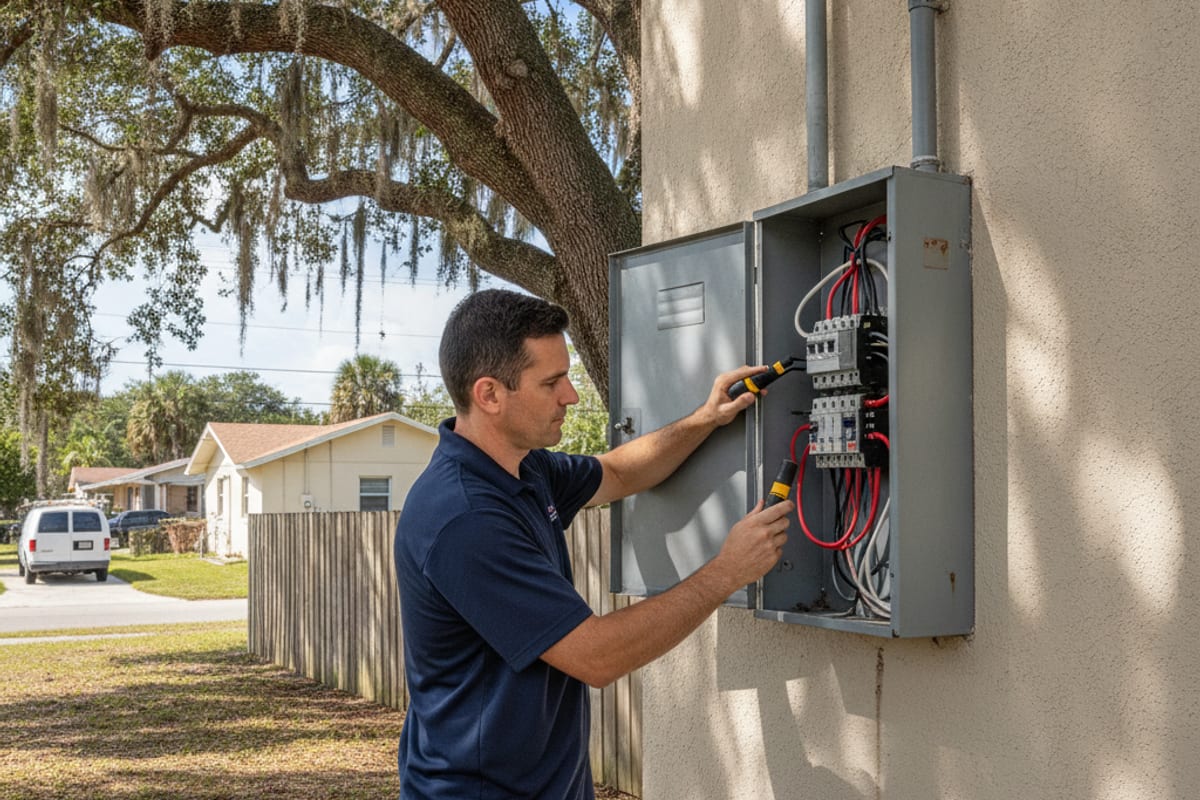
Electrician services in St. Petersburg include troubleshooting, repairs, panel work, and planned installations. Tampa Electrical Pro connects customers with independent licensed and insured electricians. The selected contractor evaluates the property, explains the options, and determines the scope, scheduling, permits, and price.
Electrician services in St. Petersburg for repairs and installations
Electrical repair starts with a symptom that needs diagnosis. Installation begins with a planned load, device, or circuit. That distinction helps an electrician prepare for the visit and keeps assumptions from becoming diagnoses.
For a repair, describe what stopped working, where it happened, and whether it returned. Note any sound, odor, heat, discoloration, shock, or breaker activity. Do not remove a panel cover or handle damaged or wet electrical equipment.
For planned work, gather the equipment label or model when available. Explain whether wiring already exists, where the equipment will go, and what access is available. New circuits, ceiling access, mounting support, controls, and outdoor exposure can all change the scope. Our guide to electrical installation in Largo explains how to prepare for new work.
Is the problem limited to one device or more?
Start by describing the size of the affected area. This gives the electrician useful evidence without guessing at the cause.
A one-device symptom affects one receptacle, switch, light, fan, or appliance connection. Record whether nearby devices still work and whether another GFCI device controls that location. A receptacle without test and reset buttons may still receive GFCI protection from another point on the circuit.
A circuit-level symptom affects several devices in one area or follows a breaker trip. Tell the electrician which rooms and devices lost power. Do not repeatedly reset a breaker that trips again.
A whole-house symptom may include unexplained flicker or dimming across several rooms. That pattern does not identify whether the issue is inside the property, at service equipment, or on the utility side. It calls for prompt qualified evaluation and should not be dismissed as harmless.
The Electrical Safety Foundation International identifies unexplained flicker, hot or discolored plates, buzzing, burning odors, shocks, and frequent trips as warning signs requiring qualified attention. If there is smoke or fire, leave the hazard area and contact emergency services.
When should a panel be evaluated?
A panel evaluation or upgrade may be appropriate when new loads are planned, equipment is damaged, or recurring symptoms involve multiple circuits. Panel size alone does not prove that an upgrade is necessary.
The electrician should evaluate the actual loads, existing service, equipment condition, available spaces, and the proposed installation. An EV charger or another new load can affect that review, but no single appliance automatically determines the answer. A generator connection needs a separate assessment of backup loads and transfer equipment; it does not add a normal utility load.
Avoid opening the panel or removing its cover to gather information. Photos of accessible labels and a written list of symptoms are safer and more useful for the initial conversation.
How are EV charger installations planned?
An EV charger installation depends on the vehicle, daily driving needs, parked time, electrical capacity, equipment instructions, and the route to the parking location.
The U.S. Department of Energy explains that Level 1 charging can cover daily driving for some drivers when suitable dedicated power and overnight parking are available. Level 2 charging uses 240 V. The right choice depends on the vehicle and the driver’s actual routine. Review the federal home-charging guidance at afdc.energy.gov.
Charging is a continuous electrical load. The electrician evaluates capacity and follows the equipment instructions and applicable requirements. Outdoor installations need equipment rated for the actual exposure. App controls, timers, and charging data do not by themselves provide service-load management.
What matters for generators and backup power in St. Petersburg?
St. Petersburg sits on a peninsula surrounded by water, which means hurricane season brings storm surge and coastal flooding. Backup power planning begins with the essential loads, fuel, equipment type, and a safe method of isolating the home from utility power. A generator is not a permanent answer to every outage.
Portable generators can power individual appliances through properly rated outdoor cords. They must remain outdoors, far from the home and away from openings. Never operate one inside a garage, home, crawlspace, basement, or shed. The Consumer Product Safety Commission explains the carbon monoxide risks of indoor generator use.
Directly backfeeding house wiring is unsafe. Fixed whole-home generator systems require professional installation and transfer equipment that isolates the property from the utility. Placement and clearance depend on the listed equipment instructions and local review. Tampa Electric provides additional home electrical and generator safety guidance.
Which permitting authority serves a St. Petersburg property?
St. Petersburg maintains its own Building Department and permitting system. Pinellas County serves unincorporated areas and certain partner jurisdictions, so a mailing address alone does not identify the correct authority.
Check the property’s jurisdiction before work begins. The City of St. Petersburg Building and Site Planning Division and its permit information provide the city starting point. The county also publishes a directory of Pinellas County building departments for properties outside city limits.
Permit and inspection requirements depend on the actual project and jurisdiction. Ask the selected contractor to identify the authority, explain what the scope requires, and state who will handle each submission. Do not assume every device replacement follows the same process.
How should you verify an electrical contractor?
Verify the business’s active license status, authorized scope, and applicable jurisdiction. Florida certified electrical contractors can work statewide. Registered contractors work within their authorized local jurisdictions, and specialty licenses have defined scopes.
An EC license is not the only lawful category for every type of electrical work. The important check is whether the business is properly licensed for the proposed scope and location. The state provides electrical contractor licensing guidance and an online license search at myfloridalicense.com.
Ask for a written proposal that identifies the work, exclusions, equipment, payment terms, and responsibility for permits or inspections. Warranty terms should also be written rather than assumed.
What if the home has aluminum wiring?
Aluminum branch-circuit concerns require an inventory of the actual wire and its connections. The presence of aluminum feeders or service conductors does not establish that the home has aluminum branch wiring.
The Consumer Product Safety Commission guidance discusses copper rewiring and approved connector repair methods, including COPALUM and AlumiConn under specified conditions. The appropriate approach depends on the wire, connections, equipment, and qualified installation method. A home’s age or neighborhood does not confirm what wiring is present.
Frequently asked questions
How much do electrical services in St. Petersburg cost?
The price depends on the diagnosed problem or planned scope. Access, wiring route, equipment, existing conditions, and permit requirements can affect the proposal. Request a written estimate after the contractor has enough information to define the work.
Do I need a permit for electrical work in St. Petersburg?
It depends on the project and the property’s jurisdiction. St. Petersburg has its own permitting process, while other Pinellas County addresses may fall under another authority. The contractor should confirm the applicable requirements for the actual scope.
What should I report when lights flicker?
Describe which lights flicker, whether the symptom crosses several rooms, what equipment was operating, and whether you noticed heat, odor, sound, or breaker activity. Widespread unexplained flicker deserves prompt qualified inspection and should not be diagnosed from a description alone.
Can I test or repair the panel myself?
Do not remove covers, work on panel wiring, or approach damaged or wet equipment. Keep a safe distance and give the electrician observable details. For smoke or fire, leave the area and contact emergency services.
Does a new appliance automatically require a panel upgrade?
No. The electrician needs to evaluate actual loads, electrical capacity, existing equipment, and the proposed installation. Panel amperage or the appliance name alone does not determine the result.
Get connected with an electrician in St. Petersburg
Call Tampa Electrical Pro at (813) 850-0320. We connect St. Petersburg customers with independent licensed and insured electricians for repair diagnostics and planned electrical work. The selected contractor determines the scope, permits, scheduling, workmanship, and price.