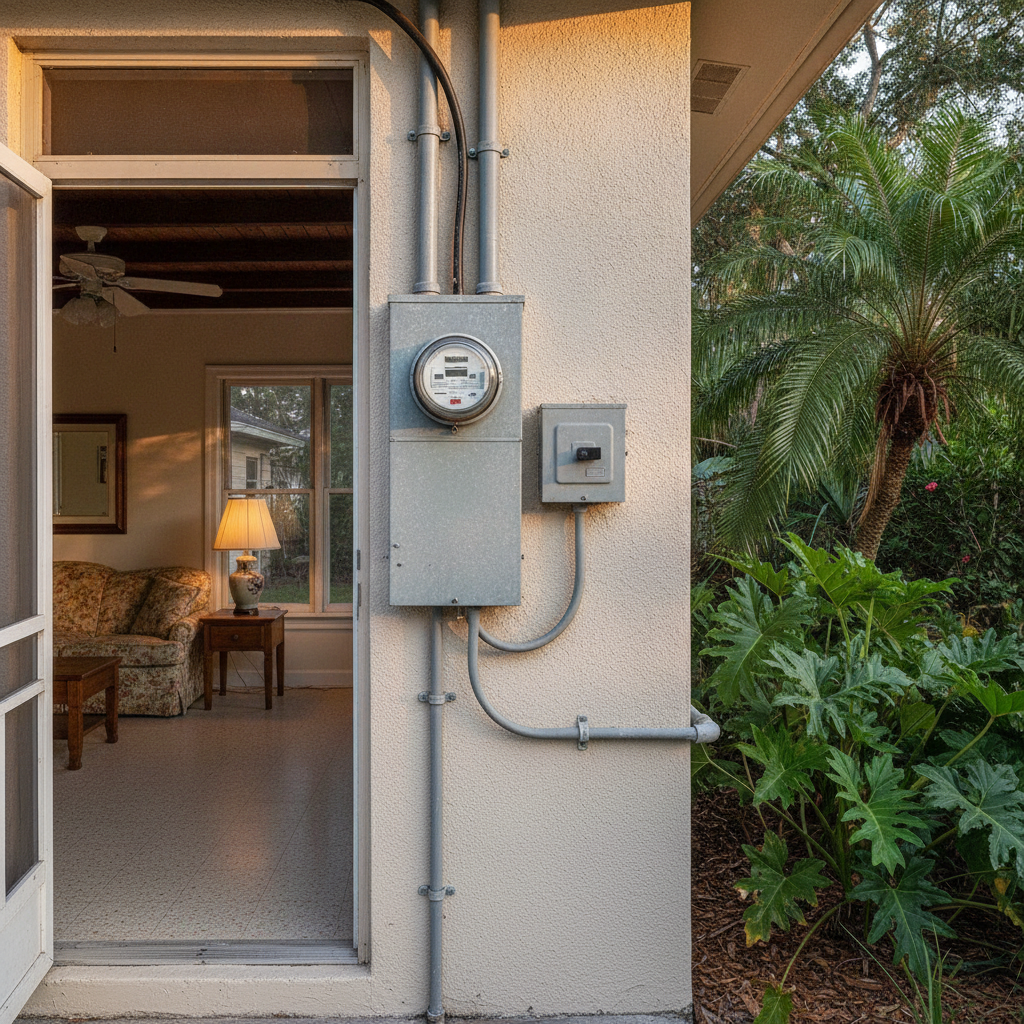
The right South Tampa electrician starts at your panel, your meter can, and the path a new circuit would take through this house. Tight side yards off Bayshore, plaster in Hyde Park, a charger on the far wall of a garage, a dock circuit at the canal: those details change the job. Tampa Electrical Pro matches you with independent licensed and insured electricians who work South Tampa addresses. The selected contractor sets the price after seeing the property.
What a licensed electrician looks at in South Tampa
The electrician is looking at four things: how much spare space the panel has, how much spare capacity the service has, where the meter and disconnect sit, and how a new run would actually get from the panel to the work. Spare spaces and spare capacity are different problems. A panel can have empty slots and still be loaded to the limit by air conditioning, a pool pump, and a kitchen that already runs hard in July. A panel can have leftover capacity and still have no room for another breaker.
On a typical visit the electrician identifies these facts on site:
- The work either lands on an existing circuit or it needs a new one from the panel.
- The route from the panel to the work is open, finished, plastered, or buried in a slab, and that route sets the labor.
- The loads already on the service, including continuous loads such as charging, either fit or they don’t.
- Outdoor gear is listed for indoor, damp, or wet exposure, and the protection on that circuit matches the location.
Florida certified electrical contractors can work statewide. Registered contractors work inside their authorized local jurisdictions, and specialty licenses have bounded scope. EC isn’t the only lawful category for every electrical task, and not every person on a job holds a contractor license. The electricians we send are licensed and insured. They confirm the permit and inspection steps with the authority for that address. This brand doesn’t pull permits.
If a breaker keeps tripping, a receptacle is dead, a switch feels hot, or something in the house just doesn’t behave, that’s electrical repair work. Tampa Electric’s home safety guidance is plain. A plug that fits loosely means the outlet needs repair. Extension cords are temporary. An appliance that repeatedly trips a breaker should be unplugged and looked at. Unexplained flicker, a burning odor, buzzing, shocks, or frequent trips call for a qualified inspection. Smoke or fire means leave the area and contact emergency services.
This site publishes an electrical repair range of $150 to $450 including the diagnostic visit. That’s a site-published band, not a Tampa average and not a quote. The contractor prices the actual job after inspecting the house. For how a nearby repair visit usually unfolds, see our note on electrical repair service near you in Tampa.
If the panel is out of spaces, or the load calculation for a charger or a generator doesn’t fit, the conversation moves to a panel upgrade. This site publishes $2,500 to $4,500 for a 100 amp to 200 amp upgrade. That band isn’t a claim that every South Tampa home needs 200 amp service. It’s the published range for that specific scope. Tampa Electric designates the metering location, and the customer provides the meter socket. That utility line is separate from the panel work inside the house.
Tight access, plaster, and added load
A Hyde Park plaster wall decides how a new circuit gets routed. It doesn’t tell anyone what wiring is in the house. The electrician opens a path, or fishes a run, based on what is actually there: plaster and lath, later drywall patches, a finished ceiling, a slab with no attic to hide in. A bungalow with a two-foot side yard and the meter on the street wall is a different job from a Palma Ceia house with a wide drive and the panel right inside the garage. South Tampa electricians spend a lot of time on access and finish because the house is already built and the walls are already closed.
Added load follows the same rule. A Level 2 charger uses 240 volts. The U.S. Department of Energy notes that Level 1 can cover daily driving for some drivers when the circuit and overnight park time fit, and that Level 2 is the 240 volt choice. The vehicle, the daily range, and parked time affect which setup makes sense. The electrician evaluates electrical capacity. Charging is a continuous load. A charger mounted on the far side of a South Tampa garage, with the panel on the opposite side of the house, means a longer 240 volt run. The conduit and conductor for that run is most of the labor. This site publishes $1,200 to $2,000 for EV charger installation when existing panel capacity is adequate. That figure doesn’t cover a service upgrade, and it is a site-published range, not a quote.
Don’t treat a neighborhood or a build year as a wiring diagnosis. Aluminum branch wiring, an older panel, ungrounded receptacles, or a small service are things the electrician finds at the property. The CPSC describes approved connector methods and copper rewire for aluminum branch circuits when that wiring is actually present. A street in Hyde Park or Ballast Point doesn’t establish that a house contains it.
Whole-house surge protection at the panel is a separate add. This site publishes $300 to $600 for that scope. A generator is another added-load conversation. Portable units power individual appliances through properly rated outdoor cords. Direct backfeeding into house wiring is unsafe. Fixed standby equipment is professionally installed with transfer isolation from the utility. Fuel-burning generators create carbon monoxide, fire, and electrical hazards. Portable generators belong outdoors, far from the house and away from openings, never in a garage, crawlspace, or shed. This site publishes $10,000 to $18,000 for a whole-home generator, installed. The selected contractor sizes the essential-load list and the equipment after seeing the house.
Dock circuits and exterior equipment
A dock circuit is a wet-location job, not a patio outlet with a longer cord. Boat lifts, shore power, and dock receptacles sit in spray and standing water. The electrician matches the equipment to that exposure and to GFCI shock protection. GFCI protection can sit at different points in a circuit, so a plain receptacle with no test-reset buttons can still be protected upstream. Absence of those buttons isn’t proof that nothing is protecting the circuit. Outdoor equipment has to match its listing: damp-rated gear for protected damp spots, wet-rated gear where water can actually hit the device. A covered porch doesn’t automatically keep rain off a fan or a receptacle.
South Tampa canals, Davis Islands, Harbor Island, and the Bayshore edge make this a regular scope. The work still starts at this dock, this pedestal, this run back to the panel. This site publishes $1,500 to $3,500 for a marine-grade outdoor panel and receptacle upgrade. That’s a site-published band for that scope, not a quote for every waterfront house. For the mechanics of lifts, bonding, and wet-location gear, we keep a separate guide on dock and boat-lift electrical in Tampa Bay.
Exterior equipment on land has the same exposure rule. Landscape lighting, pool equipment pads, and outdoor kitchens all need a path, a listing, and protection that fits the location. After storms, start with Tampa Electric’s damaged meter equipment page so you know whether the meter and service line are a utility call or the weatherhead, riser, and meter box are an electrician call. That split is for storm-related damage. Customers are not allowed to make connections to or disconnections from Tampa Electric equipment. Don’t open damaged or wet electrical gear. Don’t treat turning the main breaker off as enough protection to backfeed a generator.
Unexplained heat at a device, arcing, a burning odor, or a dock circuit that trips and will not hold is a qualified inspection, not a wait-and-see. The electrician de-energizes and verifies before any work. Homeowners shouldn’t open panels, pull deadfronts, or work on pool, spa, or dock circuits.
South Tampa electrician questions
Do I need a permit for electrical work in South Tampa?
The reviewing office depends on the property, not the mailing city. City of Tampa addresses, unincorporated Hillsborough, and nearby cities each have their own building department. The licensed contractor pulls the permit when one is required and confirms the inspection steps with that office. There is no blanket rule that every device swap needs a permit, and this brand doesn’t pull permits.
What does a South Tampa electrician visit cost?
The selected contractor sets the price after inspecting the property. This site publishes $150 to $450 for electrical repair including the diagnostic visit, $2,500 to $4,500 for a 100 amp to 200 amp panel upgrade, and $1,200 to $2,000 for an EV charger when panel capacity is already adequate. Those are site-published ranges, not Tampa averages and not quotes. Length of run, plaster or finished access, new versus existing circuits, outdoor or dock exposure, and whether the service itself has to change are what move the number.
Who should I call after storm damage at the meter?
Call Tampa Electric about storm-related damage to the electric meter and the service line. Call a licensed electrician about the weatherhead, riser, and meter box. Customers are not allowed to make connections to or disconnections from Tampa Electric equipment. If there is smoke or fire, leave and contact emergency services first.
When to call us
Call when a circuit will not reset, a new load needs a dedicated run, a dock or exterior device is in the wet, or the panel is out of space or out of capacity. The electricians we send are licensed and insured, and they confirm permits with the authority for your address. Call us at (813) 850-0320.