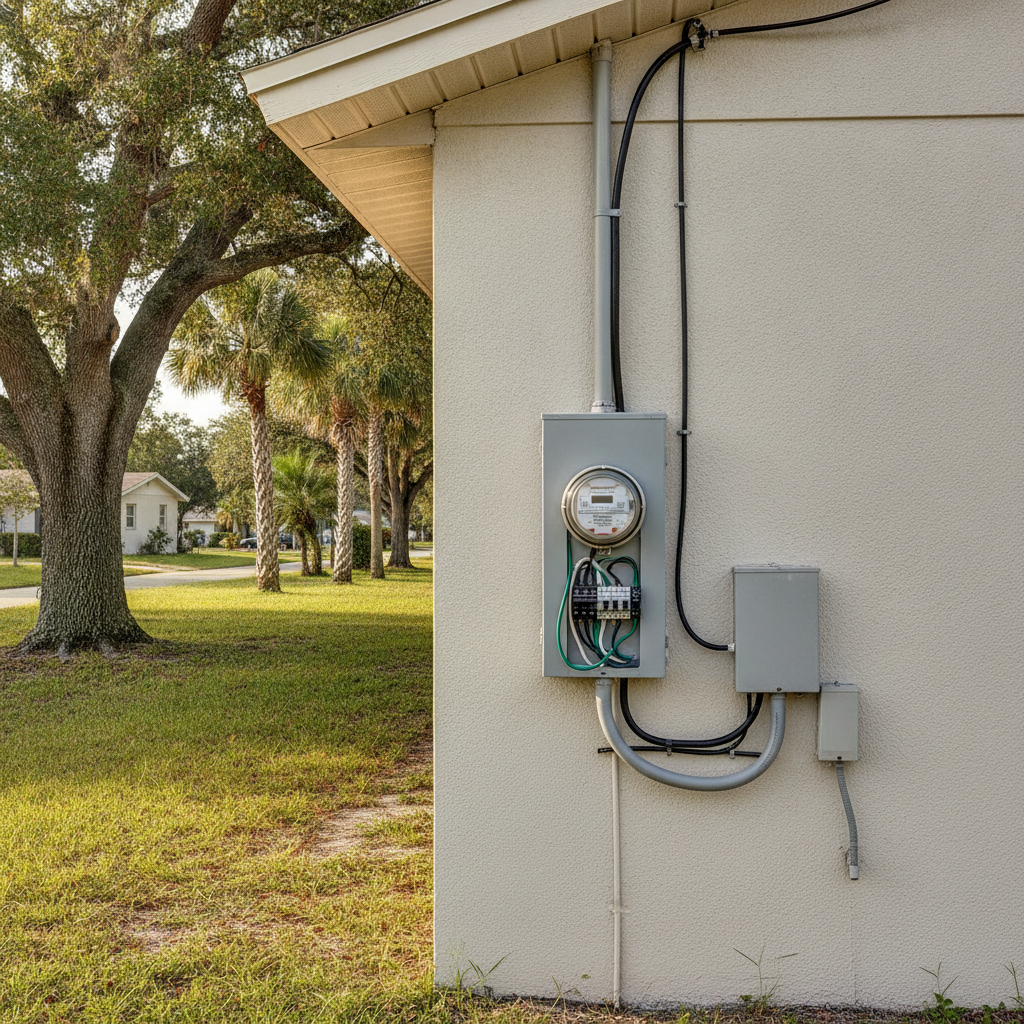
A tripped breaker that will not stay on in a ranch west of 66th Street and a 240 volt charger on the far wall of a garage off Park Boulevard are different jobs, and both start with a licensed electrician at the panel. Tampa Electrical Pro matches Pinellas Park homeowners with independent licensed and insured electricians. The electrician traces the circuit, confirms the reviewing office for that address, and prices the work after seeing the property.
What Pinellas Park homeowners hire an electrician for
Most Pinellas Park calls are repairs. A kitchen receptacle goes dead while the breaker sits on. A bathroom GFCI will not reset. A ceiling fan wobbles because the box in the ceiling was only meant to hold a light. Landscape lights on a side yard quit after a summer storm. Those are electrical repair jobs, and the electrician’s first task is to find whether the fault is at the device, in a splice, or further up the same circuit.
A GFCI device can protect a plain receptacle further down that circuit, so a cover plate with no test and reset buttons does not prove the outlet is unprotected. The electrician tests the actual path. Outdoor devices have to match the weather they actually see. A covered porch still wets a receptacle when rain drives sideways, and a wet-location cover and listing are a different product than an indoor device.
A fan is a moving load. An existing light fixture does not establish that its box can carry that load. The electrician checks for a fan-rated box and a solid structural attachment, then follows the fan’s own mounting instructions. New wiring, attic access, a control swap, and the fixture itself all change the scope.
Homeowners also call when they want something added, not fixed. A Level 2 charger is a 240 volt continuous load. A standby generator needs transfer equipment that isolates the house from the utility. A whole-house surge device mounts at the panel. Recessed lighting in a living room, a new range circuit, or a spa disconnect are the same class of work: the electrician sizes the circuit to the equipment, finds a route through slab, block, and stucco, and treats indoor, damp, and wet locations as different environments.
Unexplained flicker or dimming, a hot or discolored cover plate, buzzing or crackling, a burning odor, a shock, or breakers that trip again and again are reasons for a prompt look by a qualified electrician. None of those signs can be diagnosed from the street. If you see smoke or fire, leave the house and contact emergency services.
Pinellas Park sits between Largo and St. Petersburg, and Pinellas County electricians work all three. The city hub for electrician service in Pinellas Park is the local starting point. Largo next door runs its own Building Division. A St. Petersburg address is another city again. The mailing city on a bill does not pick the office. The property does.
Panel space, repairs, and added load
Service capacity and circuit space are two different problems. A panel can have empty breaker slots and still be at the limit of the service feeding it. A house can have leftover service capacity with no spare slots left. An EV charger, a new 240 volt appliance, or a standby generator transfer setup can run into either one, and the electrician has to measure both before anyone orders a breaker.
A charger mounted on the far wall of a Pinellas Park garage, with the panel on the opposite side of a ranch, means a long 240 volt run. Conduit, conductor, and the path through block or finished walls are most of that labour. Level 1 charging on a dedicated circuit can cover daily driving for some drivers when the car sits overnight. Level 2 uses 240 volts. The vehicle, the miles you actually drive, and how long the car is parked decide which one fits. The U.S. Department of Energy’s home charging guidance puts that choice on those three facts, plus the electrician’s reading of the panel. A smart charger’s app does not, by itself, prove the service can take the load. Outdoor chargers need outdoor-rated equipment.
A portable generator can run individual appliances through properly rated outdoor cords. It belongs outdoors, far from the house and away from windows, doors, and vents, never in a garage, crawlspace, or shed. Feeding a generator into a dryer outlet or any other receptacle backfeeds the house and the utility, and that is unsafe. Fixed standby equipment is a different installation: a licensed electrician sets transfer gear that isolates the house from the utility. Fuel-burning generators still produce carbon monoxide and exhaust. Standby equipment does not erase that. It also does not add load to the utility while it is running on its own fuel. The electrician still has to size the essential-load list, the pad, and any HOA rules that decide where that pad can sit in a villa community.
A repair that keeps a circuit working is not a panel upgrade. Replacement of a failed breaker, a damaged receptacle, or a burned device is one scope. Running out of slots, or finding that the service cannot carry a new continuous load, is another. Aluminum branch-circuit connections, if they are actually present, need a complete inventory of those connections. A build year on a Pinellas Park ranch does not establish aluminum, a particular panel brand, or a service size. The electrician identifies the conductors and the equipment that are in the house.
The electrician working a Pinellas Park panel is looking at facts on that wall, not at the neighborhood.
- Existing circuits and new circuits are priced and routed as different work, because fishing a conductor through finished rooms is not the same job as landing a breaker on a spare space.
- Indoor, damp, and wet listings follow the water the device will actually see, not the room name on a floor plan.
- Utility isolation, fuel, and an essential-load list belong on generator work; a cord through a window is not a transfer method.
Permits stay with the licensed contractor
The licensed electrician pulls the permit, not Tampa Electrical Pro. The reviewing office is the one that has authority over that Pinellas Park address, and a mailing address alone does not establish it. Pinellas County’s published list of building departments is the map the electrician uses. Pinellas County Building and Development Review Services covers unincorporated Pinellas and a short list of partner cities. A Pinellas Park property is checked against that list rather than assumed. Largo, immediately west, has its own department. The electrician confirms the permit and inspection steps with the authority for that address.
Florida licensing is not one stamp. Florida’s Electrical Contractors’ Licensing Board distinguishes certified electrical contractors, who may work statewide, from registered contractors, who work inside the local jurisdictions that authorized them. Specialty licenses have a bounded scope. EC is not the only lawful category for every electrical task, and not every person on a job holds a contractor license. What you want on the job is an active license that covers the work, in the jurisdiction that covers the house.
A like-for-like device swap and a new circuit are not the same project. Overview pages do not publish a clean exemption list that covers every receptacle, every fan, and every charger. The electrician asks the reviewing office for that property. That is the only answer that holds still from one street to the next.
The selected contractor also sets the price after seeing the house. Access through a finished ceiling, a long garage run, a wet-location listing, a full versus empty panel, and whether the work is a repair or a new circuit all move the number. There is no honest hourly figure that covers a dead kitchen receptacle and a standby generator on the same afternoon.
What is the difference between a certified contractor and a registered one?
A Florida certified electrical contractor can work anywhere in the state. A registered contractor works inside the local jurisdictions that authorized that registration. Specialty licenses cover a narrower set of tasks. Licensed is the word that matters for the homeowner, and the electrician on your job should hold a license whose scope matches the work at your address.
Can electrical work in Pinellas Park skip a permit?
The reviewing office for that property decides. A device replacement and a new 240 volt run are not treated as the same job, and Pinellas Park is not automatically the same office as unincorporated Pinellas County or as Largo next door. The electrician confirms the permit and inspection path with the authority that actually covers the house.
How do Pinellas County electricians price a job without a posted hourly rate?
They price the scope in front of them. A reset that finds a failed GFCI is a different visit than fishing a 240 volt circuit the length of a ranch, or setting transfer equipment for a standby generator. The contractor who will do the work sees the panel, the route, and the load, then writes the price for that house.
When to call us
Call when a circuit will not stay on, when a cover plate is hot or discolored, when you want a charger, a generator transfer setup, or more space in the panel, or when you need a licensed electrician to confirm the permit path for a Pinellas Park address. Tampa Electrical Pro matches you with independent licensed and insured electricians who do that work. Call us at (813) 850-0320.