A Ybor cafe adding a second espresso machine, a Westshore shop hanging new display lights, and a Hyde Park office that keeps tripping a shared copier circuit are not house calls with a different sign on the door. Commercial work is dedicated equipment circuits, panel space, and inspection in a place that has to stay open. Tampa Electrical Pro matches business owners with independent licensed and insured electricians. The matched contractor does the work.
What commercial electrical work covers in Tampa
Commercial electrical work is the wiring, panels, lighting, and equipment connections that serve a place of business, from a South Tampa cafe to a small office in a Westshore suite. Same trade as a house call. Different loads, and a room that cannot sit dark through lunch.
A house circuit is usually shared among lamps, a TV, and a few plugs. A commercial kitchen circuit is sized for equipment that sits on for hours: a refrigerator that cannot drop, a dishwasher, an exhaust fan, a point-of-sale terminal that has to survive the rush. Those loads do not live on a spare receptacle. The electrician maps each piece of equipment to a circuit that can carry it, then checks whether the panel has space for those breakers and whether the service feeding the panel can carry the total.
Service capacity and circuit space are two different problems. A panel can be packed with breakers while the service still has unused capacity. A service can be undersized while empty slots remain in the can. The electrician reads labels, existing loads, and the new equipment nameplates. The building’s age and the neighborhood do not establish what is in the wall.
If you searched for a commercial electrician in Tampa FL, you are usually trying to add equipment or restore a circuit. On a typical job that is commercial electrical work, the scope looks like a tenant build-out in a finished suite, a new 240-volt run for kitchen equipment, a failing disconnect on a concrete-block storefront, storefront or lot lighting, or a circuit that died on a Saturday. When the problem is a dead outlet, a trip that will not clear, or heat at a plate, that is electrical repair work. Overcurrent protection, GFCI shock protection, and AFCI arc-fault protection do different jobs, so a trip is not one story. Unexplained flicker, a burning odor, arcing, buzzing, or repeated trips need a qualified inspection. Smoke or fire means leaving the hazard area and contacting emergency services.
Some owners ask about backup power after a summer storm. Portable generators can power individual appliances through properly rated outdoor cords. Direct backfeeding into building wiring is unsafe. Fixed standby equipment is professionally installed with transfer isolation from the utility. Fuel-burning generators create carbon monoxide, fire, and electrical hazards, and they belong outdoors, away from openings.
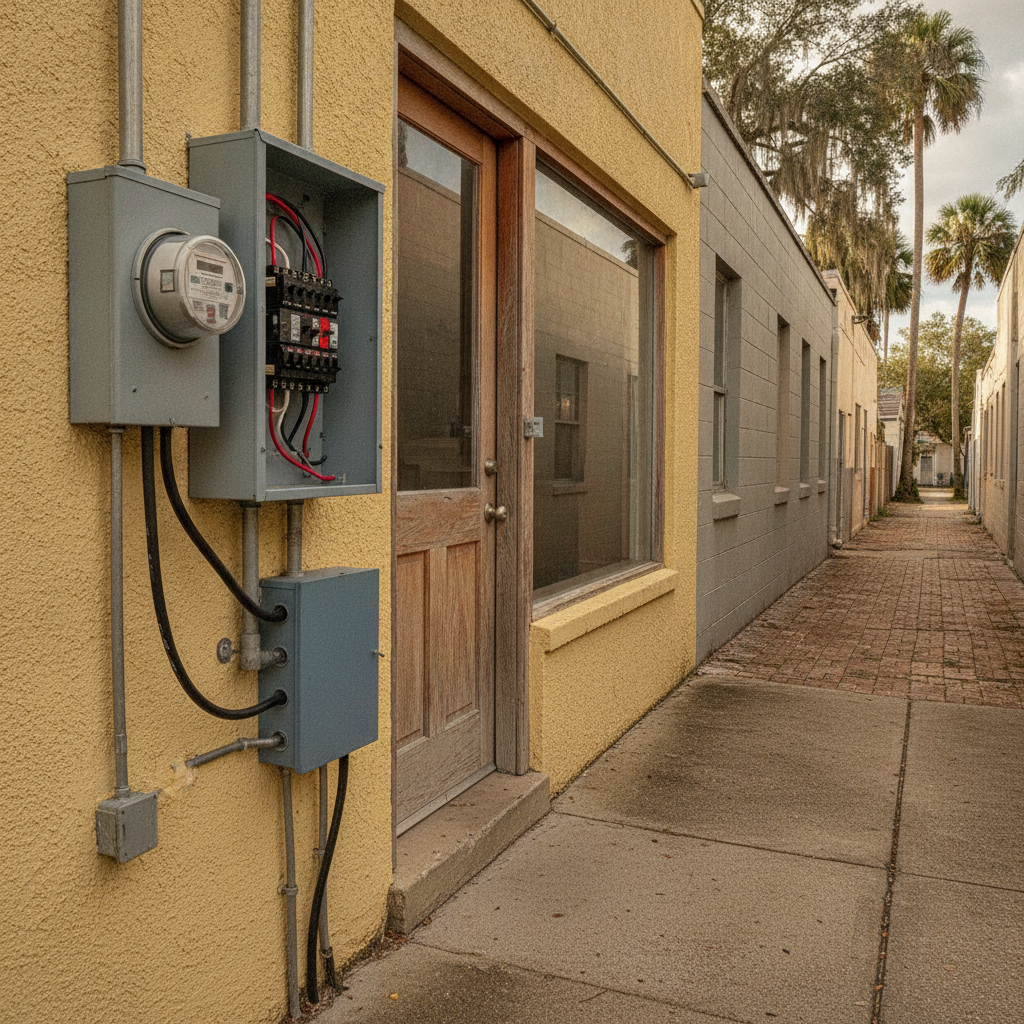
Outdoor gear has to match its exposure. The exterior meter can on a South Tampa storefront takes weather and alley traffic in a way a hallway panel does not.
A cafe, a shop, and a small office
The occupancy decides the load list. The electrician still has to see the panel.
In a cafe, the espresso machine, the undercounter fridge, the ice machine, and the POS printer each need a dedicated path back to the panel. Stacking them on one general-purpose circuit is how you get a trip in the middle of the morning rush. The electrician also looks at the exhaust, an electric water heater if there is one, and whether the existing panel has room. GFCI protection can sit at the receptacle or farther upstream on the same circuit, so a plain outlet in the dish pit does not prove the circuit is unprotected. A Hyde Park plaster wall or a finished Ybor dining room changes how a new circuit gets routed. Concealed work through a public room is a different job than an open joist in a stockroom.
In a shop, the mix is retail lighting, display cases, a rear stockroom, and a panel that is too easy to bury behind pallets. Federal workplace rules require enough access and working space around electrical equipment for ready and safe operation and maintenance, and that working space is not storage. A Westshore boutique that blocked its panel with seasonal stock has an access problem before it has a wiring problem. Exterior sign circuits and storefront lighting sit on the weather side of a stucco wall, so the equipment has to match the exposure.
In a small office, copiers, a network closet, and window HVAC units are the loads that surprise people who treated the suite like a house. A shared circuit that was fine for laptops will not hold a copier and a mini-split. The electrician identifies existing versus new circuits, the route, and the actual nameplate loads. An office-park suite and a downtown Tampa floor can look similar from the parking lot and still have completely different panels.
None of those scenes is a diagnosis from the zip code. Businesses inside the city can start from our Tampa electrician pages. The property, the equipment, and the panel in front of the electrician decide the work.
| Question the job has to answer | House call | Cafe, shop, or small office |
|---|---|---|
| Existing versus new circuit | Often a swap on a known circuit | Often a new dedicated run for named equipment |
| Panel space versus service capacity | Two separate limits | The same two limits, plus tenant access and business hours |
| How the run is routed | Attic, garage, or finished wall | Finished dining room, stockroom, or a suite you cannot close for a week |
| Inspection | The electrician confirms steps with the authority for that address | Same rule, and the reviewing office follows the property |
What moves the cost of a commercial job
There is no commercial hourly rate published on this site, and a number copied from a search result would not be the number you pay. The selected contractor prices the job after inspecting the property. Commercial electrical contractors in Tampa FL still bid that way.
What moves that number is the work itself. An existing circuit with spare capacity is a smaller job than a new run through a finished dining room. A 240-volt piece of kitchen equipment on the far wall from the panel means a longer run, and the conduit and conductor for that run is most of the labor. Panel space and service capacity are separate limits. Hitting either one changes the scope. Indoor work is not the same job as a wet or outdoor-rated install on a storefront. After-hours work so the cafe can open in the morning is a scheduling choice the contractor and the owner make together. It is not a published premium here.
A statewide salary headline is not a bid for your cafe. The useful question is the scope in front of you: existing versus new circuit, route and access, actual loads, equipment labeling, and indoor versus wet exposure.
Permits stay with the licensed contractor
The licensed contractor pulls any permit. Tampa Electrical Pro does not. The electricians we send are licensed and insured. Scheduling, scope, permits, workmanship, and price are determined by the selected contractor. The reviewing office depends on the property, not the mailing city.
Florida certified electrical contractors can work statewide. Registered contractors work within their authorized local jurisdictions. Specialty licenses have bounded scope. EC is not the only lawful category for all electrical work. Check active status, scope, and the jurisdiction for the business. Do not assume every person on the job holds a contractor license. Our note on choosing a licensed electrician in Tampa walks through that split in plain language.
A mailing address in Tampa does not put an unincorporated Hillsborough property under the City of Tampa. Pinellas County serves unincorporated areas and specified partner cities, and Largo has its own Building Division and LCAP permit process. Temple Terrace publishes its own electrical application forms. If you are outside the Pinellas County list, you use that city’s building department. The companion post on electrical permits in Tampa is the longer version of this point: confirm the authority from the address, then let the electrician handle the permit and inspection steps.
Those overview pages do not verify a blanket permit for every device replacement, an exact exemption, an approval time, or a project price. The electrician confirms the actual steps with the authority for that address.
Common questions about commercial electricians
Is a commercial electrician better than a residential electrician?
The useful split is the work, not a rank. Commercial work in a Tampa cafe is dedicated equipment circuits, panel space, and inspection in a place that has to stay open. Residential work is the same trade in a dwelling. Florida licensing is certified, registered, and specialty scope, not a separate commercial-only title that makes one person automatically better. Match the electrician to the actual loads, the route, and the authority for that address.
How much does commercial electrical work cost in Tampa?
There is no commercial hourly rate on this site. The selected contractor sets the actual price after seeing the property. Existing versus new circuit, route and access, nameplate loads, panel space versus service capacity, finished-tenant routing, and whether the business has to stay open are what move the number.
Who pulls the permit for a Tampa cafe or shop?
The licensed contractor. This brand matches you with that contractor. The reviewing office follows the property: Largo reviews Largo, Pinellas County reviews unincorporated Pinellas and named partner cities, and Temple Terrace reviews Temple Terrace. Confirm the authority from the address.
When to call us
Call when you are adding equipment, opening a suite, chasing a trip that keeps taking the cafe down, or looking at a panel that no longer has space for the load you want. That work belongs to a licensed electrician, and the contractor who does it confirms the permit for that address. Call us at (813) 850-0320.