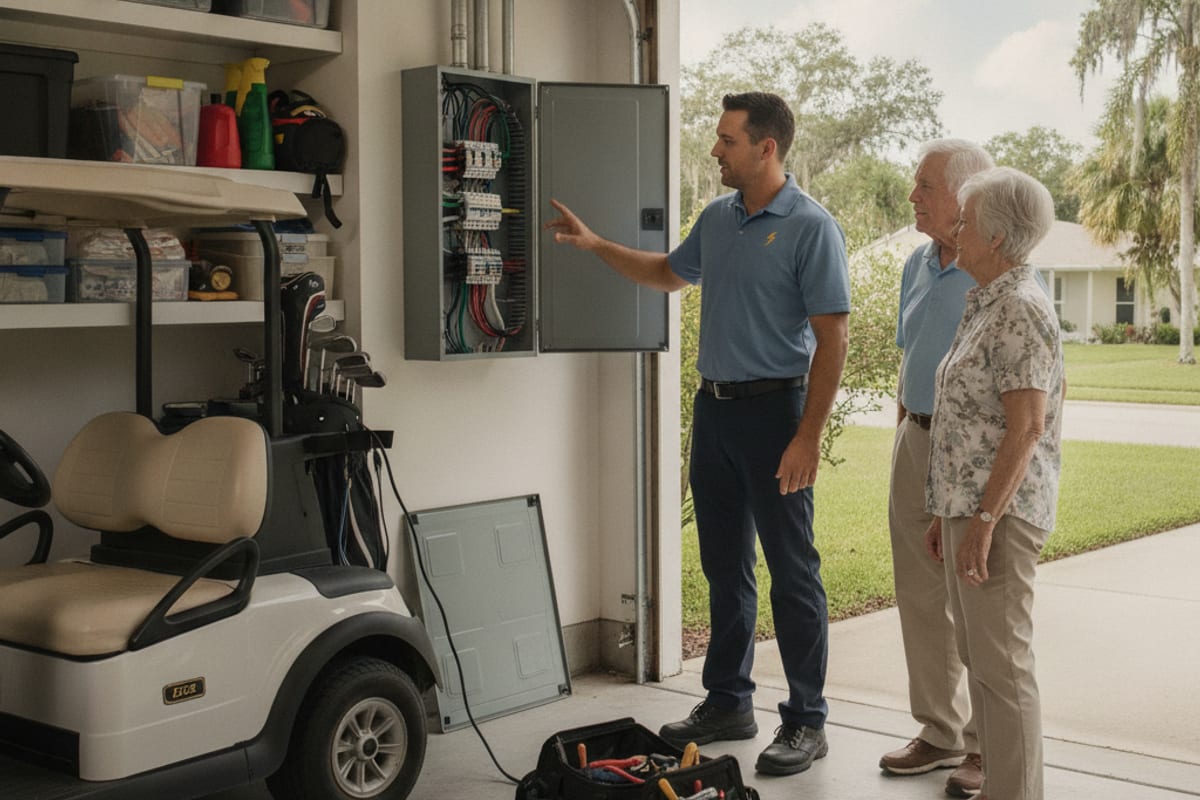
Searches for electrician Sun City almost always mean the retirement community of Sun City Center, not a separate unincorporated Sun City. Electrical work there starts with a clear description of the problem or planned addition. A qualified electrician can then evaluate the actual wiring, panel, loads and equipment instead of drawing conclusions from the home’s age or neighborhood.
Tampa Electrical Pro is a referral service. We connect homeowners with independent licensed and insured electricians who determine the work scope, scheduling, permits and price. Whether you need troubleshooting, a new circuit, a panel upgrade or surge protection, the goal is to match the solution to the property rather than recommend an upgrade by default.
Choose the service that fits the problem
Electrical service calls generally fall into two groups: troubleshooting an existing problem and planning a new installation.
Troubleshooting may involve a dead receptacle, repeated breaker trips, flickering lights, damaged devices or a circuit that behaves differently when certain equipment runs. The useful starting details are where the symptom occurs, what else loses power, whether it repeats and what was operating at the time. Those observations help the electrician test the right parts of the system without treating one symptom as proof of a particular failure.
Planned work may include lighting, ceiling fans, appliance circuits, EV charging, backup power or additional receptacles. For these projects, the electrician needs the equipment label or model, the proposed location, the wiring route and access, and the loads already served by the electrical system.
Warning signs that need qualified inspection
Repeated breaker trips, unexplained flickering or dimming, buzzing or crackling, shocks, burning odors, and hot or discolored switches or receptacle plates call for prompt inspection by a qualified electrician. These symptoms can have different causes, so they shouldn’t be diagnosed from a description alone.
Don’t repeatedly reset a breaker that trips again. Don’t remove a panel cover or approach electrical equipment that is wet, visibly damaged or producing heat, arcing or smoke. If there is smoke or fire, leave the hazard area and contact emergency services.
A dead receptacle does not always mean the receptacle itself failed. The cause could be elsewhere on the circuit. A plain receptacle without test and reset buttons may also receive GFCI protection from an upstream device. An electrician can trace the circuit and verify the protection without relying on appearance alone.
Panel capacity and circuit space are different
An electrical panel can have open breaker spaces while the service lacks capacity for a proposed load. It can also have adequate service capacity but no practical room for another breaker. Those are separate questions.
A subpanel can add circuit space, but it does not increase the utility service capacity. A service upgrade should be based on the actual loads and an appropriate load calculation, not just the panel’s age, its labeled amperage or the number of occupied slots.
This distinction matters when planning air-conditioning equipment, electric cooking, water heating, an EV charger or another substantial load. The electrician should identify whether the project needs only a branch circuit, changes inside the existing distribution equipment or work on the service itself.
EV charging and other new circuits
Level 2 EV charging uses 240 volts and is treated as a continuous electrical load. The right charging setup depends on the vehicle, daily driving needs, parked time, manufacturer requirements and the property’s available electrical capacity.
An electrician should evaluate the proposed equipment, circuit route, panel conditions and installation environment. Outdoor installations require outdoor-rated equipment. App controls, timers and charging data can be useful features, but those features alone do not establish that a charger can manage the home’s electrical load.
A panel upgrade is not automatic just because an EV charger is planned. The decision comes from the charger requirements and the electrical evaluation.
Ceiling fans and outdoor equipment
An existing ceiling light box should not be assumed to support a fan. The installer needs to verify that the box has the appropriate fan rating and secure structural attachment, then follow the mounting instructions for the selected model.
For porches and other exposed areas, product ratings matter. Damp-rated fans are intended for protected damp locations without direct water exposure. Wet-rated fans are designed for outdoor water exposure. A roof overhead does not settle the question by itself because wind-driven rain and the fan’s actual location can change the exposure.
New wiring, ceiling access, structural support, controls and the fixture supplied all affect the scope.
Surge protection and backup power solve different problems
Surge protection and backup power aren’t interchangeable. Surge protection addresses voltage surges. A generator supplies power during an outage.
A standby generator does not add utility load by itself. It supplies selected home loads when utility power is unavailable and requires transfer equipment that isolates the home from the utility. The essential-load list, generator equipment, fuel arrangement and installation conditions shape the project.
A portable generator can power individual appliances through properly rated outdoor cords. It must not be connected directly to house wiring by backfeeding a receptacle. Turning off the main breaker is not a substitute for proper transfer isolation.
Fuel-burning generators create carbon-monoxide, fire and electrical hazards. Portable generators belong outdoors, far from the home and away from doors, windows and other openings. They should never operate in a home, garage, basement, crawlspace or shed. Fixed standby equipment follows its listed installation instructions and local review requirements.
Permits and property jurisdiction
Permit and inspection requirements depend on the work and the authority responsible for the property. The selected contractor should identify the jurisdiction, determine what the project requires and explain who will submit documents and coordinate inspections.
Avoid blanket promises that every fixture replacement needs a permit or that every project is exempt. A new circuit, service change, equipment replacement and device repair can be treated differently depending on the actual scope.
How to compare electricians serving Sun City
Verify the contractor business’s active license status, authorized scope and applicable jurisdiction through the Florida Department of Business and Professional Regulation. Florida certified electrical contractors can work statewide. Registered contractors work within their authorized local jurisdictions, and specialty licenses have defined scopes. EC is not the only lawful category for every type of electrical work.
Before authorizing the project, ask for a written scope that identifies:
- What condition or installation is being evaluated
- What work and materials are included
- Whether panel, service or utility coordination is involved
- Whether a permit or inspection applies
- What could change the scope after testing or access
- The contractor’s workmanship terms and applicable manufacturer coverage
These details make proposals easier to compare without assuming that the lowest initial number covers the same work.
What affects cost and scheduling
The scope matters more than a generic local price. Troubleshooting depends on how intermittent the symptom is and how much of the circuit must be traced. New installations depend on the wiring route, wall or ceiling access, equipment requirements, panel conditions, outdoor exposure and whether utility or jurisdictional coordination is needed.
A device replacement at an existing location is different from adding a circuit through finished areas. A panel project is also different from adding circuit space in a subpanel. Ask the selected contractor to separate these elements in the written proposal and provide a project-specific schedule.
Frequently asked questions
Does a breaker that won’t stay reset mean it is defective?
Not necessarily. The breaker may be responding to an overload or fault, or the breaker itself may need evaluation. Don’t keep resetting it. Note what lost power and what was operating, then have the circuit inspected.
Does a full panel mean the electrical service must be upgraded?
No. Full breaker spaces and available service capacity are separate issues. A subpanel may address circuit space, while a load evaluation determines whether the existing service can support the proposed equipment.
Can a portable generator connect to a home receptacle?
No. Backfeeding through a receptacle is unsafe. Portable generators may power individual appliances through properly rated outdoor cords. A connection to house wiring requires professionally installed transfer isolation from the utility.
Does every outdoor ceiling fan need a wet rating?
The correct rating depends on actual exposure and the product instructions. A protected location without direct water exposure may be suitable for a damp-rated model. A location exposed to water requires equipment designed for that exposure.
Can a home’s age confirm that it has aluminum branch wiring?
No. Age and neighborhood don’t establish the wiring material. If aluminum branch wiring is suspected or identified, a qualified electrician should inventory the actual connections and determine an appropriate repair method for the installed conductors and equipment.
Next step
If you need electrical help in Sun City or Sun City Center, call Tampa Electrical Pro at (813) 850-0320. We’ll connect you with an independent licensed and insured electrician who can inspect the property, explain the available options and provide the project-specific scope, schedule and price.