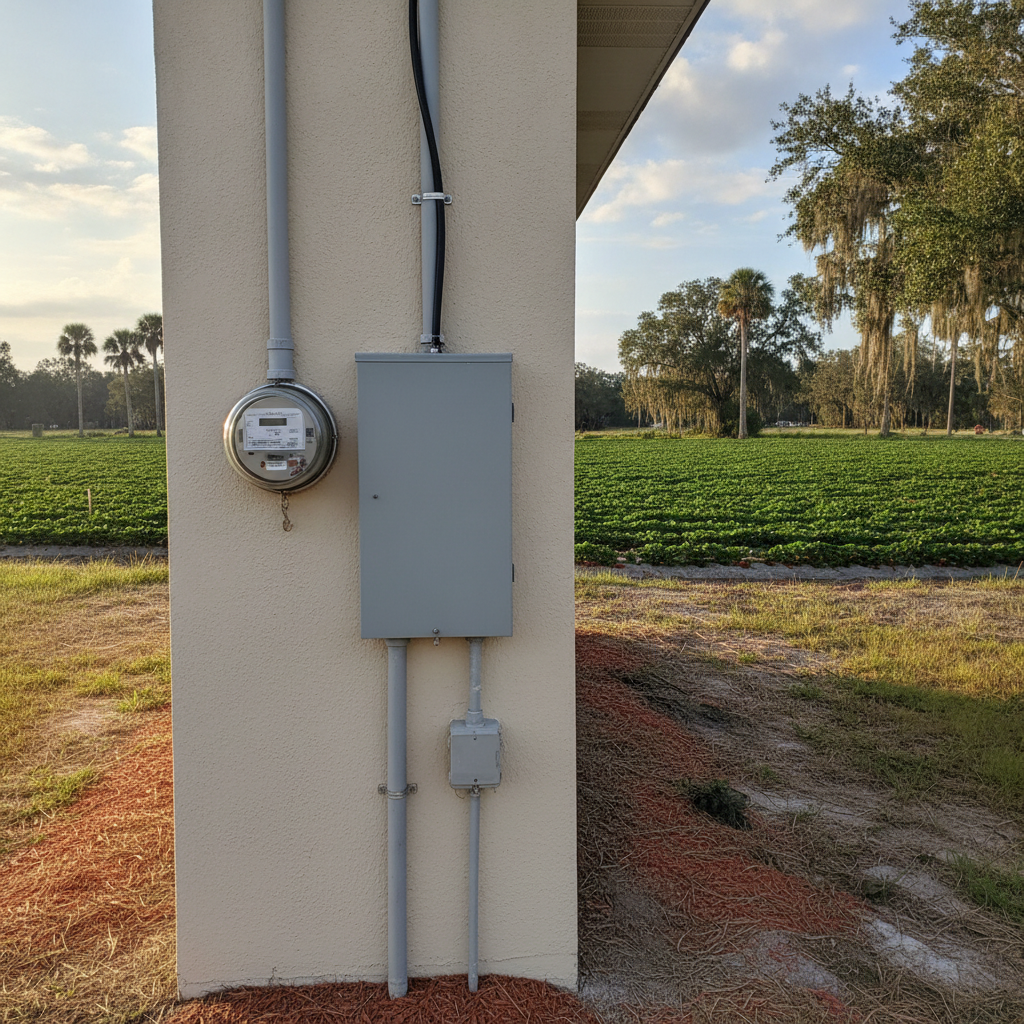
A dead bank of kitchen outlets, a breaker that trips when the air handler starts, or a 240-volt run from a street-side panel to a charger on the far garage wall. Those are the jobs that send East Hillsborough homeowners looking for a licensed electrician in Plant City. Tampa Electrical Pro matches you with independent licensed and insured electricians. The contractor who takes the job holds the license, confirms the permit path for that address, and prices the work after seeing the property.
What Plant City homeowners hire an electrician for
Most Plant City electrical calls are a failed receptacle, a fan that needs a box rated to carry a moving load, a GFCI that will not reset, or a circuit that dies while the rest of the house stays on. The electricians we send start with what they can see and measure: which breaker feeds the dead outlets, whether a GFCI device upstream is protecting a plain receptacle farther down the same circuit, and whether the load sits on a shared kitchen run or a dedicated one. Missing test and reset buttons on one receptacle do not prove the circuit has no GFCI protection. The protective device can sit at another point on the same run.
Outbuildings show up often on this side of Hillsborough. A shop at the back of a strawberry-country lot, a well pump, a barn light, or a detached garage at the end of a long conduit run is a different scope from swapping a dining-room fixture on the same slab as the panel. Run length, burial or overhead path, wet versus dry listing, and whether the outbuilding needs its own disconnect all change the work. None of that is read from the neighborhood. It is identified at the property.
Indoor rooms still have to match how they are used. A bathroom, garage, or pool equipment pad is a wet or damp location question, not a style question. GFCI protection, outdoor-rated covers, and equipment listed for the actual exposure are the decisions. A covered porch does not automatically keep rain off a fan. Damp-rated fans suit protected damp locations without direct water. Wet-rated fans are built for outdoor water exposure. The product listing and the real weather path govern.
A plaster wall in a downtown Plant City house decides how a new circuit gets routed. Block and stucco on a later subdivision house decide it a different way. The electrician has to see the path, the existing box, and the load. A build year does not establish aluminum branch wiring, an ungrounded receptacle, or the service size. If aluminum branch wiring is found, remediation is a complete connection inventory, not a slogan about the street.
Warning signs do not wait for a convenient Saturday. Unexplained flicker or dimming, hot or discolored plates, buzzing or crackling, a burning odor, shocks, and frequent trips call for prompt inspection by a qualified electrician. Tampa Electric’s home safety page is blunt about loose-fitting plugs, extension cords used as permanent wiring, and an appliance that keeps tripping a breaker: unplug it and have it repaired or replaced. Smoke or fire means leaving the hazard area and contacting emergency services. Do not open the panel, pull a cover, or keep resetting a fault.
Day-to-day failures sit under electrical repair: troubleshooting, failed devices, and restoring a circuit that should already be there. If you are comparing who to hire, start with how Florida licenses the trade. Our guide to choosing a licensed electrician in Tampa walks through certified, registered, and specialty scope without treating one category as the only lawful one.
Panel space, added load, and storm prep
Service capacity and circuit space are two different problems. A Plant City panel can have unused breaker slots and still be at the limit of what the service can feed. It can also have spare capacity on the service and no room left for another breaker. The electrician reads the labels, the loads that actually run, and the path for a new circuit. A neighborhood or a build year does not establish the service size.
Added load is why that distinction matters. A Level 2 charger uses 240 volts. Level 1 can cover daily driving for some drivers when the circuit and overnight park time fit. The vehicle, the daily range, and how long the car sits decide the choice. The electrician evaluates electrical capacity. Outdoor equipment has to be outdoor-rated. Charging is a continuous load. A smart charger’s app or timer does not, by itself, prove the service can take that load. A charger on the far wall of a garage while the panel sits on the street side of a Midway Road or Walden Lake house means a longer 240-volt run, and that run is most of the labor.
A panel upgrade is the job when the service or the interior equipment cannot support the new load. Cost on this work moves with existing versus new circuit, route and access, concealed work in plaster or block, trench or overhead to a detached building, and whether the meter socket, riser, or weatherhead is part of the same visit. Our electrical panel upgrade cost page stays on those drivers. The selected contractor sets the price after inspecting the property.
Storm prep is a separate stack, and hurricane season from June through November is when Plant City households write an essential-load list. A portable generator can feed individual appliances through properly rated outdoor cords. Direct backfeeding into house wiring is unsafe. A fixed standby unit is installed with transfer equipment that isolates the house from the utility. Standby power does not add utility load by itself. Fuel-burning generators still produce carbon monoxide, fire, and electrical hazards. Portable units belong outdoors, far from the house and away from openings, never in a garage, crawlspace, basement, or shed. Pad location, fuel, and the essential-load list are part of the plan. A generator is not a permanent cure for every outage.
After a storm, Tampa Electric publishes a split on damaged metering equipment. The utility is responsible for storm-related damage to the electric meter and the service line. The customer is responsible for damage to the weatherhead, riser, and meter box. That page exists so you know whether to call Tampa Electric or a licensed electrician. It is a storm-damage split, not a fair-weather ownership rule. Restoration on the Tampa Electric Storm page starts with health and safety facilities, then essential supplies, then the greatest number of residential customers feasible. It does not mean one Plant City street always comes back first. A backup plan still needs fuel, maintained equipment, and that written load list.
If the house took on water, Tampa Electric states it cannot reconnect power until a licensed electrician has inspected the electrical system. After repairs, that electrician has to obtain verification from the local building inspection authority before power can be restored. In a flooded Plant City house, that authority is the city’s.
Permits stay with the licensed contractor
Permits are pulled by the licensed contractor, never by Tampa Electrical Pro. We match the homeowner with the electrician. The electrician confirms the permit and inspection steps with the authority for that address.
The reviewing office follows the property, not the mailing city. A Plant City mailing address can sit inside city limits or in unincorporated East Hillsborough. Those are different desks. Hillsborough County’s storm-recovery guidance is explicit that residents inside Tampa, Plant City, and Temple Terrace go to their own city government, while unincorporated Hillsborough follows the county path. Ordinary electrical work uses the same idea: identify the jurisdiction from the lot, then follow that office. A mailing city on a bill does not settle it.
Florida licensing is not one stamp. Florida’s electrical contractor FAQs state that certified electrical contractors can work statewide, registered contractors work within their authorized local jurisdictions, and specialty licenses have bounded scope. EC is not the only lawful category for every electrical task. Verify active status, scope, and the jurisdiction that matches the business. Do not assume every worker on the job personally holds a contractor license.
Our Plant City electrician page is the city hub for this East Hillsborough service area. Use it when you want the local landing page rather than this explainer. The electricians we send are licensed and insured. Scheduling, scope, permits, workmanship, and price are determined by the selected contractor after that contractor sees the house.
Common questions about Plant City electricians
Is a plant electrician the same as a Plant City electrician?
No. A plant electrician is a trade nickname for someone who works inside a factory or industrial plant. A Plant City electrician is a licensed electrical contractor, or a worker employed by one, serving homes and businesses in Plant City, Florida. Search results mix the two because the words overlap. If you need a receptacle, a panel, or a charger at a house east of Tampa, you want residential electrical work, not an industrial maintenance title.
Who confirms the electrical permit for a Plant City house?
The licensed contractor who performs the work. Tampa Electrical Pro does not pull permits. The electrician confirms the reviewing office from the property address, because city-limit Plant City and unincorporated Hillsborough are not the same authority.
What is the difference between more breaker space and a larger service?
Breaker space is room in the panel for another circuit. Service capacity is how much load the incoming service and equipment can supply. You can have one without the other. The electrician separates those on site before anyone talks about a charger, a heat pump, or a standby generator.
When to call us
Call when a circuit fails, a breaker keeps tripping, a burning odor or unexplained flicker shows up, or you are adding load a Plant City panel may not have space or capacity for. The electricians we send are licensed and insured, and they confirm permits for that address instead of treating a mailing city as the jurisdiction. Call us at (813) 850-0320.