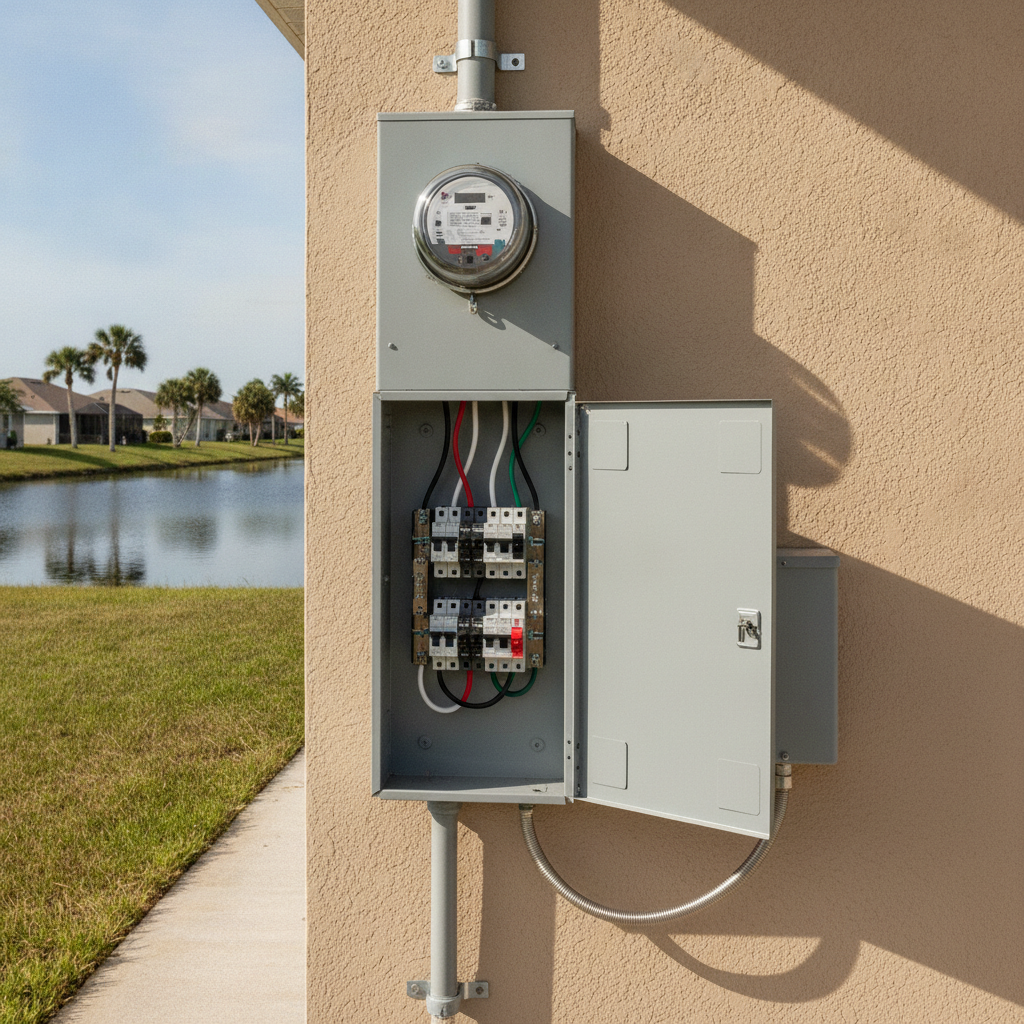
A tripped breaker that will not hold, a dead half of the house, or a scorched cover on the outdoor disconnect is why most people look up an Apollo Beach electrician. The repair starts by locating the fault: on the utility side of the meter, at the exterior gear on the wall, or on an interior circuit that lost a receptacle, a light, or a load. Tampa Electrical Pro matches homeowners in Apollo Beach with independent licensed and insured electricians. Those electricians do the diagnosis, the permit steps the job needs, and the repair. We do not.
What electrical repair looks like on the South Shore
Most electrical repair on the South Shore is a bounded job. A GFCI in a lanai bath that will not reset. A kitchen that went dark while the living room stayed on. An exterior disconnect that buzzes when the pool pump starts. A boat-lift pedestal with no power at the canal. The electrician traces the circuit, names the failed part, and repairs or replaces that part. Whole-house rewiring is a different conversation, and it is not the default.
Apollo Beach sits on low-elevation lots along Hillsborough Bay, with slab homes, stucco and concrete-block walls, and a lot of equipment mounted outdoors. Meter cans, risers, weatherheads, and exterior disconnects live on those walls. Pool pads, landscape lighting, and dock circuits sit farther from the panel, so a long run and wet-location gear are part of the map the electrician walks. That is how the lot is laid out. It is not a diagnosis of the wiring inside any one house. Two neighbors can share a canal and still have completely different panels, circuits, and outdoor equipment.
Interior calls still dominate. A receptacle that died. A ceiling fan that will not start. A breaker that trips when the microwave and the air handler share a moment. Electrical repair on this side of Hillsborough County is the electrician standing in the kitchen, the garage, or at the outdoor disconnect, matching the symptom to a circuit, a device, or a connection.
A single dead outlet is a different hunt from a dark half of the house. One dead receptacle can be a failed device, a loose connection in a box, or a GFCI upstream that already tripped and took the rest of the chain with it. Half the house dark usually means the electrician is looking at a feeder, a main, or a lost hot, not a kitchen GFCI. The homeowner’s job is to describe where the outage starts and stops. The electrician’s job is to prove which of those paths is real without the homeowner opening a panel.
The licensed electrician confirms the permit and inspection steps with the authority for that address. Tampa Electrical Pro does not pull permits. Florida certified electrical contractors can work statewide. Registered contractors work inside the jurisdictions that authorized them, and specialty licenses have a bounded scope. EC is not the only lawful category for every electrical task, and not every worker on a job holds a contractor license. The electrician on site should be able to show the license that covers the work.
If standing water reached panels, receptacles, or other equipment, that is a replacement evaluation, not a wipe-down. That path already has its own page on flooded-home electrical replacement. This page stays on ordinary repair: a circuit that failed, exterior gear that needs a licensed hand, and the first things the electrician inspects.
Exterior equipment and interior circuits
The wall of an Apollo Beach house often holds the first decision on a repair call: is this Tampa Electric’s gear, or is it the customer’s. After a storm, Tampa Electric’s damaged-meter page states that Tampa Electric is responsible for storm-related damage to the electric meter and the service line, and that customers are responsible for damage to the weatherhead, riser, and meter box. The page exists so a homeowner knows whether to call the utility or a licensed electrician. That split is for storm-related damage. It is not a general bill for rust or a loose can in fair weather.
On the customer side of that line, the electrician is looking at the enclosure, the riser, the weatherhead, and the conductors that leave the meter toward the panel. Tampa Electric’s tariff also says customers are not allowed to make connections to or disconnections from Tampa Electric equipment. Do not pull meter seals, do not open a damaged can, and do not treat flipping the main breaker as protection against backfeed. A wet, hot, buzzing, or scorched enclosure is an emergency call, not a DIY inspection.
Interior circuits are a different map. Overcurrent protection, GFCI shock protection, and AFCI arc-fault protection do different jobs. A GFCI device can protect a plain receptacle farther down the same circuit, so the absence of test and reset buttons on a particular outlet does not prove the circuit has no upstream protection. A kitchen, a bath, a lanai, a garage, and an outdoor receptacle are all places that GFCI shows up, and the electrician traces which device is actually holding the circuit rather than swapping the first dead outlet in sight.
Service size and circuit space are two different problems. Spare breaker slots do not prove the service has room for another continuous load. A packed panel does not prove the service itself is undersized. A repair that restores a dead circuit is not automatically a panel upgrade. If the electrician later finds that a new 240-volt load, a charger, or a standby generator needs capacity the existing service cannot give, that is a separate scope, priced after the inspection, not assumed from the neighborhood.
Portable generators and house wiring do not mix at an outlet. Tampa Electric’s home safety guidance is blunt about overloaded cords, loose receptacles, and appliances that keep tripping a breaker: unplug the appliance and have it repaired or replaced, and do not repair electrical products unless you are a qualified electrician. A portable generator can run individual appliances through properly rated outdoor cords. Direct backfeeding into house wiring is unsafe. Fixed standby equipment is installed with transfer gear that isolates the house from the utility. Fuel-burning generators still produce carbon monoxide, fire, and electrical hazards. Standby equipment does not erase exhaust.
Unexplained flicker, a hot or discolored plate, buzzing or crackling, a burning odor, a shock, or breakers that trip again and again are reasons to stop resetting and call. Those signs call for a prompt inspection by a qualified electrician. They are not a diagnosis you can finish from the living room. Smoke or fire means leaving the hazard area and contacting emergency services. For that class of call, the electricians we send through emergency electrician service are the right next step, not another reset.
| Where it shows up | What the electrician is usually tracing | Who else may be involved |
|---|---|---|
| Meter, riser, weatherhead, outdoor disconnect | Customer-owned service equipment on the wall | Tampa Electric, for the meter and the service line, especially after a storm |
| Interior receptacle, light, or breaker | A branch circuit, a device, or a connection in the house | The licensed electrician, and the reviewing office when the work needs a permit |
What a licensed electrician inspects first
The electrician starts with the symptom you can point to, then proves the path, with the circuit de-energized before anyone touches a connection. You do not open the panel, pull a deadfront, or repeatedly reset a breaker that will not hold. The first useful facts are where the failure is, whether it comes back, and which loads died with it. A dead dishwasher on its own circuit is a different job from lights that dip every time the air handler starts.
From there the inspection is practical. Existing circuit or new run. Indoor, damp, or wet exposure. How the conductor is routed through block, stucco, a slab, an attic, or a long outdoor stretch to a dock or a pool pad. What the equipment label and model actually say. Whether a fan box is rated to carry a moving load, or whether an outdoor device matches the weather it actually sees. A covered porch does not automatically mean rain never reaches the fixture. The listing and the installation instructions govern that, not the neighborhood.
If the complaint is a trip, the electrician is separating a mechanical overload or short from a protective device doing its job. A GFCI that trips on a damp lanai may be seeing moisture at a receptacle, a load with a real ground fault, or a device that has reached the end of its life. An AFCI that trips is pointing at an arc condition the breaker is designed to catch, and the blink language on one brand is not the blink language on another. None of that is a homeowner reset procedure. It is why the electrician tests, isolates, and replaces rather than sending you back to the handle.
Aluminum branch wiring, ungrounded receptacles, and crowded panels show up in some Tampa Bay houses and not in others. A build year does not establish any of them. The electrician identifies the conductor, the connections, and the equipment that are actually in the wall. CPSC describes copper rewiring and approved connector repairs, including COPALUM and AlumiConn under specified conditions, as methods for aluminum branch-circuit work. That is a method conversation after the wire is identified, not a neighborhood verdict.
Permit review follows the property, not the mailing city. Apollo Beach addresses are in Hillsborough County, and residents inside Tampa, Plant City, and Temple Terrace go to their own city government when that is the jurisdiction. The electrician confirms which office reviews the address and which inspections the work needs. That is the same licensed-pro path we describe in our broader electrical repair service near me guide. Tampa Electrical Pro matches the call. The selected contractor sets the scope, the permit steps, and the price after seeing the house.
Do I call Tampa Electric or an electrician in Apollo Beach
Call Tampa Electric when the outage is on the utility side: the neighborhood is dark, the meter and service line took storm damage, or the problem is the meter itself. Call a licensed electrician when the weatherhead, riser, or meter box is damaged, when an interior circuit is dead, or when a receptacle, breaker, disconnect, or appliance circuit has failed. After a storm, Tampa Electric’s own damaged-meter page is written so a customer knows which of those two calls to make. Customers still do not connect or disconnect Tampa Electric equipment.
What Florida license covers electrical repair
Florida certified electrical contractors may work statewide. Registered contractors work inside the local jurisdictions that authorized them. Specialty licenses cover a bounded scope, and EC is not the only lawful category for every task. Verify that the business is active, that the license covers the work, and that the jurisdiction matches the property. Tampa Electrical Pro refers licensed and insured electricians. We do not hold a contractor license of our own, and we do not pull the permit.
When to call us
Call when a circuit will not stay on, an outdoor disconnect is damaged, a receptacle is dead, or the house is showing heat, buzzing, odor, shock, or repeated trips. The electricians we send are licensed and insured, and they confirm permit and inspection steps with the authority for that Apollo Beach address. Call us at (813) 850-0320.