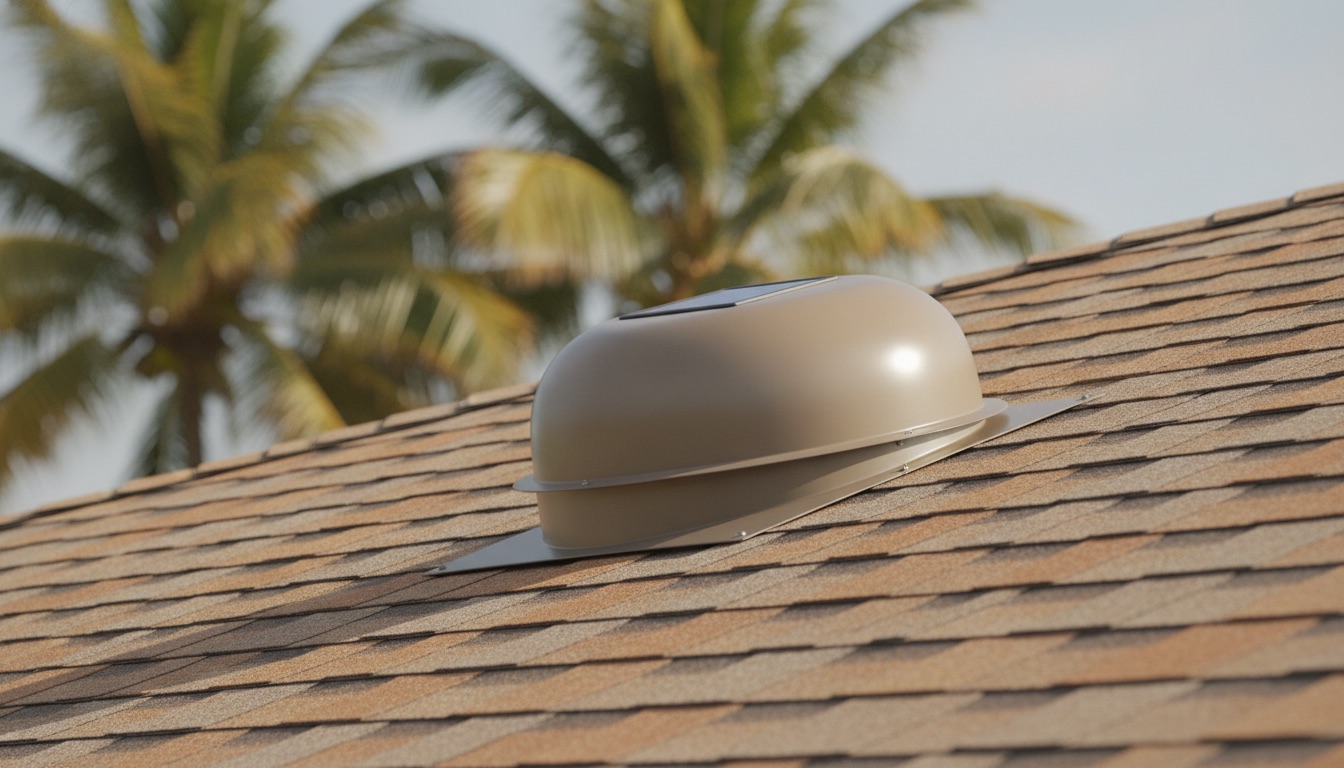
Powered attic ventilators can lower peak attic temperatures, but that result alone does not establish worthwhile energy savings for every Tampa home. In one instrumented Central Florida home, a 2000 Florida Solar Energy Center paper characterized the payback for two photovoltaic attic fans as more than 20 years, using the study’s installation costs and Florida energy prices at that time.
The decision depends on the home’s insulation, roof assembly, attic ventilation, duct location, equipment, and installation scope. A hard-wired powered attic ventilator also falls outside Hillsborough County’s published electrical and portable-ventilation exemptions, so the permit process applies.
What does an attic fan installation involve in a Tampa home?
The scope depends first on the fan and where it will be mounted. A roof-mounted unit may involve cutting and flashing a roof opening. A gable-mounted unit uses a different opening and support arrangement. The roofing portion and the electrical portion may be handled by different qualified professionals.
For the electrical work, the electrician needs to evaluate whether the fan will use an existing suitable circuit or need a new circuit, how wiring can reach the attic, what access is available, and how the model’s controls are meant to operate. Equipment labeling and installation instructions also matter.
An electrical panel with no open breaker position does not automatically require a panel upgrade. Circuit space and electrical service capacity are separate questions. A subpanel can provide additional circuit spaces, but it does not increase the utility service capacity. The electrician must evaluate the actual loads and equipment before recommending panel changes.
What did Florida research find about powered attic fans?
The Florida Solar Energy Center is a state energy research institution created by the Florida Legislature in 1975 and administered by the University of Central Florida.
In a 2000 FSEC case study, researchers monitored one occupied single-family home in Central Florida with two photovoltaic attic ventilators. The test home already had a radiant barrier, and its attic had exceeded 130°F.
The two fans showed the potential to reduce peak summer attic air temperature by more than 20°F. Over the cooling season, the study measured about a 6% reduction in space-cooling energy, estimated at roughly 460 kWh per year. Using Florida energy prices stated in the 2000 paper, the researchers valued that reduction at about $37 per year. They compared it with approximately $850 installed for the two photovoltaic units at the study’s late-1990s costs and described the resulting payback as more than 20 years.
Those figures are not current Tampa Bay prices, utility savings, or performance expectations. They belong to one instrumented home and two photovoltaic fans.
FSEC said savings could be larger in homes without a radiant barrier, with less ceiling insulation, or with the air handler in the attic. In the other direction, the test home used more air-conditioning energy than the average Central Florida household, which the researchers said could overstate the measured savings. The homeowner also reported improved comfort after the installation without changing the thermostat.
The study helps explain the tradeoffs, but it cannot predict the result for a different house or a hard-wired fan that draws power from a branch circuit.
Why can a powered attic fan pull air from the house?
A powered ventilator exhausts attic air, and replacement air must come from somewhere. FSEC’s broader attic ventilation guidance says natural ventilation can provide similar attic heat-flow reduction. It also warns that powered ventilators can significantly depressurize an attic and draw air from the house through openings in the ceiling plane.
Those openings can include penetrations around fixtures, ducts, wiring, and the attic access. If the available outdoor intake does not supply the air being exhausted, conditioned indoor air may be pulled into the attic. That can work against the reason the fan was installed.
A property-specific assessment should therefore consider the existing ventilation path, ceiling penetrations, insulation, duct location, and the selected fan rather than relying only on an advertised temperature reduction.
Does a hard-wired attic fan need a permit in Hillsborough County?
Hillsborough County’s work-exempt-from-permits page does not exempt this type of installation.
The county’s mechanical list exempts portable ventilation equipment. A powered ventilator installed in a roof or gable and connected to permanent wiring is not portable equipment.
The county’s electrical exemption is limited to installation or repair of a low-voltage system in an existing single-family residence when the stated ownership and $5,000 labor-and-material conditions are met. A hard-wired 120-volt attic fan is not a low-voltage system.
The same county page also says its residential exemption does not apply when the work includes electrical, plumbing, structural, mechanical, or gas work. Because a hard-wired attic fan includes electrical work, the exemption does not cover it.
Properties in Pinellas and Pasco are handled by their applicable permitting authorities. The selected contractor should determine the authority from the property and confirm the required permit and inspection steps. Tampa Electrical Pro is a referral service that connects customers with independent licensed and insured electricians through its Tampa Bay network.
What affects attic fan installation cost?
There is no supported flat Tampa Bay price for this work. The electrical and building conditions can change the scope substantially.
Important cost factors include:
- Whether a suitable circuit already exists or a new circuit is needed
- The distance and accessible route between the panel and the fan
- Available circuit space and the result of the electrical load assessment
- Roof-mounted versus gable-mounted equipment
- Access for wiring, support, and controls
- Whether roofing or flashing work is part of the project
- The selected fan, control equipment, and manufacturer instructions
- Permit and inspection requirements for the property’s jurisdiction
The approximately $850 installed figure in the FSEC paper belongs only to the two photovoltaic units studied in one Central Florida home at late-1990s costs. It is not a current contractor estimate.
Tampa Electrical Pro can refer you to an independent electrician serving your area, including a Brandon electrician. The selected contractor determines the installation approach, scheduling, permit responsibilities, and price after reviewing the property.
If the goal is indoor air movement rather than attic ventilation, ceiling fan installation is a separate project with different support, wiring, and exposure questions. The ceiling fan installation cost guide addresses that distinct scope.
What alternatives did FSEC identify?
After discussing unvented and sealed attics, FSEC lists radiant barrier systems, added ceiling insulation, and reflective roof finishes among roof improvements that can produce energy savings. It also notes that ductwork should ideally be located in conditioned space.
Those options address different parts of the roof and cooling system, so the right comparison depends on the house. The research does not establish a universal best choice or a specific savings figure for a Tampa property.
If attic equipment or wiring is already malfunctioning, start with electrical repair rather than treating a new fan as the solution. For indoor comfort and circulation, see how ceiling fans work in Florida heat.
Frequently asked questions
Do powered attic ventilators reduce air-conditioning costs in Florida?
They can under some conditions, but the available FSEC case study does not support a general savings promise. Its two photovoltaic fans lowered peak attic temperatures while producing a comparatively modest cooling-energy reduction in one Central Florida home. Insulation, radiant barriers, attic ductwork, air-conditioning use, and ceiling leakage can change the result.
Can a hard-wired attic fan be installed without a permit in Hillsborough County?
Hillsborough County’s published exemptions do not cover a permanently installed, hard-wired attic ventilator. The portable-ventilation exemption applies to portable equipment, and the electrical exemption applies to qualifying low-voltage work. The selected contractor should confirm the permit process for the property.
Does a full electrical panel mean the service must be upgraded?
No. A lack of open breaker positions concerns circuit space, while service capacity depends on the actual electrical load and equipment. A subpanel can add circuit spaces without increasing service capacity. An electrician needs to evaluate both questions before recommending changes.
Can an attic fan pull conditioned air from the house?
Yes. FSEC warns that powered ventilators can depressurize the attic and draw air through openings in the ceiling plane. Existing intake ventilation, ceiling penetrations, insulation, and duct location should be considered before choosing a fan.
Who handles an attic fan installation?
The project may include roofing work for the opening and flashing as well as electrical work for the circuit, fan connection, and controls. Tampa Electrical Pro can connect you with an independent licensed and insured electrician for the electrical scope. The selected contractor determines responsibilities, permits, scheduling, and price. Call (813) 850-0320 to request a referral.